




Conti's New CAirS Air Suspension Employs Hydraulic Principles
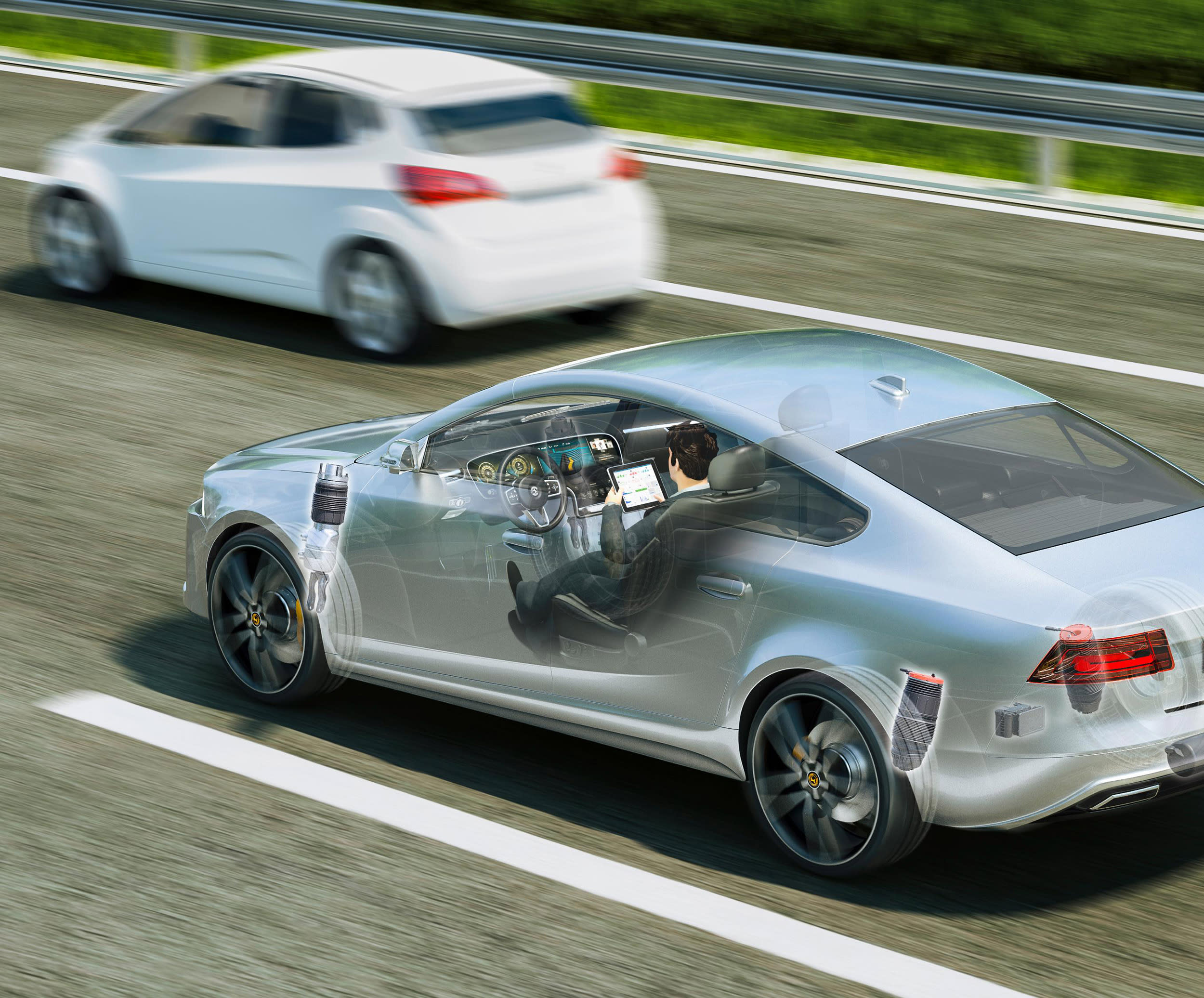
Continental has launched a new electronically-controlled three chamber air suspension system it claims is lighter, more compact and energy efficient than rival systems. Its production debut is on the 2018 Bentley Continental GT and the system is designed for electric and autonomous vehicle applications.
Known as CAirS, the system consists of only two primary components—the air supply system and the compressor, explained Uwe Folchert, head of air supply development.
“In the past we needed three components but these have been integrated saving up to 3.3 lb (1.5 kg) depending on the application [plus] packaging and assembly time on the production line,” he noted. “We’ve added functions and improved noise, vibration and harshness (NVH) as well.”
In a neat piece of lateral thinking, engineers from Conti’s air suspension and braking systems groups have taken principles usually employed in hydraulic brakes and modified them to work with air.

“Previously the suspension would be controlled across each axle, with this system the four corners are managed independently via a valve block, allowing us to manage the whole vehicle,” added Felix Bietenbeck, head of the vehicle dynamics business unit. “By switching between the four air springs body roll during cornering is controlled and vehicle dynamics are enhanced.”
CAirS can cover the full range from very comfortable to a very sporty mode. The system receives input from sensors around the vehicle including acceleration and height. “The trick is to manufacture the most accurate 'activated passive' system using road forces to stabilize the vehicle’s upper body without bringing too much additional energy into the vehicle. CAirS is a step in that direction,” explained Folchert.
Although the system isn’t predictive, it responds to inputs within 100 ms. Beitenbeck said it could be networked into the navigation system to anticipate upcoming road conditions. A further development might be linking it to forward-facing cameras as in the latest Audi A8 and Mercedes-Benz S-class.
CAirS has been engineered partially with an eye on electric vehicles (EVs) and autonomous driving developments. The challenge with EVs says Folchert is their sensitivity to energy consumption and subsequent loss of range. Because CAirS is a closed system running at 87 - 174 psi (6-12 bar) the engineers claim it is 60-70% more efficient than open systems as it is only moving air between the air reservoir and the springs.
Depending on the vehicle size a typical air tank would be 305 - 610 in3 (5-10 L) and, by nature of its integrated design and assembly, the OEM is free to mount the sealed control unit anywhere within the vehicle structure.
“With an air spring you don’t need an active control, you can achieve a level of comfort just with the air spring itself which is more efficient because it is done passively, whereas with a conventional system more energy is required,” claimed Folchert. “Lowering the vehicle reduces air resistance and cuts compressor power consumption by as much as 70%.
In an SUV this, in turn, could reduce per-vehicle CO2 emissions by up to 5%, he added.
More From SAE Media Group
Off-Highway Engineering
Israeli Startup REE Reinvents the Wheel with a Modular Approach to Future EV Design
Automotive Engineering
BEV-Agnostic’ Systems Require Attention

Automotive Engineering
Audi Details New A8 Active Suspension
Automotive Engineering
ZF’s Current Innovations Build for EV, AV Future
Tech Briefs
EV vs. ICE: How Does Wire Harness Design Differ?
Off-Highway Engineering
REE’s P7 Brings Advanced Suspension Control to Medium-Duty Trucks
Automotive Engineering
Subaru Uses ANSYS Tools to Accelerate Hybrid Vehicle Design
Tech Briefs
Future Cars Learn to Prevent Motion Sickness
Automotive Engineering
Electronic Stability Control Builds the Foundation for Safer Roads
Tech Briefs
AI-Powered Cruise Control to Thwart Traffic

Off-Highway Engineering
Connected-Vehicle Technologies Transform Drivetrains into Rich Sources of Intelligence
Tech Briefs
Making EVs Accessible for All
Motion Design
Self-Contained Wheel Unit
Tech Briefs
Are In-Wheel Motor Systems Catching On?
Automotive Engineering
Gearing Up Drive Axle Innovations

Automotive Engineering
Plotting Valeo’s Route de la Technologie


Automotive Engineering
2022 Grand Cherokee Plugs In
Automotive Engineering
Valeo Debuts New Lidars, EV Tech at CES 2022


Automotive Engineering
Integrating a Plug-In Hybrid Jeep
Autonomous Vehicle Engineering
AV Powers Bring May Flowers
Automotive Engineering
SAE WCX 2022: OEM Learnings from Level 2 ADAS
Tech Briefs
Converting an Old Truck into an EV
Off-Highway Engineering
Western Star Adds ‘Weight Sensitive’ 47X to Vocational Lineup
Top Stories
INSIDERManufacturing & Prototyping
 How Airbus is Using w-DED to 3D Print Larger Titanium Airplane Parts
INSIDERManned Systems
 FAA to Replace Aging Network of Ground-Based Radars
NewsTransportation
 CES 2026: Bosch is Ready to Bring AI to Your (Likely ICE-powered) Vehicle
NewsSoftware
 Accelerating Down the Road to Autonomy
EditorialDesign
 DarkSky One Wants to Make the World a Darker Place
INSIDERMaterials
 Can This Self-Healing Composite Make Airplane and Spacecraft Components Last...
Webcasts
Defense
 How Sift's Unified Observability Platform Accelerates Drone Innovation
Automotive
 E/E Architecture Redefined: Building Smarter, Safer, and Scalable...
Power
 Hydrogen Engines Are Heating Up for Heavy Duty
Electronics & Computers
 Advantages of Smart Power Distribution Unit Design for Automotive...
Unmanned Systems
 Quiet, Please: NVH Improvement Opportunities in the Early Design...
