




Boeing Reports on Its Environmental Efforts

In its 2019 Global Environment report, the Boeing Company provides an update on the environmental strategy the company unveiled last year. The strategy identifies 2025 as a target year to collaborate with communities around the globe and create products focused on environmental performance, emissions and waste reduction, and lower levels of water and energy consumption at work sites.
Boeing is the world’s largest aerospace company and provides commercial and military aircraft to numerous global operators. As the top U.S. exporter, the company supports commercial and government customers in more than 150 countries. The company specifically states that it is currently building cleaner, more fuel-efficient airplanes and finding innovative ways to recycle and conserve resources.
"We are committed to cleaner water, air and land, and this report highlights the wide range of efforts surrounding Boeing's environmental stewardship around the globe," says Bryan Scott, vice president of Environment, Health & Safety.
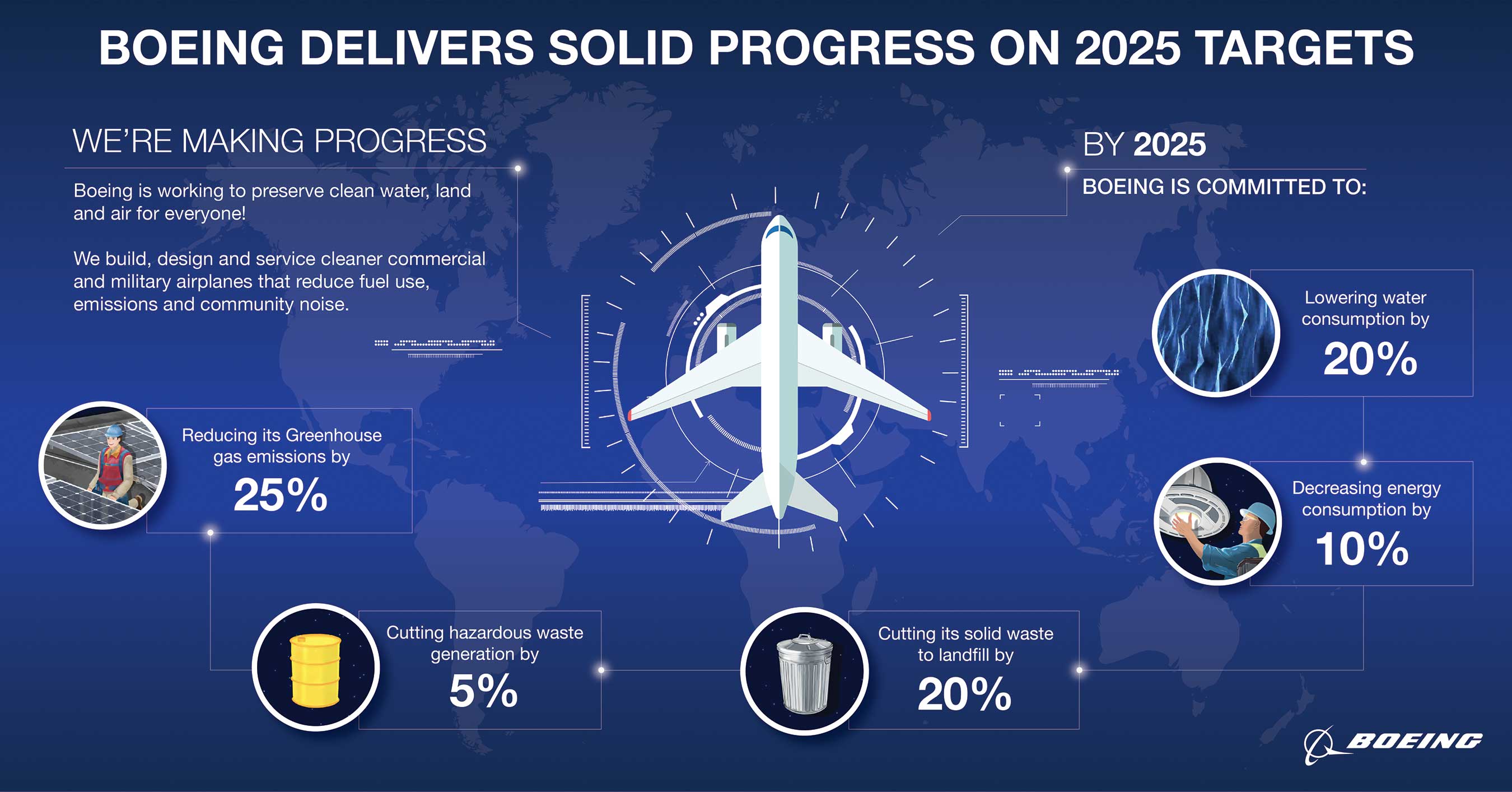
From a 2017 baseline, the company is ahead of schedule in reducing greenhouse gas emissions by 25 percent, reducing solid landfill waste by 20 percent, and reducing energy consumption my 10 percent. However, it is slightly behind in reducing water consumption by 20 percent and reducing hazardous waste by five percent.
Boeing has made both the full report and summary version available online.
To meet these goals, Boeing has partnering with a UK-based recycler to keep up to 2 million pounds of excess carbon fiber out of landfills per year.
Boeing is working with Etihad Airways to fly a 787 Dreamliner powered partly by biofuel made from desert plants irrigated with seawater and is helping develop sustainable aviation fuel and offering its customers the option of using biofuel on delivery flights.
The company has also started using renewable energy to power its primary data center, saving enough electricity to power more than 4,000 homes annually and has designed new energy-efficient facilities around the world, including the 737 Completion and Delivery Center in Zhoushan, China, and the fabrication facility in Sheffield, UK.
Learn more
- 2019 World Traffic Safety Symposium focuses on AV regulation
- Wing’s UAS delivery service has FAA certification
- Air Force tests fully autonomous UAS control system
William Kucinski is content editor at SAE International, Aerospace Products Group in Warrendale, Pa. Previously, he worked as a writer at the NASA Safety Center in Cleveland, Ohio and was responsible for writing the agency’s System Failure Case Studies. His interests include literally anything that has to do with space, past and present military aircraft, and propulsion technology.
Contact him regarding any article or collaboration ideas by e-mail at
More From SAE Media Group
Off-Highway Engineering
United Ups Commitment to Sustainable Aviation Biofuel, Extends Contract with World Energy
Automotive Engineering
Fuels to Transition the Global Legacy Fleet
Off-Highway Engineering
Response to More-Rigid NOx and GHG Regs
Aerospace & Defense Tech Briefs
Industry Invited to Participate in AeroTech Aerospace and Defense Technical Program
Aerospace & Defense Tech Briefs
SAE International Extends Call for Abstracts, Seeks Submissions for AeroTech Conference
Automotive Engineering
Engineering Sustainability

Aerospace & Defense Tech Briefs
Airbus Zephyr S Breaks World Flight Endurance Record During Maiden Flight
Aerospace & Defense Tech Briefs
SAE International Issues, Revises Technical Reports for Aerospace Engineering
Automotive Engineering
Bye Aerospace’s Solar-Electric Prototype Completes First Flight
Aerospace & Defense Tech Briefs
AIA Predicts Flying Air Taxis, Supersonic Air Travel, and Space Industry for 2050
Aerospace & Defense Tech Briefs
Boeing, SparkCognition Partner on Safe Integration of Autonomous Air Vehicles in Airspace
Off-Highway Engineering
Addressing Electromagnetic Compatibility in the Context of Aircraft Electrification
Automotive Engineering
SAE International Releases New Process for Measuring Aerosols in Aircraft Exhaust
Aerospace & Defense Tech Briefs
SAE International Launches Aerospace Technology Symposium at Japan Aerospace 2018
Aerospace & Defense Tech Briefs
Rolls-Royce Starts Lean-Burn Combustion Engine Icing Tests

Aerospace & Defense Tech Briefs
Aircraft, Engine Orders Reach $98B, Focus on Flying Farther, Faster, Greener at Farnborough Airshow

Off-Highway Engineering
Could This Infinitely Variable Compression Mechanism Be the Next Piston Engine Game-Changer?
Aerospace & Defense Tech Briefs
Bye Aerospace’s Sun Flyer Is Now the “EFlyer”
Aerospace & Defense Tech Briefs
UTC’s Project 804 Hybrid-Electric Demonstrator May Increase Regional Jet Efficiency by 30 Percent
Aerospace & Defense Tech Briefs
Air Mobility Innovations Take Center Stage at Aerospace Systems and Technology Conference
Off-Highway Engineering
Natural Gas Infrastructure Is Scaling Fast for HD Fleets
Automotive Engineering
Quicker Pathways to Reduce Transportation’s Climate Impact
Automotive Engineering
Handicapping the ‘Race Toward Zero’
Off-Highway Engineering
SAE WCX 2022: The Road to Zero Emissions Has Many Lanes
Tech Briefs
Propelling the Future of Sustainable Aviation
Aerospace & Defense Tech Briefs
FAA, SAE International Focus on Engine Fire Protection System Standards for Aerospace
Aerospace & Defense Tech Briefs
Lockheed Martin and Arconic Collaborate on 3D Printing and Advanced Aerospace Materials
Top Stories
INSIDERManufacturing & Prototyping
 How Airbus is Using w-DED to 3D Print Larger Titanium Airplane Parts
INSIDERManned Systems
 FAA to Replace Aging Network of Ground-Based Radars
NewsTransportation
 CES 2026: Bosch is Ready to Bring AI to Your (Likely ICE-powered) Vehicle
NewsSoftware
 Accelerating Down the Road to Autonomy
EditorialDesign
 DarkSky One Wants to Make the World a Darker Place
INSIDERMaterials
 Can This Self-Healing Composite Make Airplane and Spacecraft Components Last...
Webcasts
Defense
 How Sift's Unified Observability Platform Accelerates Drone Innovation
Automotive
 E/E Architecture Redefined: Building Smarter, Safer, and Scalable...
Power
 Hydrogen Engines Are Heating Up for Heavy Duty
Electronics & Computers
 Advantages of Smart Power Distribution Unit Design for Automotive...
Unmanned Systems
 Quiet, Please: NVH Improvement Opportunities in the Early Design...
