




Navistar's Latest SuperTruck Features Emerson's Electric HVAC

An innovative Emerson electric HVAC system provides more cooling capacity than the prior 48-volt system on Navistar’s CatalIST high-efficiency demonstration commercial truck.

“Our system provides over 40,000 BTU per hour which is mandatory for down-the-road cooling, but the system can scale down to the minimal loads required for night-time cooling in the sleeper. When compared to CatalIST’s prior [48V] system, the coefficient of performance is 3.5 to 4 times better,” Joe Summers, Product Planner for Transport & Commercial Controls Refrigeration, Emerson Commercial & Residential Solutions, said in an interview with Truck & Off-Highway Engineering.
A conventional Class 8 commercial truck with sleeper cab has a compressor under the hood for the driver’s heat and A/C, and an auxiliary power unit with its own fuel source to heat and cool the sleeping area.
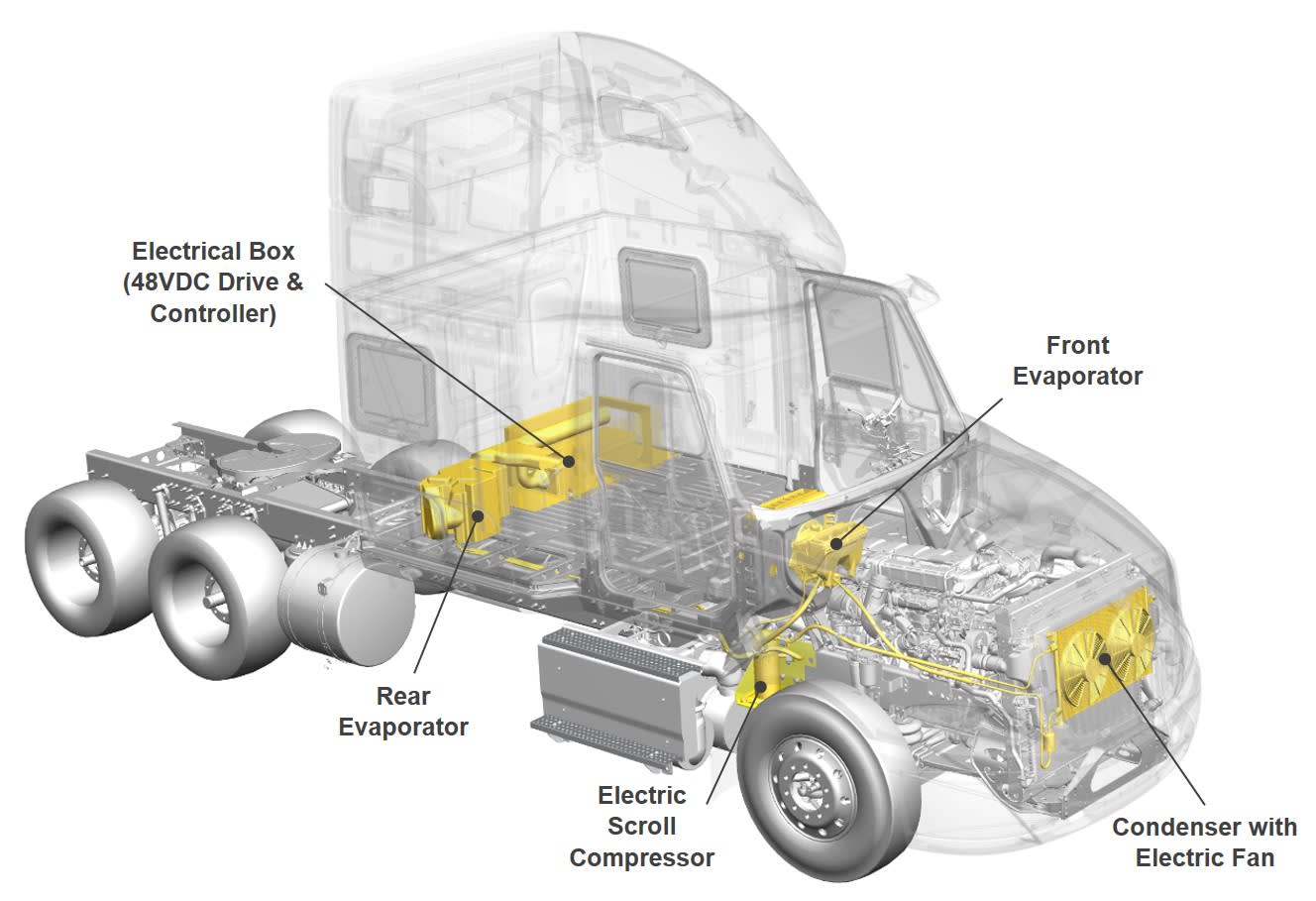
“We’ve taken out both the front power unit and the auxiliary power unit and replaced it with a single system. There is still independent control of the temperature in both zones, but we’re accomplishing that with one compressor that’s fully electric and running on 48V input,” Summers explained.
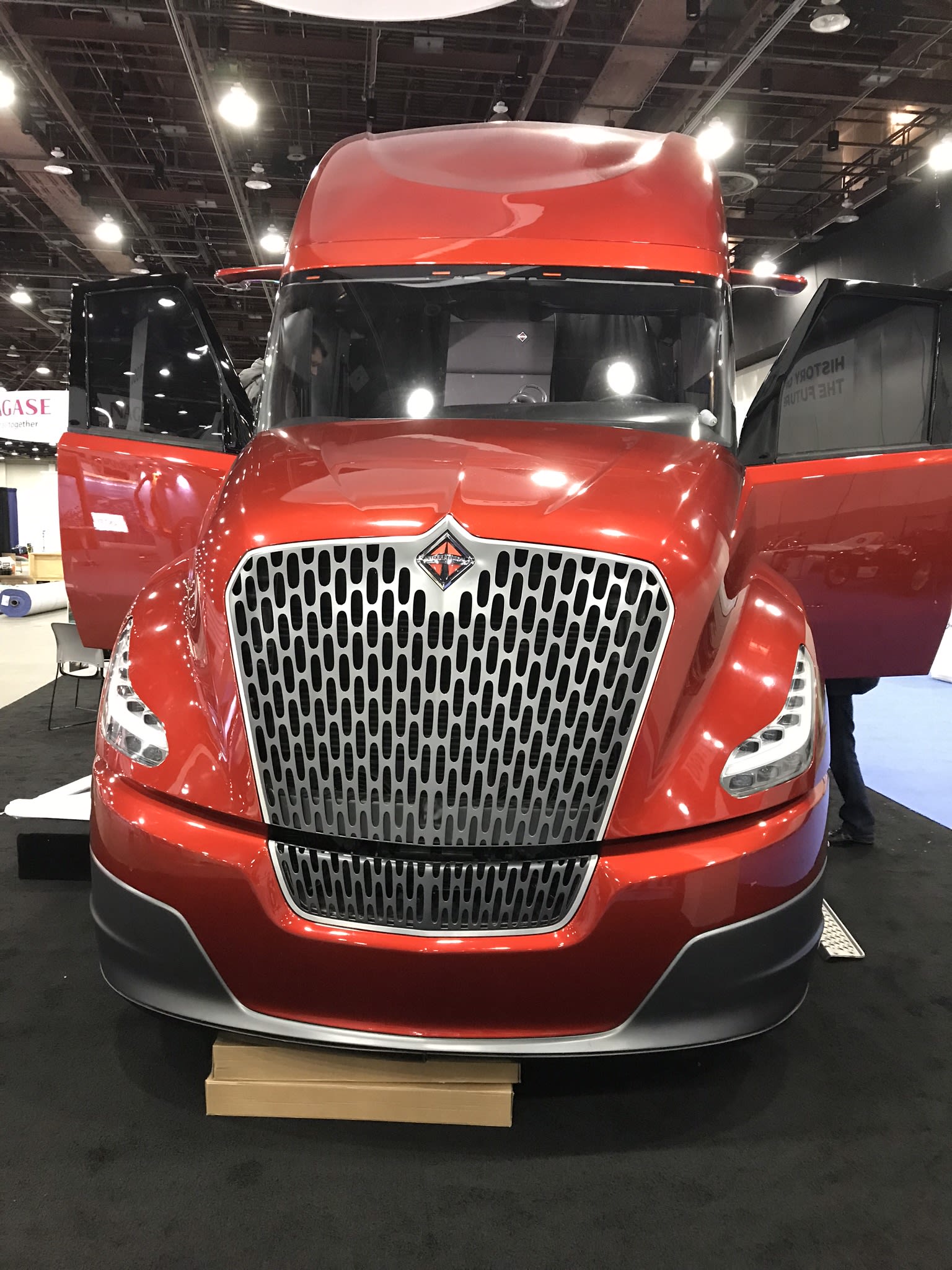
The CatalIST is Navistar International’s demonstration SuperTruck, a freight-efficiency development program with research funds from the U.S. Department of Energy. CatalIST chief engineer Dean Oppermann said that the truck’s stop/start technology lends itself to a non-traditional HVAC solution. “With any stop/start vehicle and a mechanical HVAC system, air-conditioning is stalled because the compressor isn’t running,” he said.
Engine idle times at traffic stops are relatively short compared to the fuel-fill times. “It typically takes a half hour to put 200 gallons of diesel fuel into a line-haul. And, truck drivers don’t like to re-enter a heat-soaked cab on a hot summer day,” Oppermann said, noting that Emerson’s technology solution powers the vehicle’s HVAC even when the engine is off.
Prior to working on the Navistar program, Emerson engineers helped develop a zero emissions transport refrigeration unit for a Class 7 commercial truck. That demonstration project culminated with perishable goods being delivered to Challenge Dairy customers in California’s San Joaquin Valley in the summer of 2017. Several companies participated in the project.
“We’re leveraging all of our learnings from various industry applications. So even though we’re a newcomer to the commercial truck industry, the CatalIST application plays right into our wheelhouse,” Summers said, noting the company began in 1890 as a manufacturer of electric motors and fans.
For the CatalIST application, Emerson supplies the full electric HVAC system, including two evaporators, an electric scroll compressor, a condenser with an electric fan, all venting, and the associated controls.
A second round of wind tunnel testing at the University of Ontario Institute of Technology in Oshawa, Ontario, Canada is slated for May 2018. “We’re able to do a variety of things in the the wind tunnel, ranging from testing under sun load conditions to measuring the power consumption under ram air conditions,” said Summers.
In real-world driving, a commercial truck fitted with electric HVAC system would net big paybacks. “A commercial truck can burn about three-quarters of a gallon an hour while the engine is running to keep the A/C on. That’s typically 3,000 engine idle hours a year, so a lot of fuel can be saved with an electric HVAC system,” said Summers.
Future production applications of an electric HVAC system will include a change from today’s 12V and 24V electrical architectures. According to Oppermann, “A 48V motor-generator can recover energy quicker and that higher voltage will provide more power, which is needed for an electric HVAC solution on a commercial truck. Not only do I see this as a near-term production solution for line-haul trucks, but I also think it’s a near-term production solution for electric passenger vehicles.”
Electric HVAC applications also makes sense for vehicles powered by an internal combustion engine and paired with stop/start technology. “A hermetically sealed system is inherently more robust than a system with a leaking refrigerant, which is a big greenhouse gas emission issue,” Oppermann said. “The Emerson solution is a very green technology.”
More From SAE Media Group
Automotive Engineering
Orbis Says HaloDrive Axial-Flux Motor Available for In-Wheel, Other Uses
Off-Highway Engineering
Detailing Kenworth’s Sleek SuperTruck 2
Off-Highway Engineering
Volvo Charts Its Path Towards Zero Emissions
Off-Highway Engineering
Zeroing in on Zero Emissions
Off-Highway Engineering
Hybrid Powertrains in the Product Mix
Off-Highway Engineering
Westport Awarded LNG Development Program
Off-Highway Engineering
Many ICE Paths Lead to Reduced Emissions
Off-Highway Engineering
Hexagon Agility Partners with Brudeli for Hybrid CNG Truck Powertrains
Off-Highway Engineering
Hybrids Are Having a Moment
Off-Highway Engineering
Clarios Brings AI to Idle Management for Heavy Trucks
Automotive Engineering
48V Is Coming, and Not Just for EVs
Off-Highway Engineering
Toyota Launches Second-Gen Fuel-Cell Class 8
Off-Highway Engineering
Starship Road Trip
Off-Highway Engineering
Hydrogen Shows Increased Commercial Interest
Off-Highway Engineering
Electric Machines Find Their Niche
Off-Highway Engineering
Combustion Engines Carry on in Construction
Off-Highway Engineering
Propane Powers Ahead for Medium Duty Sector
Off-Highway Engineering
Cummins Unveils PowerDrive Hybrid-Electrics, Euro 7 Diesel Concept
Automotive Engineering
Tula’s DMD Promises Gains in EV Efficiency
Off-Highway Engineering
Cummins, Tula Test ‘Dynamic’ Cylinder Deactivation for Diesels
Off-Highway Engineering
Fuel-Cell Power for Monster Mining Trucks in GM, Komatsu Deal
Off-Highway Engineering
Battery Innovation Key for Commercial and Off-Highway EVs
Off-Highway Engineering
Paccar Reveals New and Future Tech at CES 2018
Off-Highway Engineering
GM Hydrotec Boss Readies Fuel Cells for Commercial Deployment
Off-Highway Engineering
Battery of Issues Surrounds Large-Vehicle Electrification
Off-Highway Engineering
Case Launches ‘Industry First’ Electric Backhoe Loader
Off-Highway Engineering
Regulatory Landscape Challenges Commercial-Vehicle Engine Development
Off-Highway Engineering
Truckin’ on Hydrogen
Automotive Engineering
Magna Shows off Electric Offroad Powertrain, In-Cabin Tech
Off-Highway Engineering
Challenges and Opportunities of Electrifying Off-Highway Machines
Top Stories
INSIDERWearables
 A Next Generation Helmet System for Navy Pilots
INSIDERWeapons Systems
 New Raytheon and Lockheed Martin Agreements Expand Missile Defense Production
NewsAutomotive
 Ford Announces 48-Volt Architecture for Future Electric Truck
INSIDERAerospace
 Active Strake System Cuts Cruise Drag, Boosts Flight Efficiency
ArticlesTransportation
 Accelerating Down the Road to Autonomy
NewsUnmanned Systems
 Microvision Aquires Luminar, Plans Relationship Restoration, Multi-industry Push
Webcasts
Electronics & Computers
 Cooling a New Generation of Aerospace and Defense Embedded...
Power
 Battery Abuse Testing: Pushing to Failure
Communications
 A FREE Two-Day Event Dedicated to Connected Mobility
Unmanned Systems
 Quiet, Please: NVH Improvement Opportunities in the Early Design Cycle
Transportation
 Advantages of Smart Power Distribution Unit Design for Automotive &...
Aerospace
 Sesame Solar's Nanogrid Tech Promises Major Gains in Drone Endurance