




Delphi Adds to Autonomy Arsenal

Strengthening its credentials as a go-to supplier for full-capability automated-driving systems, Delphi announced a minority-stake investment in and commercial partnership agreement with Innoviz Technologies, an Israel-based startup company developing a proprietary solid-state Lidar technology that Delphi believes shows promise for the long-range sensing autonomous vehicles are said to require for safe and accurate self-driving capability.
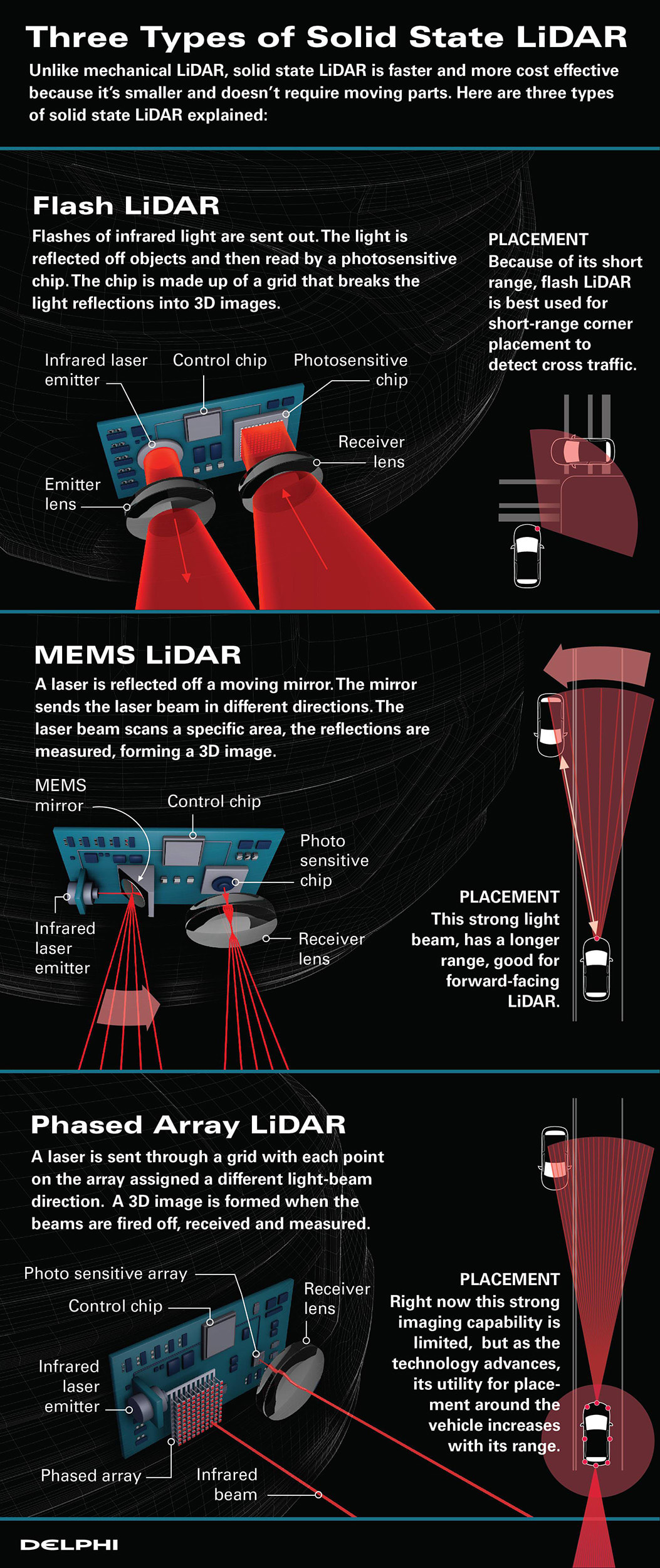
Innoviz’ MEMS (micro-electro mechanical systems)-based design is “an innovative way to do Lidar that’s interesting to us,” Dephi Automotive senior vice president Glen De Vos told a small gathering of reporters when Delphi announced the business partnership.
De Vos said Lidar sensing “is absolutely necessary” for SAE Level 4 and Level 5 autonomous operation, where the vehicle has complete control of the vehicle at all times. “Along with radar and vision technology, Lidar is an essential component to Delphi’s automated-driving perception suite,” he added.
In related background discussion with reporters, De Vos said Delphi at the moment envisions different types of Lidar as being the best way to generate the a complete and accurate “view” of the environment around an automated vehicle. Lidar such as that being developed by Innoviz is best-suited for the long-range, forward-looking sensing required for higher-speed operation. So-called “flash” Lidar or some other type of photo-optical technology is better for generating wide-angle views, helping to ensure identification of objects closer to vehicle’s corners and sides.
“We’ve concluded you need different kinds of Lidar for different uses,” he said.
De Vos added that the Innoviz Lidar technology still is in the development phase, but shows potential not only because of its performance capabilities but also to reduce costs to a point that is acceptable for consumer vehicles. “It gives you the performance—but at a price point that’s good for automotive,” he asserted. He said a broad cost goal is for Lidar sensors to drop to the $250 range from today’s cost that is closer to $1,000. He added that Delphi has an eventual cost target of $100 or less for individual Lidar sensors.
“We want to have access to what we think are the best technologies,” De Vos said in explaining Delphi’s investment in and partnership with Innoviz, which was founded less than two years ago. “Ultimately, you’ve got to get to a solid-state Lidar (technology) for production cars.”
More From SAE Media Group
Off-Highway Engineering
Forward-Looking Lidar Can Revolutionize Driver-Assistance Systems
Automotive Engineering
Nvidia’s New Level 2+ Autonomy Platform Is Making Cars Safer Today

Automotive Engineering
‘Cruising Chauffeur’ Demos SAE Level 3 Autonomy
Automotive Engineering
JLR Prepares to Leave the Road — Autonomously
Automotive Engineering
Intel Inside the Cloud-Based Data Future
Automotive Engineering
SAE Offers Free Summary Document on Levels of Vehicle Automation
Automotive Engineering
Delphi Showcasing Next-Gen Autonomous System at CES 2017
Automotive Engineering
ZF and Hella Launch Sensor-Systems Development Partnership


Automotive Engineering
Dassault Systèmes and AKKA Partner on Driverless-Vehicle Technology (Video)
Automotive Engineering
Ford Promises Full-Autonomous Car in 2021
Automotive Engineering
Continental Shows Next-Generation Highly Automated Car
Off-Highway Engineering
The Drive for Driverless Vehicles
Automotive Engineering
Toyota Sticking with Measured, ‘Teammate’ Approach to Autonomous Development
Automotive Engineering
SAE Convergence 2016: Automakers, Suppliers Firm That Autonomous Driving Not Decades Away
Automotive Engineering
U.S. Dept. of Transportation Issues New Autonomous-Vehicle Guidelines
Automotive Engineering
Autonomous Vehicle Challenge Ramps up Competition at Convergence
Automotive Engineering
It Takes Two
Automotive Engineering
SAE Publishes Terminology Standard for Automated Driving Systems
Automotive Engineering
Uncertainty Surrounds Competition to Roll out Autonomous Vehicle
Automotive Engineering
Self-Parking Vehicle Via Valeo Valet
Automotive Engineering
Luminar Expands into Automotive LiDAR with $250 Million in Fundraising
Automotive Engineering
SAE Level 3 "Hand Off" Is Challenging AI Researchers
Off-Highway Engineering
Peloton Develops a Level 4 Automated Platooning System, but Keeps the Driver in Charge
Automotive Engineering
The Impact of Shifting to the ‘Softer’ Side
Automotive Engineering
WCX17: Former Transportation Secretary Warns Against Potential CAFE Pullback
Top Stories
INSIDERManufacturing & Prototyping
 How Airbus is Using w-DED to 3D Print Larger Titanium Airplane Parts
INSIDERManned Systems
 FAA to Replace Aging Network of Ground-Based Radars
NewsTransportation
 CES 2026: Bosch is Ready to Bring AI to Your (Likely ICE-powered) Vehicle
NewsSoftware
 Accelerating Down the Road to Autonomy
EditorialDesign
 DarkSky One Wants to Make the World a Darker Place
INSIDERMaterials
 Can This Self-Healing Composite Make Airplane and Spacecraft Components Last...
Webcasts
Defense
 How Sift's Unified Observability Platform Accelerates Drone Innovation
Automotive
 E/E Architecture Redefined: Building Smarter, Safer, and Scalable...
Power
 Hydrogen Engines Are Heating Up for Heavy Duty
Electronics & Computers
 Advantages of Smart Power Distribution Unit Design for Automotive...
Unmanned Systems
 Quiet, Please: NVH Improvement Opportunities in the Early Design...
