




DARPA's ALIAS Successfully Lands a Boeing 737 Simulator
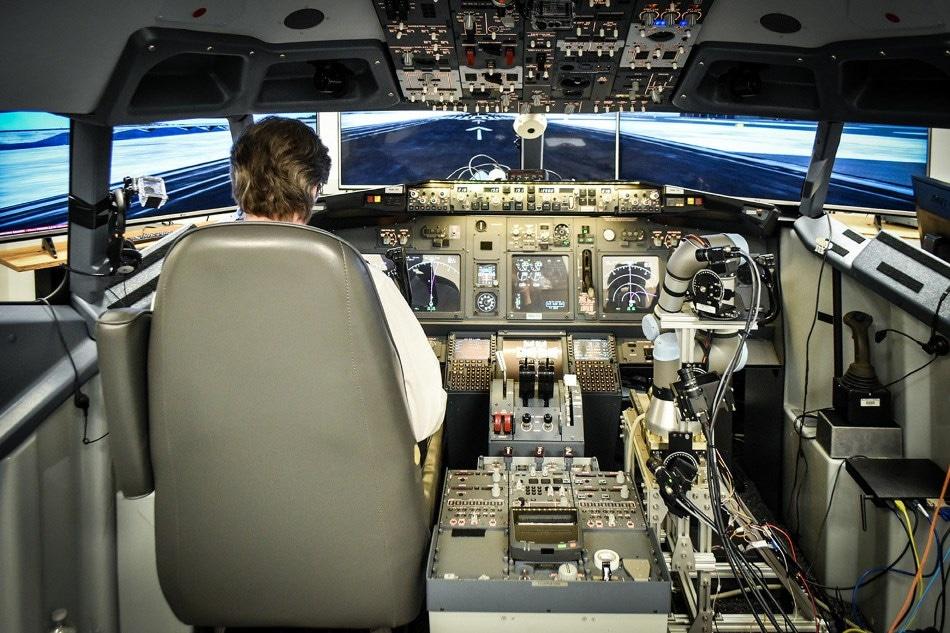
Aurora Flight Sciences has demonstrated its automated flight capabilities with various successful flight scenarios in a Boeing 737 simulator. The work, part of the Defense Advanced Research Projects Agency (DARPA)’s Aircrew Labor In-Cockpit Automation System (ALIAS) program, leverages “a tailorable, drop-in, removable kit that would promote the addition of high levels of automation into existing aircraft, enabling operation with reduced onboard crew.”

Demonstrated on a 737-800NG simulator at the U.S. Department of Transportation’s John A. Volpe National Transportation Systems Center in Cambridge, MA, ALIAS showcased its ability to utilize the existing 737 auto-landing system to autonomously land an aircraft safely in the event of pilot incapacitation.
ALIAS includes the use of in-cockpit machine vision, robotic components to actuate the flight controls, an advanced tablet-based user interface, speech recognition and synthesis, and a knowledge-acquisition process that facilitates transition of the automation system to another aircraft within a 30-day period. Aurora is also working on a version of the system without robotic actuation that instead aims to support the pilot by tracking aircraft physical, procedural, and mission states, increasing safety by actively updating pilot situational awareness.
Aurora has previously successful installed and tested ALIAS components on a Diamond DA42, Cessna 208 Caravan, Bell UH-1 Iroquois, Sikorsky S-76 ,and DHC-2 Beaver aircraft. Aurora has also demonstrated ALIAS numerous times on aircraft in flight, most recently on the DA42. In the demonstration, ALIAS actualized DA42 cockpit procedures in real time and, overseen by an onboard safety pilot, conducted a fully automated landing at a simulated site at 3000 ft in altitude. (To read more about previous ALIAS program achievements, click here.)
ALIAS aims to leverage the advances made in aircraft automation systems over the past 50 years to support execution of an entire mission from takeoff to landing, even in the face of contingency events such as aircraft system failures. ALIAS utilizes persistent-state monitoring and rapid recall of flight procedures, to further enhance flight safety. Aurora’s ALIAS technology demonstration system is designed to function as a second pilot in a two-crew aircraft, enabling reduced crew operations while ensuring that aircraft performance and mission success are maintained or improved.
More From SAE Media Group
Aerospace & Defense Tech Briefs
DARPA Works Toward Unmanning Aircraft
Aerospace & Defense Tech Briefs
General Atomics Moves Toward Global RPA Flight Certification for MQ-9B SkyGuardian
Aerospace & Defense Tech Briefs
Aurora Proves Unmanned UH-1H Capabilities for Marines, Continues Orion UAS Work for USAF
Aerospace & Defense Tech Briefs
FAA Certifies AeroVonics' Economical Avionics Upgrade for Light General Aviation Aircraft
Aerospace & Defense Tech Briefs
L3 Makes Its C-130 Modernization Package Available to Global Operators
Aerospace & Defense Tech Briefs
Lockheed Martin’s Next-Gen, 360-Degree Vision System Flies on the Bell V-280 Valor
Aerospace & Defense Tech Briefs
Aircraft Automation System
Aerospace & Defense Tech Briefs
Boeing Aerospace & Autonomy Center to Focus on Designing, Building, Flying Autonomous Aircraft
Aerospace & Defense Tech Briefs
Sikorsky to Provide an ALIAS to DARPA
Aerospace & Defense Tech Briefs
Flight Vision System for Rotary-Wing Aircraft
Aerospace & Defense Tech Briefs
Curtiss-Wright Black Boxes Receive European Approval
Aerospace & Defense Tech Briefs
Curtiss-Wright and Honeywell Team to Develop Cloud-Enabled Flight Recorders of the Future
Aerospace & Defense Tech Briefs
Elbit Systems Takes to the Skies to Demonstrate SkyVis
Aerospace & Defense Tech Briefs
Abaco’s FORCE2 Flight Computer Enables National and International Ground Control Station Certification
Aerospace & Defense Tech Briefs
SAE International Establishes a New AI Standards Committee at Le Bourget
Aerospace & Defense Tech Briefs
FLYHT and Spectralux Avionics Integrate Systems to Deliver FANS-Over-Iridium Satellite Communications to Airlines
Aerospace & Defense Tech Briefs
MagniX and AeroTEC to Fly All-Electric ECaravan May 28
Aerospace & Defense Tech Briefs
Disruptive Flight Control Technology on Trial
Aerospace & Defense Tech Briefs
Vertical Aerospace Is Honeywell’s Latest Partner in the UAM Industry
Aerospace & Defense Tech Briefs
Collins Aerospace Provides Avionics for C-130H Modernization Program
Aerospace & Defense Tech Briefs
Artificial Intelligence Could Reduce CV-22 Osprey Maintenance
Aerospace & Defense Tech Briefs
Sikorsky’s Autonomous Black Hawk Helicopter Takes Flight
Aerospace & Defense Tech Briefs
Stratolaunch All-Composite Aircraft Achieves First Flight
Aerospace & Defense Tech Briefs
Rockford Xellerix to Support Pilatus PC-24 Electrification
Aerospace & Defense Tech Briefs
Vertical Flight Society Applauds EVTOL Innovation, Bell Nexus UAM Concept
Aerospace & Defense Tech Briefs
Aitech Defense Will Provide Data Interface Technology for Boeing’s Unmanned MQ-25 Refueling Platform
Aerospace & Defense Tech Briefs
Engineering Smart Systems for Smart Air Travel, Balancing Human Constraints
Aerospace & Defense Tech Briefs
Dassault Magnifies Focus on Its 5X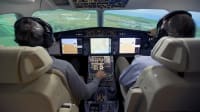
Aerospace & Defense Tech Briefs
Unleashing AI in Aviation Will Accelerate Move to Zero-Pilot Cargo and Passenger Aircraft
Aerospace & Defense Tech Briefs
Aerion and Honeywell Collaborate on Revolutionary Flight Deck for Supersonic Bizjet
Top Stories
INSIDERManufacturing & Prototyping
 How Airbus is Using w-DED to 3D Print Larger Titanium Airplane Parts
INSIDERManned Systems
 FAA to Replace Aging Network of Ground-Based Radars
NewsTransportation
 CES 2026: Bosch is Ready to Bring AI to Your (Likely ICE-powered) Vehicle
NewsSoftware
 Accelerating Down the Road to Autonomy
EditorialDesign
 DarkSky One Wants to Make the World a Darker Place
INSIDERMaterials
 Can This Self-Healing Composite Make Airplane and Spacecraft Components Last...
Webcasts
Defense
 How Sift's Unified Observability Platform Accelerates Drone Innovation
Automotive
 E/E Architecture Redefined: Building Smarter, Safer, and Scalable...
Power
 Hydrogen Engines Are Heating Up for Heavy Duty
Electronics & Computers
 Advantages of Smart Power Distribution Unit Design for Automotive...
Unmanned Systems
 Quiet, Please: NVH Improvement Opportunities in the Early Design...
