




New York Auto Show: Lincoln Unveils All-New, Aluminum-Bodied 2018 Navigator

Ford’s Lincoln luxury-vehicle unit revealed the 2018 Navigator fullsize SUV at the 2017 New York auto show by touting its blend of smart basic engineering and smart features.

Like the recently-revealed Ford Expedition, its Lincoln counterpart is fitted with weight-saving aluminum bodywork to cut roughly 200 lb (91 kg) from the curb weight and helping offset the mass of the new Navigator’s copious luxury and advanced driver-assist features.
The new Navigator’s single-spec powertrain is stark evidence that engine downsizing and advanced transmission technology have come fully of age: the body-on-frame Navigator, positioned to be one of the largest and most-spacious 3-row SUVs on the road, isn’t deemed to require a V-8. Instead, Lincoln projects it will reap some 450 hp from a 3.5-L twin-turbocharged V6. And backing the thrusty 6-cylinder engine is Ford’s new 10R80 10-speed automatic transmission.
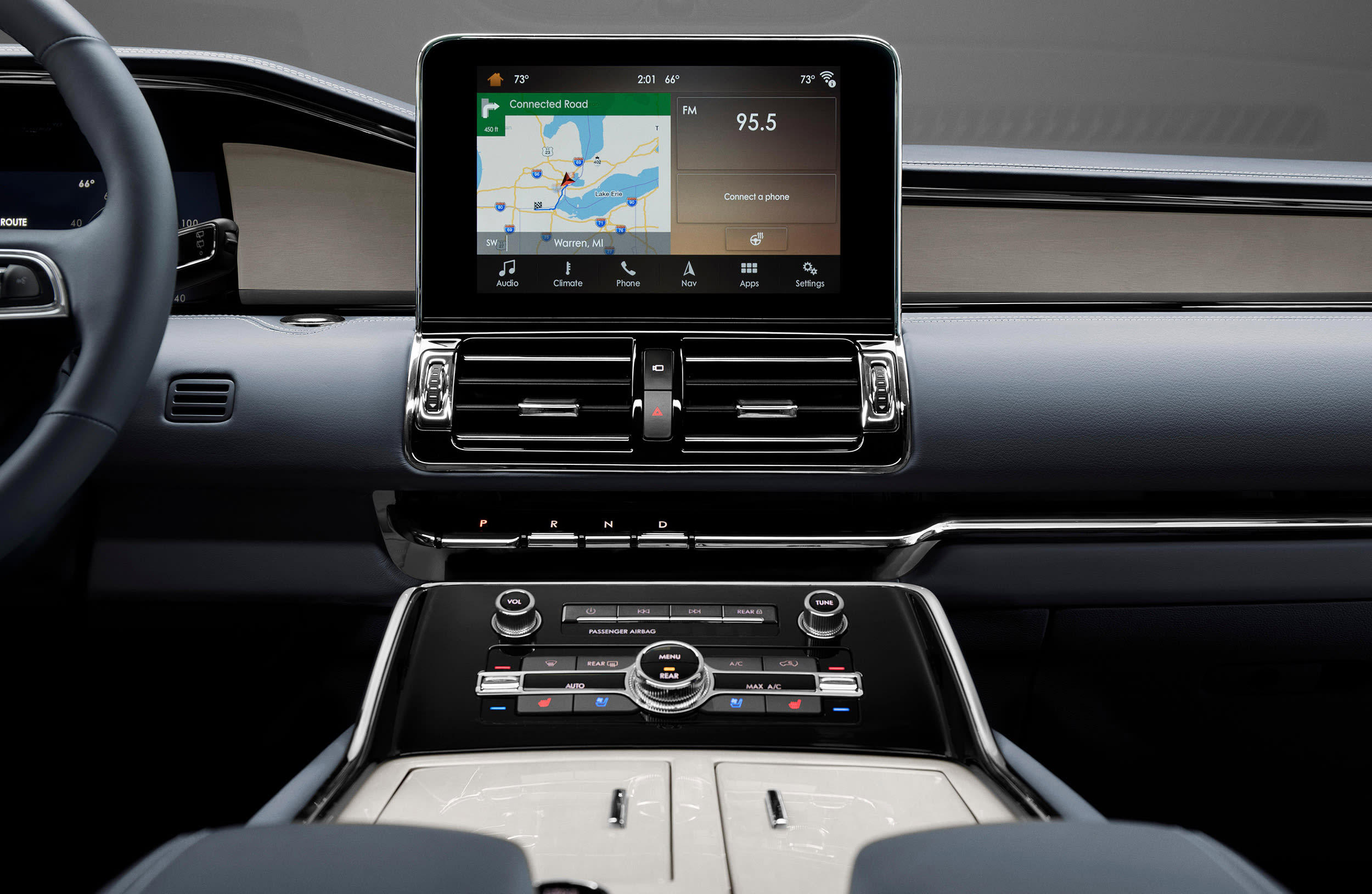
At the 2018 Navigator’s New York auto show launch, Ford had yet to distribute final specifications, but one company source said the new Navigator is expected to surpass the 17-mpg (13.8 L/100 km) combined fuel-economy rating of the previous-generation Navigator fitted with the twin-turbocharged V6 and all-wheel drive.

Although the new Navigator has Ford’s latest weight-saving and powertrain know-how, the brand is steadfastly focused on the SUV’s occupant-luxury and convenience attributes, as it must do marketplace battle with rival GM’s segment-defining Cadillac Escalade and fresh new European rivals that include large unibody SUVs from Land Rover’s Range Rover and Mercedes-Benz, among others.
The 2018 Navigator has a laminated windshield and side glazing and so-called Perfect Position seats for the front occupants that are 30-way adjustable and offer heating, cooling and massage. Twin 10-in (25-cm) screens on the back of the front seats allow second-row occupants to view separate video sources and the second-row occupants have their own dedicated climate-control sector. The third-row seats offer a power-recline function.

Other electronic features include a head-up display for the driver and Ford’s clever Trailer Backup Assist that greatly simplifies the act of reversing a trailer. A simple pushbutton arrangement on the center console selects transmission gear (there is no “L,” setting, however, so it appears it technically cannot be called a “PRNDL”).
And one unique new function sees the adaptive LED headlights broaden their beam at low speeds to enhance peripheral lighting then narrowing the beams as speed rises to provide better long-range projection and reduce glare from signs and other roadside distractions.
More From SAE Media Group
Off-Highway Engineering
First Drive: Drifting in the Electric 2027 Mercedes GLC 400
Automotive Engineering
New York Auto Show 2016: Lincoln Unveils Big-SUV Future with Navigator Concept
Automotive Engineering
5 More HP for 2026 Kia Sportage: First Drive
Automotive Engineering
Discovery Sport Introduces Evoque-Based Land Rover
Automotive Engineering
Infiniti Creates 'Executive Boardroom' for 2015 Model
Automotive Engineering
Ford Refines Interior, Exterior on 2025 Explorer
Automotive Engineering
Lincoln’s Tech-Rich 2019 Nautilus Replaces MKX Crossover
Automotive Engineering
TRD Spells Capability for Toyota’s Latest Tundra
Automotive Engineering
2016 Discovery Sport Spearheads More Efficient Land Rovers
Automotive Engineering
Toyota Stretches SUV Line-Up with World Debut of Grand Highlander
Automotive Engineering
VW Finally Fills Its SUV Gap with 2018 Atlas
Automotive Engineering
Lotus Breaks out with New Eletre Electric SUV
Automotive Engineering
Bentley Takes SUV to Super Premium Level
Automotive Engineering
2019 Ford Ranger Returns as a Midsize with 10-Speed and Turbo Four
Automotive Engineering
2017 Cadillac XT5 Brings Superior Dynamics to Luxo-Crossover Segment
Automotive Engineering
Loss Leader: 2018 Chevy Equinox Gets Smaller, Lighter, Tidier
Automotive Engineering
Second Time a Charm for Honda’s Unibody Ridgeline Pickup?
Automotive Engineering
Ford Puts More ‘Super’ into the All-New 2023 Super Duty
Automotive Engineering
Nissan Readies Light-Duty Version of Titan Pickup
Automotive Engineering
2018 Cadillac CT6 Platinum AWD
Automotive Engineering
Mercedes’ New GLC Represents a Sportier Focus
Automotive Engineering
Toyota Chief Talks Trucks
Automotive Engineering
Mercedes Boosts Off-Road Prowess of 2019 G-Wagen
Automotive Engineering
See-Through A-Pillars, Ghost Navigation, and Discovery Sport Extreme Testing
Automotive Engineering
Mercedes-Benz Melds SUV and Coupe Styling for GLE Coupe
Automotive Engineering
Flex4 System Leads Magna's Wave of New Fuel-Saving Technologies
Automotive Engineering
Kia Reveals Electric AWD Trail'ster Concept
Automotive Engineering
Jaguar F-Pace 35t R-Sport
Automotive Engineering
2017 Nissan Titan Gets New Platform, Powertrain, Cab and Bed Features
Automotive Engineering
2017 Nissan Armada Steps onto Patrol Platform
Top Stories
INSIDERManufacturing & Prototyping
 How Airbus is Using w-DED to 3D Print Larger Titanium Airplane Parts
INSIDERManned Systems
 FAA to Replace Aging Network of Ground-Based Radars
NewsTransportation
 CES 2026: Bosch is Ready to Bring AI to Your (Likely ICE-powered) Vehicle
NewsSoftware
 Accelerating Down the Road to Autonomy
EditorialDesign
 DarkSky One Wants to Make the World a Darker Place
INSIDERMaterials
 Can This Self-Healing Composite Make Airplane and Spacecraft Components Last...
Webcasts
Defense
 How Sift's Unified Observability Platform Accelerates Drone Innovation
Automotive
 E/E Architecture Redefined: Building Smarter, Safer, and Scalable...
Power
 Hydrogen Engines Are Heating Up for Heavy Duty
Electronics & Computers
 Advantages of Smart Power Distribution Unit Design for Automotive...
Unmanned Systems
 Quiet, Please: NVH Improvement Opportunities in the Early Design...
