




2016 Discovery Sport Spearheads More Efficient Land Rovers
JLR’s space-efficient, flexible SUV moves to JLR’s new Ingenium modular engines.

The vast, volcanic, and starkly beautiful Highlands interior of Iceland is an ideal place to demonstrate the do-it-all capabilities of Land Rover’s all-new Discovery Sport. Two days spent there last January testing early-VIN production vehicles in on- and off-road conditions gave Automotive Engineering and other media insight into the work lives of Land Rover engineers. For them, extreme departure angles, tricky split-μ surfaces, and icy-river fords are routine development stuff, as proven by how well their versatile new C-segment SUV performs off road.
However, Land Rover’s 250-strong engineering team also delivered luxury-car levels of cabin noise and ride comfort on pavement, aimed at the majority of “Disco” Sport customers who will rarely, if ever, venture into the mud or engage low range.
“We’ve been working closely with our Jaguar colleagues on ride quality and the details of NVH engineering for quite some time now,” explained Program Manager Bob Prew. He said development of the new vehicle (known internally by its L550 program code) targeted two pairs of competitors: Audi Q5 and BMW X3 were the “premium” bogies, and Honda’s CR-V and the Hyundai Sorento were the “non-premiums” — the latter receiving Prew’s praise for their overall five-seater’s execution.
New multilink rear

The newest Land Rover replaces the LR2/Freelander and uses a modified iteration of the Evoque’s LR-MS unibody architecture that Land Rover engineers said will underpin subsequent models. The compact SUV is 181.1 in (4599 mm) long and 81.5 in (2069 mm) wide and rides on a 107.9-in (2741-mm) wheelbase — 3.25 in (82.5 mm) longer than Evoque’s and 10 in (254 mm) longer overall. The taller greenhouse benefits passenger ingress and interior room, which feels as spacious as any vehicle in in the class.
Two seating configurations, five- and seven-seat (called “five plus two”) are offered. The tight third row, which folds flat, sits on a “stadium” perch about an inch (25 mm) above the second row and is only practical for small kids and pets. With both seats fully stowed, the vehicle offers 60 ft3 (1700 L) of cargo volume, claimed to be class-leading.
The Discovery Sport’s steel-intensive body structure features 20% high-strength boron alloys, with aluminum hood, roof, front fenders, and liftgate, and a magnesium cross-car structure behind the cowl. Base curb weight is 3854 lb (1748 kg). The hood assembly includes an airbag module mounted on the windshield side for meeting ped-pro (pedestrian impact) requirements. The vehicle earned a five-star safety rating in Euro NCAP testing.
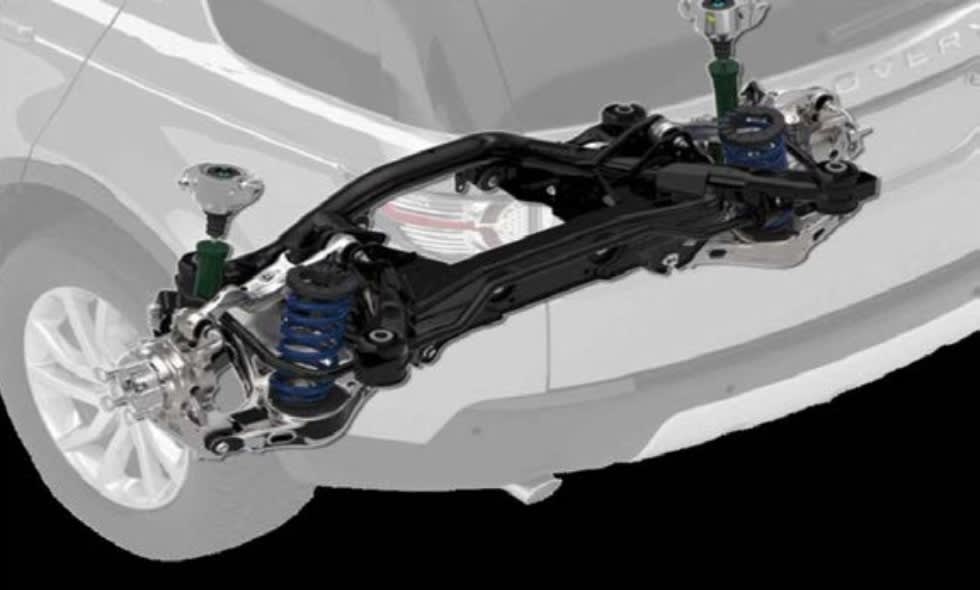
Prew’s team extensively modified the Evoque’s structure to package a new compact multi-link rear suspension — itself designed to enable the third-row seat to be folded down into the cargo well with enough room to also accommodate the space-saver spare tire (on five-seat versions; the spare is underneath the vehicle on 5+2 models). “It was critical that we keep the rear load floor at a practical height,” he said. The modular MacPherson front suspension carried over from Evoque uses hydraulic rebound stops on the struts. Its upper and lower control arms are in aluminum and steel, respectively.
Variable-ratio electric power-assist steering is fitted, which Prew said enables an automatic parking assist function. The Disco Sport’s steering requires 2.43 turns lock-to-lock, with a 38.9-ft (11.9-m) turning circle. Foundation braking is by four vented discs, 12.8-in (325-mm) front and 12-in (300-mm) rear.
New Ingenium engines power 2016 models
The Discovery Sport is available in both two- and all-wheel-drive configurations. For 2016 the new Jaguar Land Rover “Ingenium” 2.0-L family of modular turbocharged gasoline and diesel engines replaces the previous Ford-sourced EcoBoost and Duratorq ranges used on MY2015 vehicles. Developed by JLR in-house, the Ingenium range features a common 0.5-L cylinder displacement, rolling-element camshaft bearings for reduced friction, and stop-start/ mild-hybrid functionality.
North American market vehicles are expected to use the gasoline engine initially, paired with the incumbent ZF 9HP nine-speed automatic transmission. A Getrag M66EH50 six-speed manual is available in global markets.
There are two different AWD setups, neither equipped with a transfer case. Standard is a BorgWarner-sourced Haldex system; optional is the Land Rover Active Driveline, an axle-disconnect system co-developed with and supplied by GKN Driveline. Active Driveline is claimed to reduce driveline parasitic losses by 75% compared with the Haldex system. The GKN system also features torque vectoring-by-braking, controlled via the DSC (stability control) module at rates up to 100 times/s.
To deliver a low-range 4x4 function, the 9HP is fitted with a super-low “crawl” first gear ratio available only in off-road conditions. For typical road use the vehicle starts in second gear. Locking differentials are not offered on the new Disco Sport.
Land Rover’s patented Terrain Response 2 offers drivers several automatic operating modes for tackling various road conditions and traction situations, with the option of manual override. The technology (which includes a new pitch-rate sensor and upgraded Hill Descent Control that is claimed to be three times faster than that used on the LR2) has settings for General, Grass/Gravel/ Snow, Mud/Ruts, and Sand vehicle use. The system’s algorithmic maps configure throttle, steering response, transmission gear ratio, center diff, and the braking/DSC for optimum performance.
Terrain Response Control 2 is not offered on the front-wheel-drive version, which will be JLR’s fuel-economy play for this segment.
600-mm water fording
Despite its on-road design bias, the 8.3 in (212 mm) of ground clearance and up to 24 in (600 mm) of water-fording capability — the latter an improvement of 3.9 in (100 mm) over the LR2 — gives the new Disco Sport more than respectable off-road capability, as our Iceland cold-weather testing confirmed. Approach and ramp angles, 25° and 21°, respectively, are slightly less than those of the LR2, while the 31° angle-of-departure carries over. But for owners who crave more rock-crawling capability, a section of the front bumper can be removed to increase the approach angle.
The Discovery Sport’s interior design and trim are straightforward and fairly plain. Potential distractions appear to be minimized. An 8-in touchscreen that is shared with the new Jaguar XE sedan dominates the center of the IP and controls vital infotainment and navigation functions for the vehicle’s three trim packages. The SE base model includes rear parking sensors, rearview camera, and 18-in wheels among many other features. Next up is the HSE, which adds 19-in wheels, a panoramic glass roof, and upgraded audio and interior trim.
Top-of-range HSE Lux models can be had with a Vision Assist package that includes adaptive xenon headlights, automatic high beam control, a surround-view camera system, blind spot monitoring, rear cross-traffic alert, and parking assist.
More From SAE Media Group
Automotive Engineering
Discovery Sport Introduces Evoque-Based Land Rover
Automotive Engineering
5 More HP for 2026 Kia Sportage: First Drive
Automotive Engineering
Toyota Stretches SUV Line-Up with World Debut of Grand Highlander
Automotive Engineering
See-Through A-Pillars, Ghost Navigation, and Discovery Sport Extreme Testing
Automotive Engineering
Systems-engineering a New 4x4 Benchmark
Automotive Engineering
Mercedes-Benz Melds SUV and Coupe Styling for GLE Coupe
Automotive Engineering
Hyundai Updates Its Tucson Compact Crossover
Automotive Engineering
Volkswagen Re-Engineers Tiguan
Automotive Engineering
Lighter, More Powerful 3rd-Gen Pilot Debuts Honda’s NPD Process
Automotive Engineering
Subaru Carefully Reworks Outback on New Platform
Automotive Engineering
2019 Subaru Ascent Premium
Automotive Engineering
Mitsubishi Puts NVH in 2016 Outlander's Crosshairs
Automotive Engineering
2024 Lexus GX Ready for Off-Road Adventure with New Platform, E-KDSS
Automotive Engineering
Redesigned 2017 Infiniti Q60 Gets New Engine
Automotive Engineering
Lexus Unveils Concept Flagship Crossover
Automotive Engineering
Lexus Sharpens Best-Selling RX for 2016
Automotive Engineering
2016 Explorer Gains More Powerful Four-Cylinder, Platinum Opulence
Automotive Engineering
2015 Ford Edge Boasts New 2.0-L EcoBoost Engine
Automotive Engineering
Porsche Ties Sportscar Label to Its New Macan SUV
Automotive Engineering
New Ford S-Max to Get Class-Leading Driver Assistance Features
Automotive Engineering
2018 Subaru Crosstrek Moves to New Stiffer Global Platform
Automotive Engineering
Road-Efficient Mud Machine
Automotive Engineering
2026 Nissan Sentra Review: Putting the Pieces Together
Automotive Engineering
Infiniti Creates 'Executive Boardroom' for 2015 Model
Automotive Engineering
Audi Unveils New R8 and All-Electric E-Tron Version
Automotive Engineering
2023 Cadillac Lyriq Executive Chief Engineer: New EV Her ‘North Star’
Automotive Engineering
Nissan Readies Light-Duty Version of Titan Pickup
Automotive Engineering
2021 Toyota Supra 2.0
Automotive Engineering
Audi's New Compact Q2 Blends 3-Cylinder Efficiency, Agile Chassis
Automotive Engineering
Mazda Enters Subcompact Crossover Segment with 2016 CX-3
Top Stories
INSIDERManufacturing & Prototyping
 How Airbus is Using w-DED to 3D Print Larger Titanium Airplane Parts
INSIDERManned Systems
 FAA to Replace Aging Network of Ground-Based Radars
NewsTransportation
 CES 2026: Bosch is Ready to Bring AI to Your (Likely ICE-powered) Vehicle
NewsSoftware
 Accelerating Down the Road to Autonomy
EditorialDesign
 DarkSky One Wants to Make the World a Darker Place
INSIDERMaterials
 Can This Self-Healing Composite Make Airplane and Spacecraft Components Last...
Webcasts
Defense
 How Sift's Unified Observability Platform Accelerates Drone Innovation
Automotive
 E/E Architecture Redefined: Building Smarter, Safer, and Scalable...
Power
 Hydrogen Engines Are Heating Up for Heavy Duty
Electronics & Computers
 Advantages of Smart Power Distribution Unit Design for Automotive...
Unmanned Systems
 Quiet, Please: NVH Improvement Opportunities in the Early Design...
