




NAIAS 2017: Lightweight Door Module Aims to Trim Vehicle Weight
A new ultralight door architecture nets a 42.5% weight savings compared to a current production door—and that’s enough to put this lightweight concept in an enviable position.
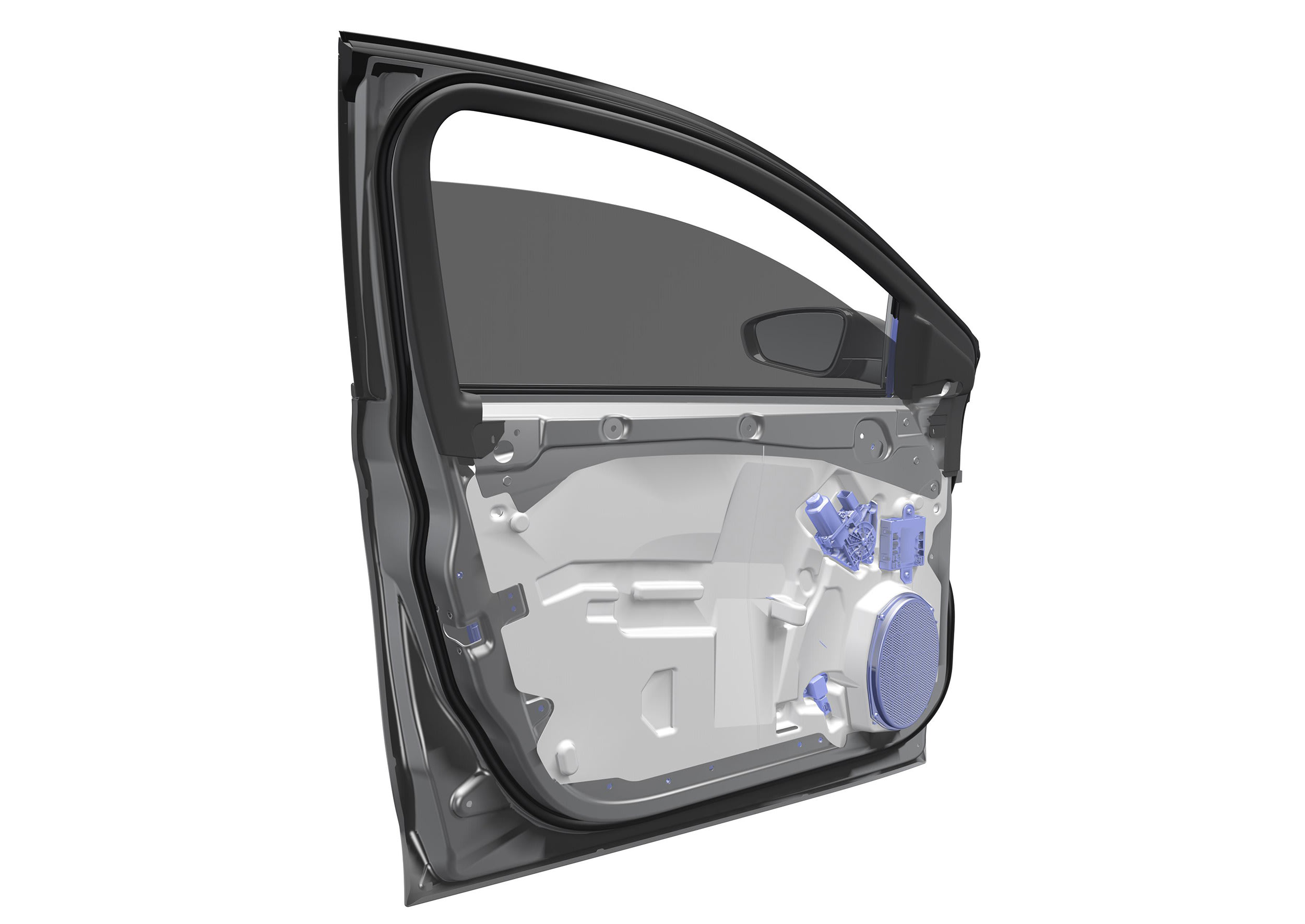
“This lightweight door module has a great opportunity to be commercialized. It’s not just high-tech. It’s also at the right cost,” said Reuben Sarkar, Deputy Assistant Secretary for Transportation, Energy Efficiency and Renewable Energy at the U.S. Department of Energy.
Sarkar and Ian Simmons, Vice President Business Development, Corporate Engineering and R&D at Magna, spoke with Automotive Engineering following a press conference detailing the lightweight door project at the 2017 Detroit auto show.
Magna, in cooperation with the DoE and partners FCA US and Grupo Antolin, developed the driver’s-side door in less than 10 months.
Aluminum accounts for approximately half of the total mass reduction of the door-in-white assembly. The door module also includes Magna’s SmartLatch electronic latch system, which eliminates the need for mechanical hardware.

Grupo Antolin’s contributions in the area of molding techniques and polymers represented approximately 7% of the total mass reduction.
“This lightweight door was done with today’s production materials and today’s production processes and methodologies in mind. It’s a holistic approach that includes the module, door inner, mirror and trim,” said Simmons.
The concept door also was developed at significantly less than the venture's cost bogie. “The target in terms of cost was approximately $5 per pound and we came in at $2.59 per pound,” Simmons said.
Simulation showed the door module passing all safety and durability requirements. “FCA US is supporting us with all the prototype builds and all the testing. And it’s their functional requirements that we simulated.,” said Simmons, “All the simulation work and all the initial testing has come back positive.”
Next steps include the manufacture of full-scale prototype door assemblies, performance tests and safety tests to validate the design. The goal is to have the lightweight door available for production vehicles by the fall of 2020.
More From SAE Media Group

Automotive Engineering
Yanfeng Shows Autonomous Vehicle Interior Concepts
Automotive Engineering
Seats and Instrument Panel in Faurecia's Autonomous Vehicle Sights
Automotive Engineering
Mechatronic System Production on the Uptick at Brose's Michigan Plant
Automotive Engineering
Adient Rethinks Interior Technology for Autonomous Vehicles
Aerospace & Defense Tech Briefs
Assessment of Noncommercial Icing Prediction Capabilities for Army Applications

Autonomous Vehicle Engineering
Budget Airline Car Concept Is the Short-flight Alternative
Autonomous Vehicle Engineering
Aptiv’s Autonomous-Vehicle ‘Air-Traffic Control’

Automotive Engineering
Chevrolet Unveils 2024 Corvette E-Ray Hybrid
Automotive Engineering
Hydrogen Won't Accept 'No' for an Answer
Automotive Engineering
The International Fight over EFuels, Internal Combustion’s Would-Be Savior

Autonomous Vehicle Engineering
The Future of Automated Vehicle Cabins
Defense INSIDER
DEVCOM Tests Airdrop System for Rapid Deployment in the Field
Defense INSIDER
ERDC Begins Testing with World’s Largest Heavy Vehicle Simulator
Aerospace & Defense Tech Briefs
Personal Aerial Vehicle Pilot Training
Aerospace Manufacturing and Machining INSIDER
Army Launches $50 Million Advanced Manufacturing Initiative for Aviation and Weapon Systems
Automotive Engineering
Bob Lutz: What Makes a Great Engineer?
Automotive Engineering
WCX 2024: Volunteers Sought for SAE’s AWIM Student Challenges
Battery & Electrification Technology
Testing the Engineering Limits for eVTOL Battery Power
Aerospace & Defense Tech Briefs
Centre for Modelling & Simulation to Develop Digital Twins for GKN Aerospace Additive, Composite, and Industry 4.0 Technologies
Aerospace & Defense Tech Briefs
Uncrewed Solar Aircraft Passes Key Ground Tests
Off-Highway Engineering
CES 2025: Oshkosh Puts AI, Autonomy and Electrification to Work


NASA Spinoff
Bringing Hybrid Power to the Rescue
Aerospace Manufacturing and Machining INSIDER
Amprius Eyes Mass Production for Next Generation Electric Aircraft Battery
Automotive Engineering
Planning for a Digital World
Top Stories
INSIDERManufacturing & Prototyping
 How Airbus is Using w-DED to 3D Print Larger Titanium Airplane Parts
INSIDERManned Systems
 FAA to Replace Aging Network of Ground-Based Radars
NewsTransportation
 CES 2026: Bosch is Ready to Bring AI to Your (Likely ICE-powered) Vehicle
NewsSoftware
 Accelerating Down the Road to Autonomy
EditorialDesign
 DarkSky One Wants to Make the World a Darker Place
INSIDERMaterials
 Can This Self-Healing Composite Make Airplane and Spacecraft Components Last...
Webcasts
Defense
 How Sift's Unified Observability Platform Accelerates Drone Innovation
Automotive
 E/E Architecture Redefined: Building Smarter, Safer, and Scalable...
Power
 Hydrogen Engines Are Heating Up for Heavy Duty
Electronics & Computers
 Advantages of Smart Power Distribution Unit Design for Automotive...
Unmanned Systems
 Quiet, Please: NVH Improvement Opportunities in the Early Design...
