




Mercedes EQ Concept Previews 2019 Electric SUV
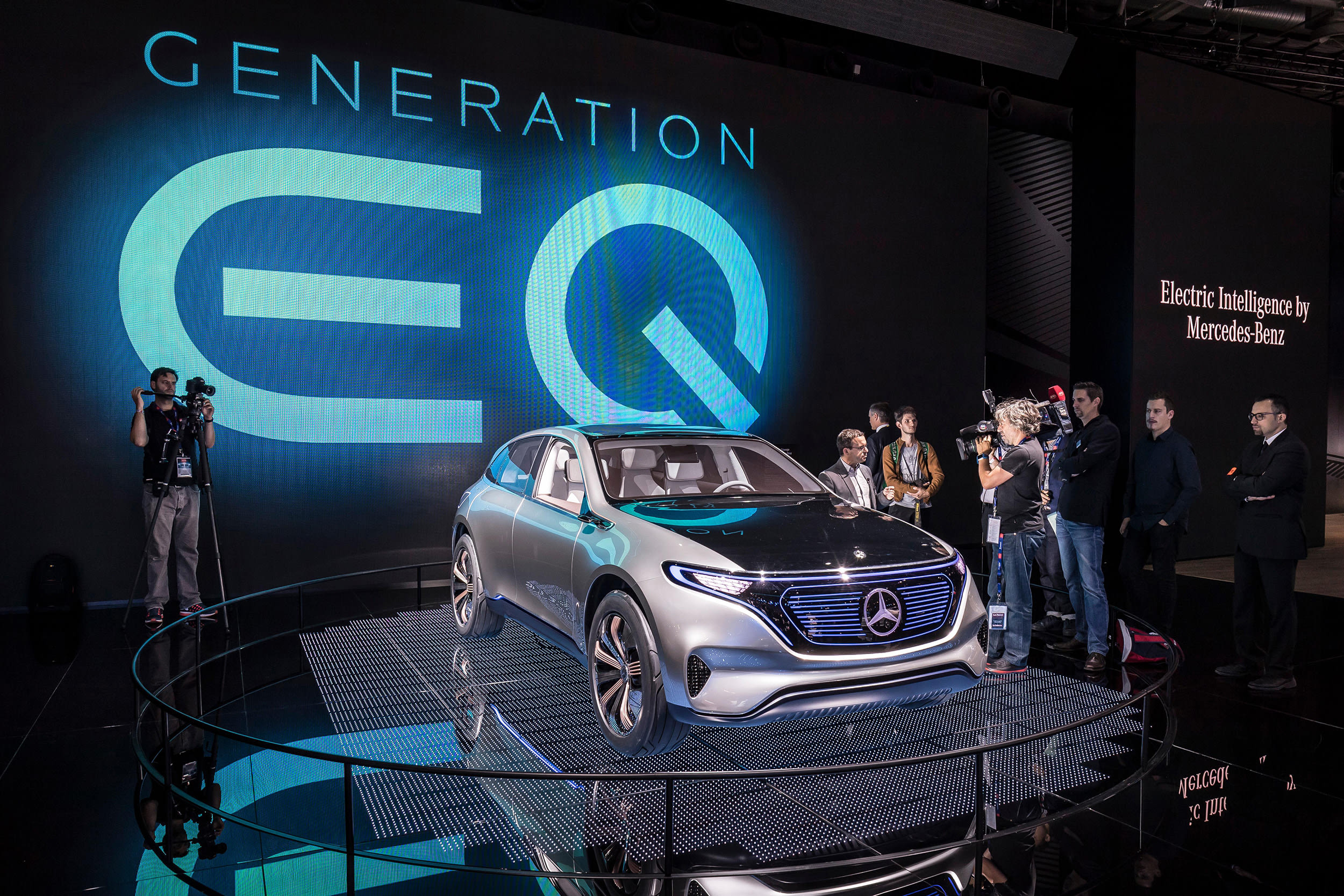
Mercedes-Benz officially revealed its comprehensive electrified-mobility strategy at the 2016 Paris Motor Show, while unveiling a new electric concept vehicle, the Generation EQ, that previews an electric SUV slated for production by 2019.
The new strategy, named CASE—which stands for Connected, Autonomous, Shared and Electric—incorporates all electric mobility-related activities under the EQ brand. These will include a diverse range of services including energy storage units, designed for both private and commercial customers and charging technologies, including inductive charging. Sustainable recycling will also be included.
Mercedes-Benz says that by 2025, the company aims to have more than 10 all-electric vehicles in its model range. Heavy investment, over €1B ($1.12B U.S.) will be made in battery production around the world. €500 M ($560 M) will be invested in a second battery production site in Kamenz, Germany.
Describing the new electric models, Dr. Thomas Weber, Member of the Board of Management of Daimler AG responsible for Group Research and Mercedes-Benz Cars Development, said, "The new generation of electric vehicles will be based on an architecture developed specifically for battery-electric models, which is scalable in every respect and usable across all models. It is suitable for all model series as well as sub-models, such as SUVs, saloons and coupés. Wheelbase and track are variable."

This dedicated architecture will incorporate two electric motors driving both front and rear axles, with a total power and torque output of up to 300 kW (402 hp) and 700 N·m (516 lb·ft). The Generation EQ concept car has a range of up to 500 km (310 mi), Dr. Weber claimed.
The design of the new EVs will include a specific “radiator” grille and new exterior lighting treatment. Inside, the only traditional switchgear to survive will be the electric seat adjustment switch. All other controls will use touch-sensing switchgear.
This includes the steering wheel spokes, where the touch controls are integrated into Organic Light Emitting Diode (OLED) displays. A 24-in (609-mm) TFT dashboard display carries all relevant driver information. The displays can be customized to suit individual needs.
The scalable architecture of the new EVs will provide for varying wheelbase lengths and track width. Battery architecture will also be scalable using a modular system, with the batteries contained in the floor section within the wheelbase. Mercedes-Benz has chosen to build the cars in a mixture of steel, aluminum and carbon fiber.
Features include tight panel gaps, concealed windscreen wipers, cameras replacing conventional door mirrors and no conventional door handles. The front features a black panel with a three-pointed star illuminated in white and surround illuminated in blue, with LED headlamps. At the rear LED optical fiber illuminates the rear panel surround and switches to red when the vehicle is moving, providing a tail light function.
The concept EQ will illuminate automatically when the driver approaches, with digital lighting embedded in the interior door panels. Mercedes-Benz mapping partner HERE (co-owned with BMW and VW Group) will provide mapping that can integrate with autonomous drive functions.
More From SAE Media Group
Automotive Engineering
LEAF Turns to the 2020s
NASA Spinoff
Scaling Up Hydrogen
Automotive Engineering
Mercedes-Benz AMG GT R Wins German Engineers’ Lightweighting Award
Automotive Engineering
Chevrolet Unveils 2024 Corvette E-Ray Hybrid
Automotive Engineering
Tested: 2025 Mercedes-Benz G 580 Spins up a Winner
Automotive Engineering
Volvo XC90 Line-Up Keeps Hybrid Futures Safe
Automotive Engineering
Making over the World’s Leading Hybrid
Tech Briefs
Top 10 Most-Read Tech Briefs Stories of 2022
Green Design & Manufacturing
MUTE: The Efficient City Car
Automotive Engineering
2025 Lucid Air Review: Unnecessarily Fast, Astonishingly Efficient
Automotive Engineering
2025 BMW M5 First Drive: Stuffed like Schnitzel with PHEV Tech
Automotive Engineering
Toyota Punches up the Prius
Automotive Engineering
Volvo’s Electric High-Wire Act
Automotive Engineering
Hercules Readies Alpha Electric Pickup Prototypes
NASA Spinoff
Home-Grown Housing
Automotive Engineering
With 2019 Sierra, GMC Puts Brand Differentiation Behind It—literally
Automotive Engineering
2019 Hyundai Kona Electric Goes Content and Torque Heavy in a B-Class EV
Automotive Engineering
Honda Pioneering New Manufacturing Tech for Zero Electrified Platform
Automotive Engineering
2019 S60 and V60 Volvo’s Newest Chips in the Transformation Game
Automotive Engineering
Engineering the 2022 Toyota Tundra
Automotive Engineering
Alliance Platform Elevates 2022 Mitsubishi Outlander

Automotive Engineering
Turbocharged Hybrid: 2021 Kia Sorento Revealed
Battery & Electrification Technology
Putting a New ‘Charge’ in EV Recharging
Automotive Engineering
Williams Debuts New Flexible Platform for BEVs and FCVs
Autonomous Vehicle Engineering
Volvo Leads the Shift to ‘Driver Understanding’
Automotive Engineering
BMW Engineers for the EV-Transition Reality
Automotive Engineering
Toyota Targets 2015 for First Fuel-Cell Car
Power Electronics INSIDER
World’s Strongest Battery Paves Way for Light, Energy-Efficient Vehicles
Top Stories
INSIDERManufacturing & Prototyping
 How Airbus is Using w-DED to 3D Print Larger Titanium Airplane Parts
INSIDERManned Systems
 FAA to Replace Aging Network of Ground-Based Radars
NewsTransportation
 CES 2026: Bosch is Ready to Bring AI to Your (Likely ICE-powered) Vehicle
NewsSoftware
 Accelerating Down the Road to Autonomy
EditorialDesign
 DarkSky One Wants to Make the World a Darker Place
INSIDERMaterials
 Can This Self-Healing Composite Make Airplane and Spacecraft Components Last...
Webcasts
Defense
 How Sift's Unified Observability Platform Accelerates Drone Innovation
Automotive
 E/E Architecture Redefined: Building Smarter, Safer, and Scalable...
Power
 Hydrogen Engines Are Heating Up for Heavy Duty
Electronics & Computers
 Advantages of Smart Power Distribution Unit Design for Automotive...
Unmanned Systems
 Quiet, Please: NVH Improvement Opportunities in the Early Design...
