




Lightweighting Focus for TE's Connectivity Solutions

TE Connectivity recently announced two new aerospace connectivity solutions that offer substantial weight savings: its COPALUM Lite sealed terminals and splices, and its Raychem INSTALITE lightweight braid system.
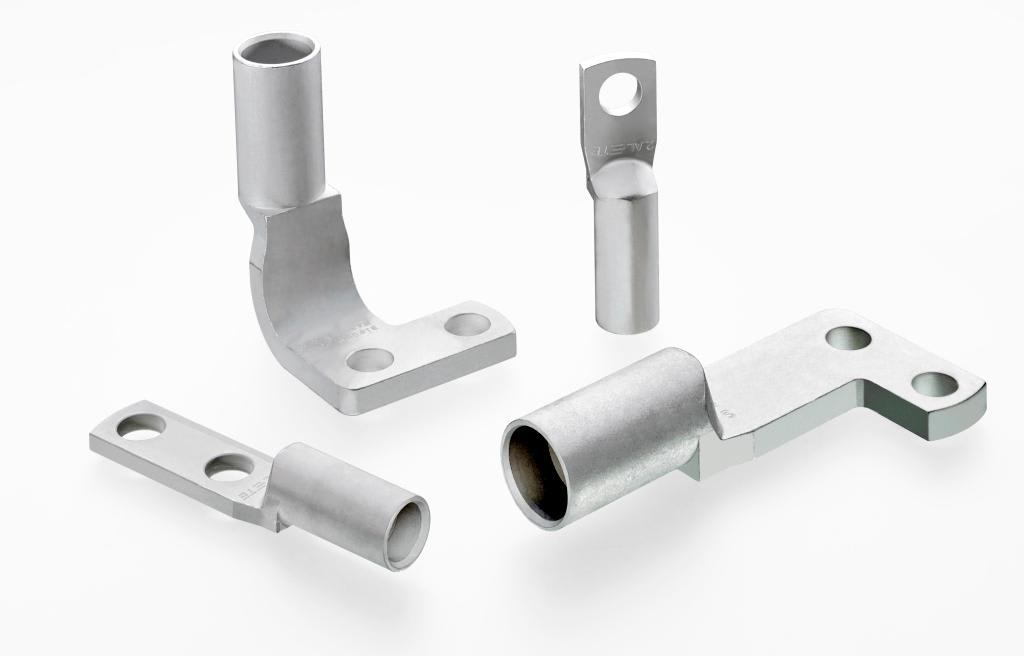
TE’s new COPALUM Lite sealed terminals and splices provide up to a 60% weight savings versus copper terminal alternatives, and up to 53% weight savings versus drop-forged aluminum terminals. The new terminals feature dry crimp technology that has provided three decades of reliable connectivity to the commercial aerospace industry, the company notes.
“Saving weight is always critical when designing interconnect solutions for aerospace applications,” said Steve McIntire, Product Manager, Global Aerospace, Defense & Marine, TE. “We’ve taken the time-tested COPALUM design and developed a family of terminals and splices that offer even greater weight savings than previous designs.”
The new terminals’ weight savings originate from aluminum base metal, an optimized wall thickness, and a shorter wire barrel.
The grease-free COPALUM dry crimp technology provides an efficient and clean process using a single-step crimp for conductor termination and wire sealing. The terminal’s screened crimp barrel cuts through aluminum oxides to form a reliable, oxide-free termination. The single-crimp process reduces applied cost, according to TE, by eliminating the need for a second crimp for wire sealing. The enhanced wire barrel design can result in additional efficiency gains, making wire insertion easy with ample room for conductors.
Single- or dual-hole terminals can be customized with straight or angled tongues, enabling design flexibility. The sealed terminals provide watertight wire sealing that withstands 500 h of salt spray exposure, TE claims. Combined with an operating temperature rating of 175°C, the terminals are suitable for aerospace applications including commercial aircraft, UAVs, primary power feeders, and grounding systems.
TE’s new Raychem INSTALITE lightweight braid system offers up to 50% weight savings over traditional copper braids. Made from a high-performance, nickel-plated copper alloy, the RoHS-compliant pull-on braid is claimed to provide better low-frequency performance than plated fibers or microfilaments.
Existing low-weight screening solutions are more limited with reduced electrical screen performance at low frequencies and lower protection against lightning strike, according to TE, also noting that plated fibers and microfilament stainless steel braids are more expensive options.
“Electromagnetic interference (EMI) protection is an ever-increasing requirement in the aerospace industry, especially as system functionality is increasing with higher signal speeds,” said Doug Jones, Product Manager, Global Aerospace, Defense & Marine, TE. “The INSTALITE lightweight braid has the ability to save weight while providing a high level of EMI screening across a wide frequency range. Its economical price makes it an attractive option for designers.”
TE’s INSTALITE lightweight braid is available in 3- to 20-mm diameters and installs and performs as a traditional metal braid does. It uses existing installation and termination methods and equipment to make integration into current applications simpler. The new lightweight braid also is flexible and easy to handle. It is provided on a former for easy installation on a variety of substrates.
More From SAE Media Group
Aerospace & Defense Tech Briefs
Lightweighting Focus for TE's Connectivity Solutions
Aerospace & Defense Tech Briefs
Composite Enclosures Combine Light Weight with Shielding Effectiveness
Aerospace INSIDER
High-Power Contacts

Aerospace INSIDER
Custom Grounding Cables and Clips
Aerospace & Defense Tech Briefs
UCLA Researchers Develop New Strong and Lightweight Metal Nanocomposite
Aerospace & Defense Tech Briefs
Researchers Reduce Graphene-Enhanced Composite Development Time Using Neural Networks
Aerospace & Defense Tech Briefs
AFRL, ThermAvant Collaborate on Technologies to Help Electronics Stay Cool
Electronics & Sensors INSIDER
Blocking Electromagnetic Radiation with the Flip of a Switch

Aerospace INSIDER
Extended Temperature Crystals
Aerospace INSIDER
Pressure Switches


Aerospace & Defense Tech Briefs
Shielding Aerospace Systems from Electromagnetic Interference
Aerospace & Defense Tech Briefs
The Tug-of-War Between Speed and Strength
Aerospace & Defense Tech Briefs
The Future of EMI Shielding Is Lightweight, Flexible, and Ready for Flight
Automotive Engineering
Noise and Vibration-Resistant Rotary Latch
Aerospace & Defense Tech Briefs
New Thin-Film Resistor Technology Developed for High Temperatures
Off-Highway Engineering
Thermoplastic Connectors
Off-Highway Engineering
Heavy-Duty Connectors
Aerospace & Defense Tech Briefs
Avoiding EMI

Aerospace & Defense Tech Briefs
The Next Material Disruption
Aerospace & Defense Tech Briefs
Lockheed Martin Will Merge Machine Learning with 3D Printing
Aerospace Manufacturing and Machining INSIDER
Army Launches CMOSS Prototyping Competition for Computer Chassis and Cards
Off-Highway Engineering
Origami Goes High-Tech for Potential Military Applications
Aerospace & Defense Tech Briefs
Lockheed Martin Shows Big Support for Metamaterial Technologies’ Smart Materials Research
Defense INSIDER
Air Force Scientists Discover Unique Stretchable Conductor
Aerospace & Defense Tech Briefs
The Rapid Rise of Beryllium-Aluminum Alloys in Aerospace
Top Stories
INSIDERManufacturing & Prototyping
 How Airbus is Using w-DED to 3D Print Larger Titanium Airplane Parts
INSIDERManned Systems
 FAA to Replace Aging Network of Ground-Based Radars
NewsTransportation
 CES 2026: Bosch is Ready to Bring AI to Your (Likely ICE-powered) Vehicle
NewsSoftware
 Accelerating Down the Road to Autonomy
EditorialDesign
 DarkSky One Wants to Make the World a Darker Place
INSIDERMaterials
 Can This Self-Healing Composite Make Airplane and Spacecraft Components Last...
Webcasts
Defense
 How Sift's Unified Observability Platform Accelerates Drone Innovation
Automotive
 E/E Architecture Redefined: Building Smarter, Safer, and Scalable...
Power
 Hydrogen Engines Are Heating Up for Heavy Duty
Electronics & Computers
 Advantages of Smart Power Distribution Unit Design for Automotive...
Unmanned Systems
 Quiet, Please: NVH Improvement Opportunities in the Early Design...
Power

Similar Stories
NewsElectronics & Computers

ArticlesAerospace
 The Tug-of-War Between Speed and Strength
NewsRF & Microwave Electronics
 Composite Enclosures Combine Light Weight with Shielding Effectiveness
INSIDER ProductDefense

NewsPower
 Battery Innovation Key for Commercial and Off-Highway EVs
