




First Lockheed Martin-Built GPS III Ready for System-Level Testing

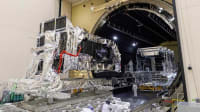
In early May, Lockheed Martin engineers and technicians used a 10-ton crane to gently lower the system module of the U.S. Air Force’s first next-generation GPS III satellite into place over its propulsion core, successfully integrating the two into one space vehicle.
GPS III space vehicle one (SV 01) is the first of an advanced GPS satellite design block for the USAF. GPS III is expected to deliver three times better accuracy, provide up to eight times improved anti-jamming capabilities, and extend spacecraft life to 15 years, 25% longer than current satellites launching today. GPS III’s new L1C civil signal also will make it the first GPS satellite interoperable with other international global navigation satellite systems.
The systems integration event brought together several major fully functional satellite components. The system module includes the navigation payload, which performs the primary positioning, navigation, and timing mission. The functional bus contains sophisticated electronics that manage all satellite operations. The propulsion core allows the satellite to maneuver for operations on orbit.
According to Mark Stewart, Vice President of Lockheed Martin’s Navigation Systems mission area, “This summer, SV 01 will begin thermal vacuum testing, where it will be subjected to simulated harsh space environments. Successful completion of this testing is critical as it will help validate our design and manufacturing processes for all follow-on GPS III satellites.”
Lockheed Martin is currently under contract to build eight GPS III satellites at its GPS III Processing Facility near Denver, a factory specifically designed to streamline satellite production.
The GPS III team is led by the Global Positioning Systems Directorate at the USAF Space and Missile Systems Center. Air Force Space Command’s 2nd Space Operations Squadron (2SOPS), based at Schriever Air Force Base, CO, manages and operates the GPS constellation for both civil and military users.
More From SAE Media Group
Aerospace & Defense Tech Briefs
Three Times More Power Density the Charm for Lockheed Martin Cooling System
Aerospace & Defense Tech Briefs
New Zealand and LeoLabs Establish the First Low-Earth Orbit Regulatory Platform
Aerospace & Defense Tech Briefs
U.K. Space Agency Partners with Industry to Advance Spaceflight Program
Aerospace & Defense Tech Briefs
Lockheed Martin Ships AEHF Satellite in Advance of ULA Rocket Launch
Aerospace INSIDER
Boeing X-37B Latest Mission Tests Quantum Inertial Sensor in Space
Aerospace & Defense Tech Briefs
QinetiQ Technology the Driver Behind ESA Space Taxi
Aerospace & Defense Tech Briefs
Lockheed Martin’s “Non-Operational” Space Fence Detects Indian Anti-Satellite Operations While Still in Test Mode
Aerospace & Defense Tech Briefs
Stratolaunch All-Composite Aircraft Achieves First Flight
Aerospace & Defense Tech Briefs
JAXA Launches HTV7 Unmanned Cargo Spacecraft on Resupply Mission to ISS
Aerospace & Defense Tech Briefs
Iridium, Aireon, SpaceX Celebrate Satellite Launch, System Deployment
Aerospace & Defense Tech Briefs
Rocket Engine Technology
Aerospace & Defense Tech Briefs
AVIO Engineers Evolve Vega Rocket Design, Enhance Avionics and Propulsion
Aerospace & Defense Tech Briefs
NASA Budget Amendment to Help Send Americans to Moon by 2024, Then Mars
Aerospace INSIDER
Boeing to Develop New Space Force Nuclear Communications Satellites
Defense INSIDER
Satellite Communications for the Army’s NGC2 Pilot

Aerospace & Defense Tech Briefs
NASA Invests in Aerospace Start-Up, University Projects on CubeSat Platform
Aerospace & Defense Tech Briefs
Lockheed Martin Rolls out Cybersecurity Standardization Model
Aerospace & Defense Tech Briefs
Orbex Debuts Innovative Smallsat Launch Vehicle
Aerospace & Defense Tech Briefs
Northrop Grumman Will Develop Next-Gen Navigation System for U.S. Air Force
Aerospace & Defense Tech Briefs
Air Force Tests Fully Autonomous UAS Control System
Aerospace & Defense Tech Briefs
New Zealand Will Become a Testbed for Airbus Unmanned Aircraft and Space Technology
Aerospace & Defense Tech Briefs
L3 Makes Its C-130 Modernization Package Available to Global Operators

Tech Briefs
Building Technology to Clean Up Space
Aerospace & Defense Tech Briefs
In-Orbit Commercial Spacecraft Undocking

Aerospace & Defense Tech Briefs
JAXA MINERVA-II1 Rovers Achieve Asteroid Landing, Autonomy, Image and Data Capture
Aerospace INSIDER
Air Force Researchers Design, Build and Fly Drone in 24 Hours
Top Stories
INSIDERManufacturing & Prototyping
 How Airbus is Using w-DED to 3D Print Larger Titanium Airplane Parts
INSIDERManned Systems
 FAA to Replace Aging Network of Ground-Based Radars
NewsTransportation
 CES 2026: Bosch is Ready to Bring AI to Your (Likely ICE-powered) Vehicle
NewsSoftware
 Accelerating Down the Road to Autonomy
EditorialDesign
 DarkSky One Wants to Make the World a Darker Place
INSIDERMaterials
 Can This Self-Healing Composite Make Airplane and Spacecraft Components Last...
Webcasts
Defense
 How Sift's Unified Observability Platform Accelerates Drone Innovation
Automotive
 E/E Architecture Redefined: Building Smarter, Safer, and Scalable...
Power
 Hydrogen Engines Are Heating Up for Heavy Duty
Electronics & Computers
 Advantages of Smart Power Distribution Unit Design for Automotive...
Unmanned Systems
 Quiet, Please: NVH Improvement Opportunities in the Early Design...
