




Xerox Eyes DSRC for Vehicle Infrastructure Support

The U.S. National Highway Traffic Safety Administration (NHTSA) hasn’t yet issued a mandate for dedicated short range communications (DSRC), but many companies are planning for the eventual adoption of vehicle-to-vehicle and vehicle-to-infrastructure communications. On the infrastructure side, Xerox is eyeing DSRC as a potential standard for many tasks such as tolling and commercial vehicle monitoring.
NHTSA is continuing to research DSRC because it can have a big impact on safety. The agency appears bullish on its potential, though no requirements have been set. Companies like Xerox feel there’s a high likelihood that the technology can be used for many additional functions.
“We’re looking at DSRC’s potential if NHTSA requires it in all cars,” said Joe Averkamp, Senior Director, Technology, Policy & Strategy, at Xerox. “It could be used as a payment device for tolling. If it’s used, it could become a national standard, which means the transponder inventory will go away.”
Xerox hopes to expand its infrastructure services in automotive, which grew substantially when it acquired Affiliated Computer Services in 2010. The company manages tolling operations and vehicle monitoring systems in several states. Xerox also manages a public-private partnership that spans 32 states trucking companies with around 500,000 drivers.
The company has partnered with the University of Michigan Mobility Transformation Center to participate in studies that are beginning with a simulated city before eventually expanding to 20,000 vehicles. Those trials will help companies figure out issues including security and privacy.
“In the safety world, vehicles need to be anonymous,” Averkamp said. “When it comes to tolling, drivers are subscribers we’ll need to manage that bifurcated identity environment.”
Many companies are examining DSRC’s potential for providing additional features and functions. That would help companies amortize the cost of adding the technology while also generating more customer interest. However, these additional features can’t detract from DSRC’s primary goal.
“The first rule is that nothing can interfere with safety communications,” Averkamp said. “Once the technology is put into the car, you might as well leverage it to give the driver a better experience, maybe by finding a parking space, which also helps reduce congestion. You can also provide in-vehicle signage, telling someone that driving time to Maryland is 20 minutes for free but paying to use the high occupancy vehicle lane costs $3 and cuts the time to 10 minutes, for example.”
While DSRC may displace some technologies, it will be just one the wireless communication protocols used in future vehicles. Bluetooth will be used inside the cabin, while cellular links like LTE will handle long-range communications and large amounts of data.
More From SAE Media Group
Automotive Engineering
As V2I Evolves, Costs, Maintenance Concerns Emerge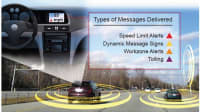
Automotive Engineering
V2X Communications Face Many Challenges Before Deployment
Automotive Engineering
Can Ads Help in Vehicle-To-Vehicle Rollout?
Automotive Engineering
SAE Government/Industry 2018: AT&T Reaffirms Mobile 5G Trials, DSRC ‘Still Alive’
Automotive Engineering
Denso Shows Readiness for V2X and Smart City
Automotive Engineering
BMW, Honda and Yamaha Form Connected Motorcycle Consortium
Off-Highway Engineering
Europe’s Blockchain-Based Smart E-Mobility Challenge Will Conclude This May in Germany

Automotive Engineering
2016 SAE Congress: Fear of the Driverless Car as 2020 Approaches
Automotive Engineering
Shanghai’s Human Horizons Unveils a 5G-V2X-Enabled Electric, Luxury SUV
Autonomous Vehicle Engineering
Prepping Cities for Vehicle Autonomy
Off-Highway Engineering
Peloton Develops a Level 4 Automated Platooning System, but Keeps the Driver in Charge
Off-Highway Engineering
MOBI Rolls out the First Blockchain-Enabled Vehicle Identity (VID) Mobility Standard
Automotive Engineering
Integrated Automotive Gateway Can Enable Connected Cars
Automotive Engineering
Parsons New Smart City Challenge Aims to Reduce Intersection Congestion
Automotive Engineering
Challenges Galore for Connected Cars

Off-Highway Engineering
WCX 2019: IAMTS Association Will Establish Standardization and Testing for Connected Vehicles
Automotive Engineering
Automotive-Qualified Chipset for V2X
Off-Highway Engineering
Connecting Off-Highway Vehicles in Remote Locations
Autonomous Vehicle Engineering
Predicting the Road to Efficiency
Off-Highway Engineering
DENSO and Toyota Form a Joint Venture for Next-Generation Vehicle Semiconductors
Aerospace & Defense Tech Briefs
Mettis Aerospace to Serve as Testbed for World’s First Wi-Fi 6-Enabled Smart Factory Technologies
Automotive Engineering
U.K. Creates New "Route 66” for Connected-Vehicle Testing
Automotive Engineering
Automotive Cybersecurity Needs Serious Work
Autonomous Vehicle Engineering
TCU Testing at the Heart of Vehicle Connectivity
Automotive Engineering
Sensor Fusion Expanding in Step with Advancing Vehicle Sophistication
Aerospace & Defense Tech Briefs
EU to Deploy UAV Traffic Management System by 2019
Off-Highway Engineering
Argus Makes Fleet Protection Cybersecurity Available to Both Automotive and Aircraft Fleets
Top Stories
INSIDERManufacturing & Prototyping
 How Airbus is Using w-DED to 3D Print Larger Titanium Airplane Parts
INSIDERManned Systems
 FAA to Replace Aging Network of Ground-Based Radars
NewsTransportation
 CES 2026: Bosch is Ready to Bring AI to Your (Likely ICE-powered) Vehicle
NewsSoftware
 Accelerating Down the Road to Autonomy
EditorialDesign
 DarkSky One Wants to Make the World a Darker Place
INSIDERMaterials
 Can This Self-Healing Composite Make Airplane and Spacecraft Components Last...
Webcasts
Defense
 How Sift's Unified Observability Platform Accelerates Drone Innovation
Automotive
 E/E Architecture Redefined: Building Smarter, Safer, and Scalable...
Power
 Hydrogen Engines Are Heating Up for Heavy Duty
Electronics & Computers
 Advantages of Smart Power Distribution Unit Design for Automotive...
Unmanned Systems
 Quiet, Please: NVH Improvement Opportunities in the Early Design...
