




Hybrid-Electric Distributed Propulsion Explored
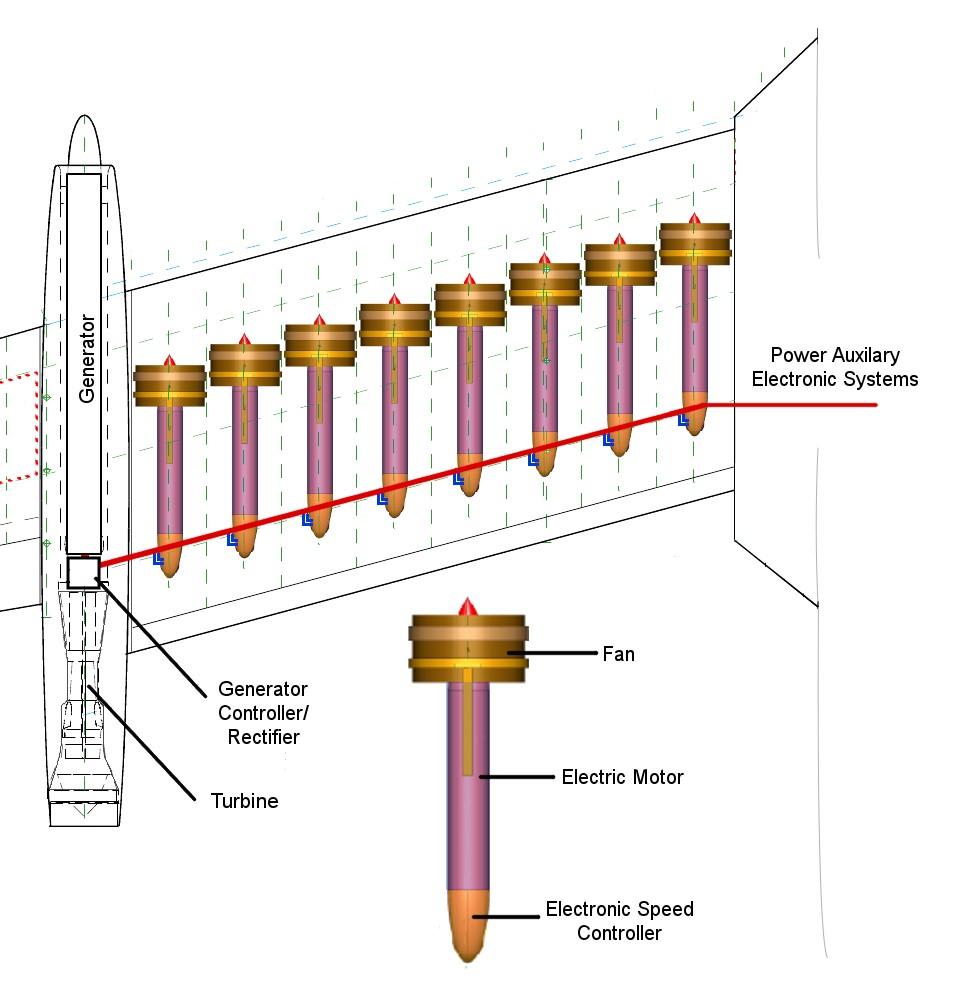
A turboelectric distributed propulsion (TeDP) system is a powertrain consisting of a turboshaft engine used solely to provide electrical power through a generator to electric motors driving multiple propulsive fans that are distributed above, below, or inside a wing.

Empirical Systems Aerospace, Inc. (ESAero) has studied the application of TeDP in several forms to a wide variety of manned and unmanned air vehicles since its inception in 2003 with several approaches to distributed propulsion. In the studies, it developed a distributed propulsion system architecture and used it to estimate vehicle performance including details on the propulsion components, battery sizing and augmentation, and system performance using in-house design tools. It also identified tools that could be developed during future work.
Its most recent project (certain aspects of which are discussed here) was done under NASA’s Environmentally Responsible Aviation Project, part of the Integrated Systems Research Program, to provide configuration alternatives to those being studied by the major airframe manufacturers and two universities.
Decoupled energy management
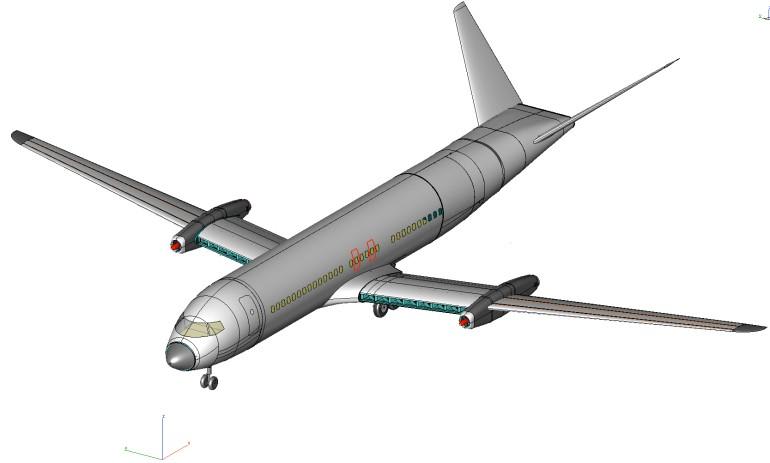
Participants in an FY11 NASA-sponsored TeDP workshop collectively agreed that TeDP might be more accurately considered decoupled energy management (DEM) as the overarching concept that enables hybrid-electric propulsion. The major benefit that DEM brings is an abundance of options pertaining to the aircraft's configuration and operation.
Decoupling the gas generator from the thrust producer allows for several unique advantages that could very well improve aircraft performance and efficiency. Turbofan engines are designed with a mechanical linkage between fan and gas generator that forces all components—fan, low- and high-pressure compressor, and turbine—to compromise on their individual peak operating points. Removing the mechanical linkage, or shaft, and replacing it with an electrical system allows components to be optimized with less concern for each other especially in regards to rotational speed.

Not only does this yield the possibility for reduced component weight and fuel burn, but other advantages can be garnered, such as:
- Use of supplemental power (batteries, super capacitors, fuel cells) for failure modes or downsizing of gas generators
- Effective bypass ratio increases without excessively large diameter fans
- Finer control over power distribution during any flight segment.
Introducing this method of DEM does bring with it high transmission losses and an overall increase in propulsion group weight. From an efficiency standpoint, propulsive efficiency can be increased. But until technology of conventional machines is improved, the increase cannot offset the weight penalty for regional missions. Savings in fuel burn must be much higher than the increase in propulsion system weight for a fixed takeoff gross weight if TeDP is to be economical.
Conventional electric component sizing
Electric components to power large commercial aircraft do not currently exist and thus it is difficult to estimate their performance and weight without a focused motor, generator, and controller design effort. With hybrid electric system research in full stride, it may require many years to establish a flight-worthy component database for use in modern conceptual and preliminary aircraft design.
In the meantime, off-the-shelf electric components must be used for scaling and performance curve extrapolation. Using this method has potential side effects since power requirements of airliner components is exceptionally larger than what current off-the-shelf components can provide.
ESAero maintains a database that now includes nearly 100 state-of-the-art machines, the most powerful of which delivers up to 885 hp and weighs roughly 7300 lb. Meanwhile, the commercial and military dual-use variants require 1500- to 2000-hp motors and 10,000- to 16,000-hp generators. Without an electric machine design effort with an emphasis on flight-ready components, extrapolating motor and generator size has a large potential for error.
Summary and conclusions
Aircraft integration, terminal-area operations, and climb and approach angles are among the other aspects of the researchers’ work, and are detailed in the technical paper on which this is article based (paper number at end).
Building off of earlier work involving cryogenically cooled, superconducting technology, more recent effort succeeded in preliminarily closing the ECO-150 and dual-use aircraft using conventional, state-of-the-art electric machines and components. While several benefits appear to show promise of improved mission performance and efficiency, concerns of integration, current state of high-performance electric machines, and the ever growing propulsion system weight of TeDP casts a dark shadow on future feasibility. As technology improves in the area of electric components so will their use and application into regional aircraft. In the meantime, it may behoove the aerospace industry to invest time in research and development tools to aid in the analysis of hybrid transport aircraft.
The article is based on SAE International technical paper 2013-01-2306 by Benjamin Schiltgen, Andrew R. Gibson, Michael Green, and Jeffrey Freeman, Empirical Systems Aerospace Inc.
More From SAE Media Group
Aerospace & Defense Tech Briefs
Hybrid-electric distributed propulsion explored
Aerospace & Defense Tech Briefs
SAE International’s Fundamentals of Electric Aircraft Takes Deep Dive on Aircraft Electrification Paradigm Shift, Innovation
Aerospace & Defense Tech Briefs
Rolls-Royce to Work with Airframe Manufacturers, Seek Partners for EVTOL Project
Aerospace & Defense Tech Briefs
MagniX and AeroTEC to Fly All-Electric ECaravan May 28
Aerospace & Defense Tech Briefs
Rolls-Royce’s Race to Develop the World’s Fastest All-Electric Aircraft
Aerospace & Defense Tech Briefs
Vertical Flight Society Applauds EVTOL Innovation, Bell Nexus UAM Concept
Aerospace & Defense Tech Briefs
Air Racing Is Going Electric
Aerospace & Defense Tech Briefs
Maintaining the Data-Rich Pratt & Whitney GTF Engine
Aerospace & Defense Tech Briefs
Curtiss-Wright Black Boxes Receive European Approval
Aerospace & Defense Tech Briefs
Vertical Aerospace Is Honeywell’s Latest Partner in the UAM Industry
Aerospace & Defense Tech Briefs
Bye Aerospace’s Sun Flyer Is Now the “EFlyer”

Aerospace & Defense Tech Briefs
Collaborative Research Project Leads to Potentially Swarming VTOL UAVs
Aerospace & Defense Tech Briefs
Electronics Take Charge
Aerospace & Defense Tech Briefs
Artificial Intelligence Could Reduce CV-22 Osprey Maintenance
Aerospace & Defense Tech Briefs
Air Force Tests Fully Autonomous UAS Control System
Aerospace & Defense Tech Briefs
In Pursuit of Networked Drone Operations
Aerospace & Defense Tech Briefs
ANSYS Will Help Airbus Develop AI-Enabled Flight Controls for the FCAS Program’s Autonomous Wingmen
Aerospace & Defense Tech Briefs
Personal Air Transport Drives Need for Advanced VTOL Technologies, Standards
Aerospace & Defense Tech Briefs
Lockheed Martin Will Merge Machine Learning with 3D Printing
Aerospace & Defense Tech Briefs
Air Mobility Innovations Take Center Stage at Aerospace Systems and Technology Conference
Aerospace & Defense Tech Briefs
Unmanned Aircraft Must Rise Above Barriers for Commercial Applications
Aerospace & Defense Tech Briefs
Bell Nexus Full-Scale Air Taxi Design Debuts, Taps Novel VTOL, Hybrid Propulsion, Energy Storage, and Avionics Technologies
Aerospace & Defense Tech Briefs
Explainable-AI Image Recognition Is the Next Step for U.S. Air Force Unmanned Aircraft
Aerospace & Defense Tech Briefs
Abaco’s FORCE2 Flight Computer Enables National and International Ground Control Station Certification
Aerospace & Defense Tech Briefs
Collins Aerospace Taps Wind River Helix Virtualization Platform to Future-Proof Avionics
Aerospace & Defense Tech Briefs
Sensuron Enables Real-Time Structural Health Monitoring Onboard NASA’s X-56 UAV
Aerospace & Defense Tech Briefs
Battery Technology Is Still the Key Barrier to Better Urban Air Mobility
Aerospace & Defense Tech Briefs
L3 Makes Its C-130 Modernization Package Available to Global Operators
Aerospace & Defense Tech Briefs
SAE International Establishes a New AI Standards Committee at Le Bourget
Top Stories
INSIDERManufacturing & Prototyping
 How Airbus is Using w-DED to 3D Print Larger Titanium Airplane Parts
INSIDERManned Systems
 FAA to Replace Aging Network of Ground-Based Radars
NewsTransportation
 CES 2026: Bosch is Ready to Bring AI to Your (Likely ICE-powered) Vehicle
NewsSoftware
 Accelerating Down the Road to Autonomy
EditorialDesign
 DarkSky One Wants to Make the World a Darker Place
INSIDERMaterials
 Can This Self-Healing Composite Make Airplane and Spacecraft Components Last...
Webcasts
Defense
 How Sift's Unified Observability Platform Accelerates Drone Innovation
Automotive
 E/E Architecture Redefined: Building Smarter, Safer, and Scalable...
Power
 Hydrogen Engines Are Heating Up for Heavy Duty
Electronics & Computers
 Advantages of Smart Power Distribution Unit Design for Automotive...
Unmanned Systems
 Quiet, Please: NVH Improvement Opportunities in the Early Design...
