




Technique Extends Next-Generation Lithium Metal Batteries
The discovery could enable lightweight, low-cost, long-lasting energy storage for electric vehicles, houses, and more.
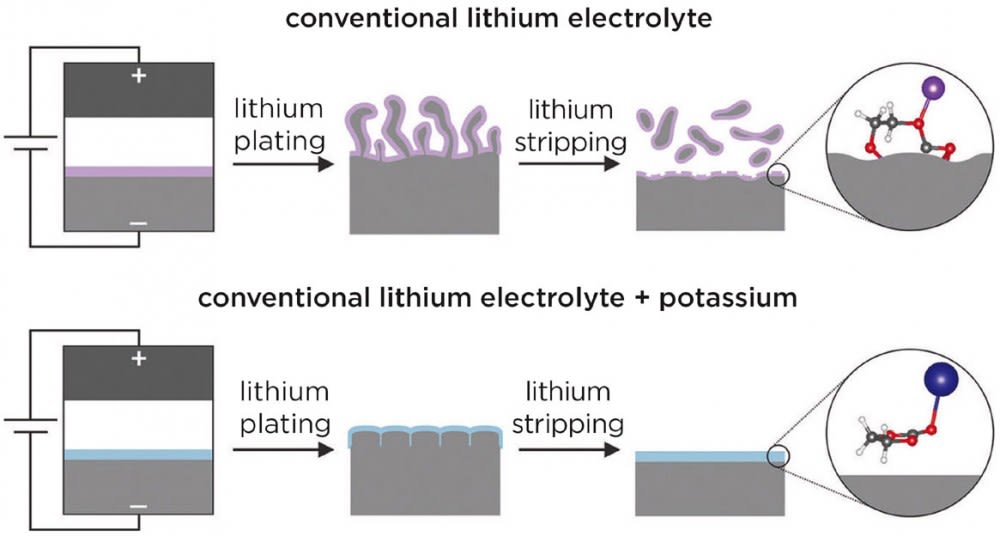
Among the limitations of electric vehicles (EVs) is the lack of a long-lasting, high-energy-density battery that reduces the need to fuel up on long-haul trips. The same is true for houses during blackouts and power grid failures— small, efficient batteries able to power a home for more than one night without electricity don’t yet exist. A major issue is that while rechargeable lithium metal anodes play a key role in how well this new wave of lithium batteries functions, during battery operation, they are highly susceptible to the growth of dendrites — microstructures that can lead to dangerous short-circuiting, catching on fire, and even exploding.
Researchers have found that alkali metal additives, such as potassium ions, can prevent lithium microstructure proliferation during battery use. They used a combination of microscopy, nuclear magnetic resonance (similar to an MRI), and computational modeling to discover that adding small amounts of potassium salt to a conventional lithium battery electrolyte produces unique chemistry at the lithium/electrolyte interface. Specifically, they found that potassium ions mitigate the formation of undesirable chemical compounds that deposit on the surface of lithium metal and prevent lithium-ion transport during battery charging and discharging, ultimately limiting microstructural growth.
The discovery that alkali metal additives suppress the growth of nonconductive compounds on the surface of lithium metal differs from traditional electrolyte manipulation approaches, which have focused on depositing conductive polymers on the metal’s surface.
Commercial electrolytes are a combination of carefully selected molecules. Using NMR and computer simulations, the researchers were able to understand how the electrolyte formulations improve lithium metal battery performance at the molecular level. The team is now testing alkali metal additives that stop the formation of deleterious surface layers in combination with more traditional additives that encourage the growth of conductive layers on lithium metal. They are also actively using NMR to directly measure the rate of lithium transport through this layer.
For more information, contact Holly Evarts at
More From SAE Media Group
Battery & Electrification Technology
Building Temperature-Resilient Batteries
Tech Briefs
Building Temperature-Resilient Batteries
Battery Technology
Semi-Liquid Metal Anode



Battery & Electrification Technology
Designing Safer, Higher-Performance Lithium Batteries

Battery & Electrification Technology
New Priming Method for Improving Battery Lifecycle

Battery & Electrification Technology
Cobalt-Free Electrodes Achieved with Nickel Ions
Battery Technology
Doubling Battery Performance with Lithium Metal
Battery Technology
Hybrid Membrane Doubles the Lifetime of Rechargeable Batteries
Battery & Electrification Technology
Cobalt-Free Batteries Could Power EVs of the Future
Battery & Electrification Technology
Enhancing the Performance of All-Solid-State Batteries

Battery Technology
Low-Cost, Fast Production of Solid-State Batteries
Battery & Electrification Technology
Anode-Free Lithium Batteries with Maximized Energy Density


Battery Technology
Nanostructured Alloy for Battery Anodes
Battery & Electrification Technology
Improving and Increasing Energy Density of Batteries
Automotive Engineering
Nissan's Innovative Solid-State Gambit
Battery & Electrification Technology
Material Derived from Trees Could Replace Liquid Electrolytes
Battery & Electrification Technology
Electrolyte Additive Improves Battery Performance
Battery Technology
Design Enables Safe Storage of Lithium Ions
Top Stories
NewsSensors/Data Acquisition
 Microvision Aquires Luminar, Plans Relationship Restoration, Multi-industry Push
INSIDERRF & Microwave Electronics
 A Next Generation Helmet System for Navy Pilots
INSIDERWeapons Systems
 New Raytheon and Lockheed Martin Agreements Expand Missile Defense Production
NewsAutomotive
 Ford Announces 48-Volt Architecture for Future Electric Truck
INSIDERAerospace
 Active Strake System Cuts Cruise Drag, Boosts Flight Efficiency
ArticlesTransportation

Webcasts
Aerospace
 Cooling a New Generation of Aerospace and Defense Embedded...
Energy
 Battery Abuse Testing: Pushing to Failure
Power
 A FREE Two-Day Event Dedicated to Connected Mobility
Automotive
 Quiet, Please: NVH Improvement Opportunities in the Early Design Cycle
Electronics & Computers
 Advantages of Smart Power Distribution Unit Design for Automotive &...
Unmanned Systems
 Sesame Solar's Nanogrid Tech Promises Major Gains in Drone Endurance