




Technique Merges Solar Cell and Liquid Battery
A highly efficient and long-lasting solar flow battery generates, stores, and redelivers renewable electricity from the Sun in one device.

A solar flow battery was developed that is made of silicon solar cells combined with advanced solar materials integrated with optimally designed chemical components. While solar flow batteries are years away from commercialization, they offer the potential to provide reliable electricity generation and storage for lighting, cellphones, or other fundamental uses for homes in remote areas. They combine the advantages of photovoltaic cells that convert sunlight into electricity with the advantages of flow batteries, which use tanks of chemicals that can react to produce electricity and be recharged by the solar cells.
Since the Sun doesn’t always shine, storage is key for practical solar electricity, especially in remote and rural regions with a lot of sunlight such as in the sunbelt regions of the US, Australia, Saudi Arabia, and Africa. Many solar home systems use lead-acid or lithium-ion batteries for electricity storage. Flow batteries could be less expensive at a larger scale and are an ideal storage choice for merging with solar cells.
The researchers turned to an increasingly popular material for photovoltaic cells: halide perovskites. The solar conversion efficiency of these special materials has dramatically increased. The materials can also increase the efficiency of traditional silicon solar cells by capturing more energy from the Sun. Yet silicon remains key for making a stable device that can withstand the chemicals in a flow battery.

The team fabricated the perovskite-silicon solar cells with an additional protection layer on the silicon surface. To predict the ideal voltage at which the flow batteries should run, the team developed a new theoretical modeling method that allowed them to select a pair of chemicals in the flow battery that would operate at the ideal voltage based on the characteristics of the solar cell, maximizing efficiency. The chemicals are organic compounds, not expensive metals as in traditional flow batteries, and are dissolved in a benign water solution of table salt rather than strong acids.
The resulting device maintained a high efficiency over hundreds of hours and hundreds of charge-discharge cycles while retaining most of its capacity. That lifespan was several times longer than earlier devices.
For more information, contact Song Jin at
More From SAE Media Group
Tech Briefs
Technique Merges Solar Cell and Liquid Battery

Battery Technology
Enhancing Hybrid Flow Battery Electrodes with Nanomaterials
Battery Technology
Using Electric Vehicle Batteries for Solar Energy Farms

Photonics Tech Briefs
Integrated Solar-Energy-Harvesting and -Storage Device
Sensor Technology
Solar PV and Lithium-Ion Battery Hybrids for the IIoT — A User's Guide
Tech Briefs
Thermochromic Photovoltaic Windows
Battery & Electrification Technology
Recyclable ‘Water Batteries’ That Won’t Catch Fire
Battery & Electrification Technology
Oxygen-Ion Battery: A Solution for Large Energy Storage Systems
Off-Highway Engineering
Sinonus Carbon-Fiber Structural Batteries Would Reduce Weight While Adding Range

Tech Briefs
Developing More Durable Solar Cells
Photonics & Imaging Technology INSIDER
Invention Merges Solar With Liquid Battery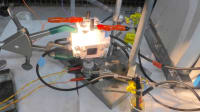

Tech Briefs
Organic Redox Flow Battery
Tech Briefs
Water-Based Battery Stores Solar and Wind Energy
Battery & Electrification Technology
New Cathode Material for Sodium-Ion Batteries
Battery & Electrification Technology
Extending the Lifetime of Organic Aqueous Flow Batteries
Tech Briefs
5 Ws of the Ocean Battery

Tech Briefs
Device Creates Electricity from Snowfall
Sensor Technology
Printed Rechargeable Batteries for the IIoT
Tech Briefs
Facility Focus: Argonne National Laboratory

Tech Briefs
Enhancing Solar Option During Power Outages
Tech Briefs
Chip Converts Wasted Heat to Usable Energy

Top Stories
INSIDERManufacturing & Prototyping
 How Airbus is Using w-DED to 3D Print Larger Titanium Airplane Parts
NewsAutomotive
 Microvision Aquires Luminar, Plans Relationship Restoration, Multi-industry Push
INSIDERAerospace
 A Next Generation Helmet System for Navy Pilots
INSIDERDesign
 New Raytheon and Lockheed Martin Agreements Expand Missile Defense Production
ArticlesAR/AI
 CES 2026: Bosch is Ready to Bring AI to Your (Likely ICE-powered) Vehicle
Road ReadyDesign

Webcasts
Semiconductors & ICs
 Advantages of Smart Power Distribution Unit Design for Automotive...
Unmanned Systems
 Quiet, Please: NVH Improvement Opportunities in the Early Design...
Electronics & Computers
 Cooling a New Generation of Aerospace and Defense Embedded...
Power
 Battery Abuse Testing: Pushing to Failure
AR/AI
 A FREE Two-Day Event Dedicated to Connected Mobility
