




Autonomous Vehicle Engineering - July 2021
Inside this issue
Overview
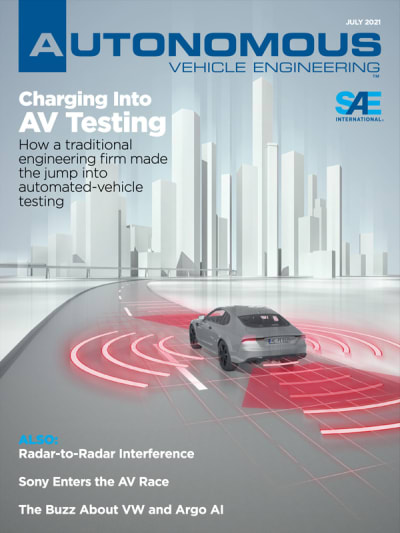
The July 2021 issue of Autonomous Vehicle Engineering presents a comprehensive overview of the evolving landscape of the automotive industry, particularly focusing on the transition from traditional combustion-engine vehicles to automated and electrified driving technologies. This issue features a variety of articles that delve into the challenges, innovations, and strategic moves being made by key players in the field.
Editorial Insights
The editorial section, led by Bill Visnic, discusses the significant consolidation occurring within the autonomous vehicle (AV) sector. It highlights the increasing financial stakes as companies seek substantial funding to sustain their operations and innovations. Notably, Waymo's recent .5 billion funding round is mentioned as a pivotal moment, indicating that only those with deep financial resources and established businesses will thrive in the competitive landscape of AV development.
The Navigator
The issue opens with a focus on C-V2X (Cellular Vehicle-to-Everything) technology, which is gaining momentum in the U.S. This technology is crucial for enhancing communication between vehicles and infrastructure, thereby improving safety and efficiency in transportation systems.
Making the Strategic Move Into AV Testing
A key feature article discusses how FEV, a traditional engineering firm known for its work in combustion-engine technology, is pivoting towards automated vehicle testing. This transition reflects a broader industry trend where established companies are adapting their expertise to meet the demands of new vehicle technologies. The article emphasizes the importance of testing and validation in ensuring the safety and reliability of automated systems.
Sony's Entry into AV Sensors and Software
Another significant article covers Sony's foray into the AV market, where the consumer electronics giant is leveraging its innovative technologies to develop advanced driver-assistance systems (ADAS) and automated driving software. Partnering with Hungary-based AImotive, Sony aims to integrate its sensor technologies into the evolving landscape of automated vehicles, showcasing the intersection of consumer electronics and automotive engineering.
Mitigating Radar-to-Radar Interference
The issue also addresses the technical challenges associated with radar technology in AVs. An article on radar-to-radar interference discusses strategies for mitigating interference, which is critical for the effective functioning of radar systems in automated driving. The balance between complexity and capability in developing effective interference mitigation strategies is highlighted as a key consideration for engineers.
Amending the Automated-Driving ‘Constitution’
A noteworthy discussion revolves around the revisions to SAE International’s J3016 standard, which classifies automated driving capabilities. The article features insights from Barbara Wendling, the committee chairperson, who explains the new distinctions and definitions that have been introduced. This standard is essential for establishing a common language and understanding within the industry, particularly as automated driving technologies continue to evolve.
The ‘Buzz’ in Driverless Shuttling
The issue also explores the collaboration between Volkswagen (VW) and Argo AI in developing driverless shuttles. The article highlights VW's retro ID. Buzz, which is equipped with a high-performing lidar system developed by Argo. This partnership exemplifies the innovative approaches being taken to enhance automated driving capabilities and the growing interest in driverless public transportation solutions.
Accelerating Truck Autonomy
Another article focuses on Embark, a company that is developing an interoperable automated-driving stack for various truck platforms, including Freightliner, International, Peterbilt, and Volvo. This initiative aims to streamline the integration of automated driving technologies in the trucking industry, which is poised for significant transformation as automation becomes more prevalent.
New Tools & Technologies
The issue concludes with a section dedicated to new tools and technologies that are shaping the future of mobility engineering. This includes advancements in testing and measurement tools that are essential for engineers working on automated vehicle systems.
Conclusion
Overall, the July 2021 issue of Autonomous Vehicle Engineering provides a rich tapestry of insights into the current state and future direction of the automotive industry. It captures the essence of a sector in transition, where traditional engineering firms are adapting to new technologies, and innovative companies are emerging to redefine mobility. The articles collectively underscore the importance of collaboration, innovation, and rigorous testing in navigating the complexities of automated vehicle development. As the industry continues to evolve, staying informed about these trends and technologies will be crucial for professionals in the field.
Articles
-
Editorial
-
The Navigator
Top Stories
INSIDERAerospace
 How Airbus is Using w-DED to 3D Print Larger Titanium Airplane Parts
NewsAutomotive
 Microvision Aquires Luminar, Plans Relationship Restoration, Multi-industry Push
INSIDERManufacturing & Prototyping
 A Next Generation Helmet System for Navy Pilots
INSIDERDefense
 New Raytheon and Lockheed Martin Agreements Expand Missile Defense Production
ArticlesAR/AI
 Accelerating Down the Road to Autonomy
Road ReadyDesign

Webcasts
Automotive
 Advantages of Smart Power Distribution Unit Design for Automotive...
Unmanned Systems
 Quiet, Please: NVH Improvement Opportunities in the Early Design...
Defense
 Cooling a New Generation of Aerospace and Defense Embedded...
Power
 Battery Abuse Testing: Pushing to Failure
Power
 A FREE Two-Day Event Dedicated to Connected Mobility
