




Radiation-Hardened ICs
Renesas Electronics Corporation
Milpitas, CA
408-432-8888
www.renesas.com
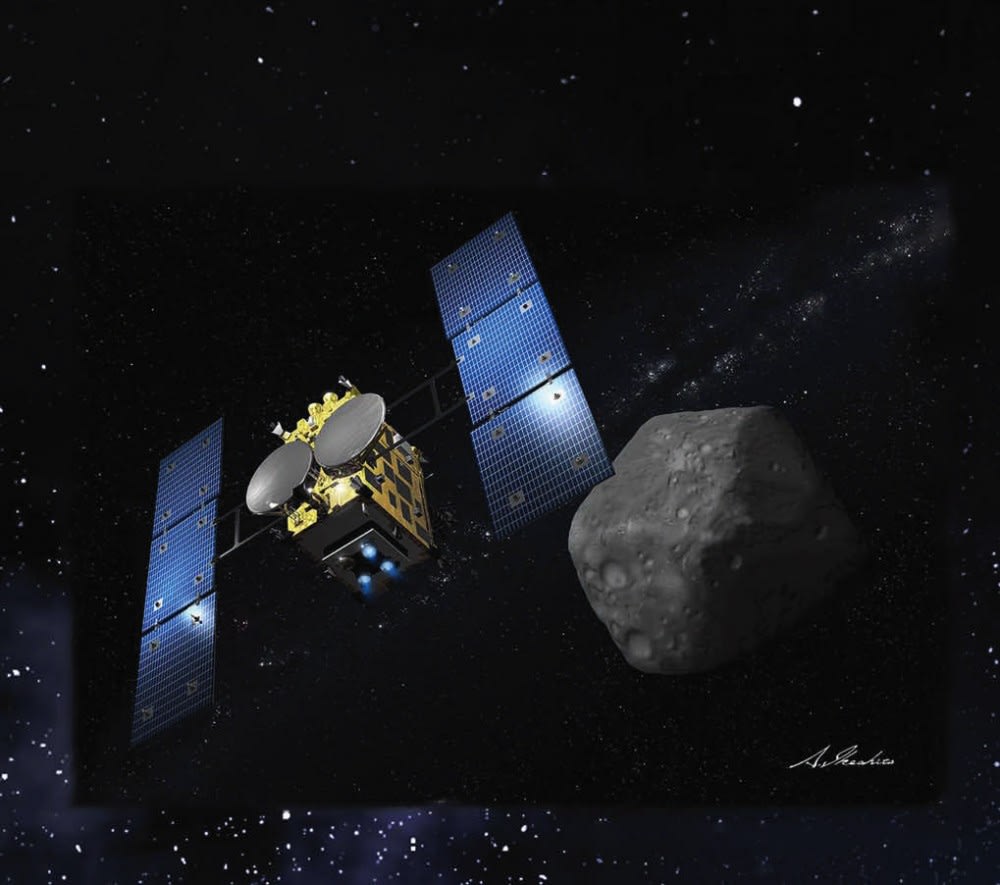
Renesas Electronics Corporation announced that its radiation-hardened (rad-hard) integrated circuits (ICs) were onboard the Hayabusa2 spacecraft that returned asteroid samples to Earth in an armored re-entry capsule on December 6, 2020. Operated by the Japan Aerospace Exploration Agency (JAXA), Hayabusa2 launched onboard the H-IIA rocket from the Tanegashima Space Center on December 3, 2014.
Arriving at the Ryugu asteroid on June 27, 2018, the Hayabusa2 asteroid samples retrieval mission was designed to explore the origins of the planets, the water of Earth’s oceans and source of life. Hayabusa2 carried multiple science payloads for remote sensing and sampling, and its four small rovers investigated the asteroid surface and analyzed the environmental and geological context of the surface and subsurface samples collected.
Renesas’ Intersil-brand rad-hard ICs were deployed throughout the Hayabusa2 spacecraft. Renesas’ Intersil brand rad-hard solutions included a linear regulator, voltage reference, PWM controller, MOSFET drivers, quad comparator, 8-channel and 16-channel multiplexers, and RS-422 receivers & drivers.
The Renesas Intersil brand has a long history in the space industry spanning more than six decades, beginning with the founding of Radiation Inc. in 1950. Since then, virtually every satellite, shuttle launch and deep-space exploration mission has included Intersil-branded products. Renesas leverages this experience to deliver efficient, thermally optimized and reliable SMD, MIL-STD-883 and MIL-PRF 38535 Class-V/Q Intersil-branded products for the defense, high-reliability (Hi-Rel), and rad-hard space markets. Renesas Intersil-brand rad-hard ICs support subsystems for mission critical applications in data communications transfer; power supplies and power conditioning; general protection circuitry; and telemetry, tracking and control (TT&C).
Deep space is a challenging environment for spaceflight and asteroid exploration systems, particularly due to the intense radiation environment encountered in nearly all mission profiles. Design, layout, certain process technologies, and manufacturing steps like burn-in and total dose testing of ICs ensures predictable performance and prevents system failure while in flight and on long duration robotic and crewed missions to other planets.
For Free Info Click Here
More From SAE Media Group
Tech Briefs
Tech Briefs Interview: NASA’s Kathy Lueders
Aerospace & Defense Tech Briefs
Radiation Tolerant “Smart Backplanes” for Spacecraft Avionics
Tech Briefs
Spacecraft to Remove Orbital Debris
Tech Briefs
Data Recorders Prepare Orion for Splashdown Test
Tech Briefs
Flexible, Spinning Heat Shield for Spacecraft

Aerospace & Defense Tech Briefs
NASA Invests in Aerospace Start-Up, University Projects on CubeSat Platform
Tech Briefs
GPS-Enhanced Onboard Navigation System (GEONS)
Tech Briefs
Cameras Capture Asteroid Debris Retrieval
Tech Briefs
RapidScat Flight Software

Tech Briefs
7 Space Sustainability Startups
Aerospace & Defense Tech Briefs
U.K. Space Agency Partners with Industry to Advance Spaceflight Program
Aerospace & Defense Tech Briefs
In-Space Upgrade Satellite System
Tech Briefs
SMART Solar Sail
Tech Briefs INSIDER
From the Earth to the Moon: How Robert Goddard Launched Present-Day Spaceflight
Tech Briefs
Rad-Hard Avionics for Moon Rover
Tech Briefs
Marshall Space Flight Center



Tech Briefs
Building Technology to Clean Up Space
Aerospace & Defense Tech Briefs
Multi-Orbit Space Relay Communications

Tech Briefs
Artemis II: The Final Countdown
Tech Briefs
Facility Focus: NASA Goddard Space Flight Center
Top Stories
INSIDERDefense
 New Raytheon and Lockheed Martin Agreements Expand Missile Defense Production
NewsAutomotive
 Ford Announces 48-Volt Architecture for Future Electric Truck
INSIDERManufacturing & Prototyping
 Active Strake System Cuts Cruise Drag, Boosts Flight Efficiency
ArticlesTransportation
 Accelerating Down the Road to Autonomy
INSIDERMaterials
 How Airbus is Using w-DED to 3D Print Larger Titanium Airplane Parts
Road ReadyTransportation

Webcasts
Electronics & Computers
 Cooling a New Generation of Aerospace and Defense Embedded...
Power
 Battery Abuse Testing: Pushing to Failure
Connectivity
 A FREE Two-Day Event Dedicated to Connected Mobility
Automotive
 Quiet, Please: NVH Improvement Opportunities in the Early Design Cycle
Transportation
 Advantages of Smart Power Distribution Unit Design for Automotive &...
Aerospace
 Sesame Solar's Nanogrid Tech Promises Major Gains in Drone Endurance