




Sustainable Aluminum-Anode Batteries
The rechargeable batteries could be a safer and more environmentally friendly alternative to lithium-ion batteries.
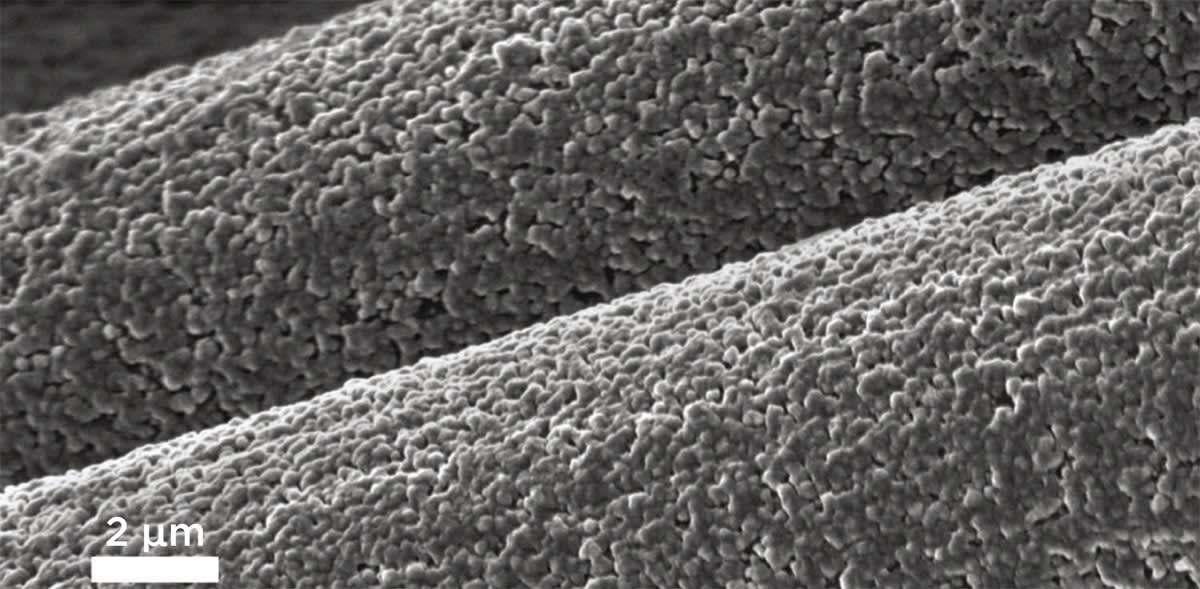
The challenges of energy storage — which require the capacity to bank an intermittent and seasonally variable supply of solar energy — have kept the technology from being economically competitive. Researchers have used low-cost materials to create rechargeable batteries that will make energy storage more affordable. These materials could also provide a safer and more environmentally friendly alternative to lithium-ion batteries that currently dominate the market but are slow to charge and have a knack for catching fire.
The group previously demonstrated the potential of zinc-anode batteries. Now, they have employed a different approach for incorporating aluminum, resulting in rechargeable batteries that offer up to 10,000 error-free cycles. Only two elements are used for the anode and the cathode — aluminum and carbon — both of which are inexpensive and environmentally friendly with very long cycle life.
Among the advantages of aluminum is that it is abundant in the Earth’s crust, it is trivalent and light, and it therefore has a high capacity to store more energy than many other metals. However, aluminum can be tricky to integrate into a battery’s electrodes. It reacts chemically with the glass fiber separator, which physically divides the anode and the cathode, causing the battery to short circuit and fail.
The researchers’ solution was to design a substrate of interwoven carbon fibers that forms an even stronger chemical bond with aluminum. When the battery is charged, the aluminum is deposited into the carbon structure via covalent bonding, i.e., the sharing of electron pairs between aluminum and carbon atoms. While electrodes in conventional rechargeable batteries are only two dimensional, this technique uses a three-dimensional — or nonplanar — architecture and creates a deeper, more consistent layering of aluminum that can be finely controlled.
The aluminum-anode batteries can be reversibly charged and discharged one or more orders of magnitude more times than other aluminum rechargeable batteries under practical conditions. The substrates provide a large thermo-dynamic driving force that promotes nucleation. Runaway — unsafe growth of the metal electrode — is prevented by forces such as surface tension that can be massive at small scales.
For more information, contact Jeff Tyson at
More From SAE Media Group
Tech Briefs
Stable, Efficient, Anode-Free Sodium Battery
Battery Technology
Hybrid Membrane Doubles the Lifetime of Rechargeable Batteries
Battery Technology
Semi-Liquid Metal Anode
Battery & Electrification Technology
Enhancing the Performance of All-Solid-State Batteries
Battery & Electrification Technology
Technique Extends Next-Generation Lithium Metal Batteries
Battery Technology
Nanostructured Alloy for Battery Anodes
Battery & Electrification Technology
A New Way to Enhance Durability of Lithium Batteries


Battery & Electrification Technology
Niobium: Magic Metal for Battery Anodes?
Battery & Electrification Technology
Iron Could Be Key to Less Expensive, Greener Lithium-Ion Batteries
Battery Technology
Mapping Performance Variations to See How Lithium-Metal Batteries Fail

Battery Technology
Design Enables Safe Storage of Lithium Ions
Tech Briefs
A New Design for Lithium-Sulfur Batteries

Battery Technology
New Approach Makes Lighter, Safer Lithium-Ion Batteries


Battery & Electrification Technology
New Priming Method for Improving Battery Lifecycle
Battery & Electrification Technology
Recyclable ‘Water Batteries’ That Won’t Catch Fire


Power Electronics INSIDER
World’s Strongest Battery Paves Way for Light, Energy-Efficient Vehicles
Battery & Electrification Technology
Anode-Free Lithium Batteries with Maximized Energy Density

Top Stories
INSIDERManufacturing & Prototyping
 How Airbus is Using w-DED to 3D Print Larger Titanium Airplane Parts
INSIDERManned Systems
 FAA to Replace Aging Network of Ground-Based Radars
NewsTransportation
 CES 2026: Bosch is Ready to Bring AI to Your (Likely ICE-powered) Vehicle
NewsSoftware
 Accelerating Down the Road to Autonomy
EditorialDesign
 DarkSky One Wants to Make the World a Darker Place
INSIDERMaterials
 Can This Self-Healing Composite Make Airplane and Spacecraft Components Last...
Webcasts
Defense
 How Sift's Unified Observability Platform Accelerates Drone Innovation
Automotive
 E/E Architecture Redefined: Building Smarter, Safer, and Scalable...
Power
 Hydrogen Engines Are Heating Up for Heavy Duty
Electronics & Computers
 Advantages of Smart Power Distribution Unit Design for Automotive...
Unmanned Systems
 Quiet, Please: NVH Improvement Opportunities in the Early Design...
