




Flexible Manufacturing Cell Increases Efficiencies, Component Readiness
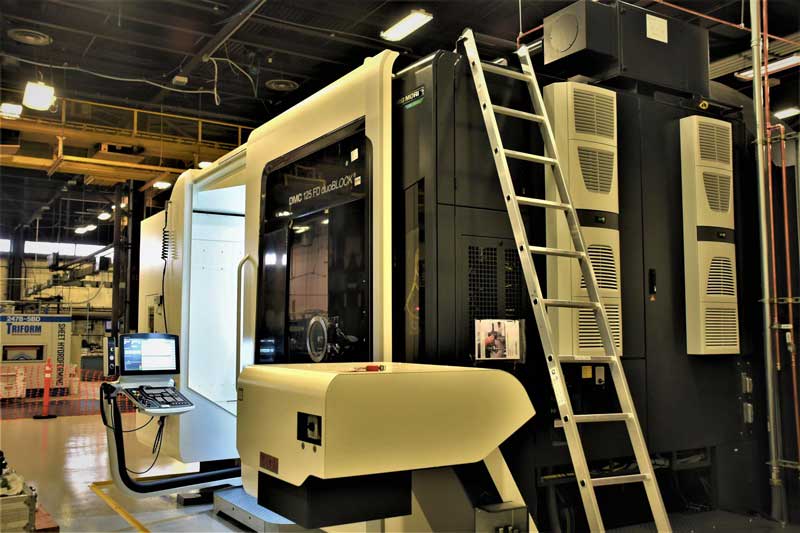
A flexible manufacturing cell (FMC) currently under development is projected to save Fleet Readiness Center Southwest (FRCSW) approximately $2.5 million annually in set-up time within the command’s manufacturing and components programs. The FMC will generate additional savings by creating more efficient rework processes, according to Gabe Draguicevich, FRCSW New Technology Division Director.
Costing almost $18 million and occupying close to 7,000 square feet of floor space, the FMC is comprised of six computer numerically controlled (CNC) five-axis machines and a pallet system which are manufactured by DMG-Mori and Fastems, respectively.
“These six machines with the pallet system replace a total of 12 machines that had less capability, and will replace a number of our Haas machines and both DeVliegs,” Draguicevich said. “With the improvement of manufacturing techniques within the machine tool industry, five-axis machines have improved the accuracy to that of the older, more traditional jig mills. The five-axis CNCs are capable of milling, turning and grinding within one machine. They use Siemens Unigraphics NX CAM Software along with Celos Suite of software that manages the CNC machines. The Fastems pallet system software delivers the parts and fixturing to each machine for processing while tracking schedule and the time remaining for project completion. All of this technology will be managed and monitored within a Research, Development, Test, and Evaluation (RDT&E) network called the Industrial Manufacturing System Lab,” he said.
Four of the CNCs are installed and can accommodate components up to 55-inches in diameter. With attached tooling, the CNC spindle height is approximately 30 inches. The other two machines are designed for larger components and along with the pallet system, should be operational by the end of August.
Draguicevich said that the CNCs are applicable to all type/model/series (TMS) of naval assets serviced by the command, and that they can be used on parts and components made of aluminum, steel, and titanium.
“The fixturing and preprogrammed parts support F/A-18 and E-2/C-2 landing gear specifically,” he said. “This is a game changer for FRCSW and we will be virtually eliminating process variance while improving turn-around time. There is nothing like this system installed anywhere in the DOD. There are huge opportunities for new workload such as the E2-D and Joint Strike Fighter (JSF) landing gear. The possibilities are endless and the opportunity to advance as a command is certain.”
In the meantime, 12 artisans including machinists, model makers, maintenance technicians and industrial engineers will be trained to run the FMC, which is slated for full operation by December.
More From SAE Media Group

Aerospace & Defense Tech Briefs
5-Axis Machining Center

Motion Design
IMTS2018 Preview
Aerospace & Defense Tech Briefs
CAD-CAM-CNC System
Aerospace Manufacturing and Machining
Machining Titanium Aero-Frames
Aerospace Manufacturing and Machining INSIDER
How the US Navy Uses Organic Manufacturing to Combat Supply Chain Constraints
Motion Design INSIDER
Unified Approach Improves the Accuracy of Five-Axis Machine Tools
Aerospace Manufacturing and Machining INSIDER
Micro Machining Center
Aerospace & Defense Tech Briefs
Aerospace Production: Overcoming Challenges in Composite Machining

Motion Design
Cross-Training Made Possible by Common Control Platform
Aerospace & Defense Tech Briefs
Overcoming Machining Productivity Challenges with Aerospace Components
Tech Briefs
Executive Roundtable: 3D Printing
Aerospace Manufacturing and Machining
Changing How the Aerospace Industry Makes Parts
Tech Briefs
How Much Do You Know About CNC Machining?
Medical Manufacturing and Fabrication
Grinding Machines Offer Unique Capabilities for the Medical Industry

Motion Design
Smart Manufacturing Control
Aerospace Manufacturing and Machining
CAM Software Technology Keeps Pace with Aerospace Manufacturing Challenges
Aerospace & Defense Tech Briefs
Making the Rounds in Aerospace: Tooling and Techniques for Discs, Blisks and Rings
Medical Design Briefs
How Automation Can Improve Tubing Manufacturing
Medical Design Briefs
Boston Scientific Improves Cardiac Monitoring Component with Heimatec Speeders
Medical Design Briefs
Methods Machine Tools Opens Precision Center
Medical Manufacturing and Fabrication
CAM Programming vs. Manual Programming in Medical Machining
Medical Design Briefs
Product Focus: Laser Machining/Marking
Aerospace Manufacturing and Machining
New Products & Services
Medical Manufacturing and Machining
Running Titanium and Other Exotic Metals at Faster Speeds
Top Stories
NewsSensors/Data Acquisition
 Microvision Aquires Luminar, Plans Relationship Restoration, Multi-industry Push
INSIDERRF & Microwave Electronics
 A Next Generation Helmet System for Navy Pilots
INSIDERWeapons Systems
 New Raytheon and Lockheed Martin Agreements Expand Missile Defense Production
NewsAutomotive
 Ford Announces 48-Volt Architecture for Future Electric Truck
INSIDERAerospace
 Active Strake System Cuts Cruise Drag, Boosts Flight Efficiency
ArticlesTransportation

Webcasts
Aerospace
 Cooling a New Generation of Aerospace and Defense Embedded...
Energy
 Battery Abuse Testing: Pushing to Failure
Power
 A FREE Two-Day Event Dedicated to Connected Mobility
Automotive
 Quiet, Please: NVH Improvement Opportunities in the Early Design Cycle
Electronics & Computers
 Advantages of Smart Power Distribution Unit Design for Automotive &...
Unmanned Systems
 Sesame Solar's Nanogrid Tech Promises Major Gains in Drone Endurance