




Nanostructured Alloy for Battery Anodes
The alloy could influence the way energy storage devices are designed and manufactured.
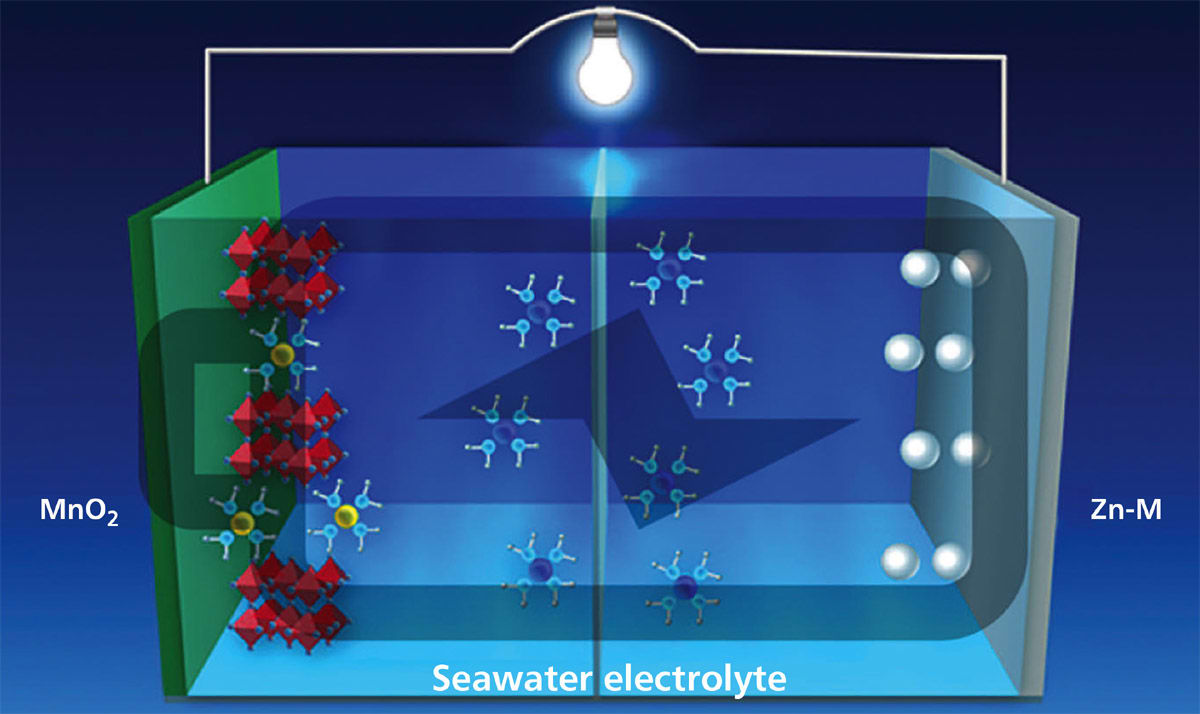
Researchers have developed a battery anode based on a new nanostructured alloy. The zinc- and manganese-based alloy further opens the door to replacing solvents commonly used in battery electrolytes with something much safer, less expensive, and abundant: seawater.
A battery stores power in the form of chemical energy and through reactions, converts it to the electrical energy needed to power vehicles, cellphones, laptops, and many other devices and machines. A battery consists of two terminals — the anode and cathode, typically made of different materials — as well as a separator and electrolyte, a chemical medium that allows for the flow of electrical charge.
In a lithium-ion battery, as its name suggests, a charge is carried via lithium ions as they move through the electrolyte from the anode to the cathode during discharge and back again during recharging. Electrolytes in lithium-ion batteries are commonly dissolved in organic solvents that are flammable and often decompose at high operation voltages. Thus, there are safety concerns with lithium dendrite growth at the electrode-electrolyte interface that can cause a short between the electrodes. Dendrites resemble tiny trees growing inside a lithium-ion battery and can pierce the separator like thistles growing through cracks in a driveway. The result is unwanted and sometimes unsafe chemical reactions.
Aqueous batteries are a promising alternative for safe and scalable energy storage. Aqueous electrolytes are cost-competitive, environmentally benign, capable of fast charging and high power densities, and highly tolerant of mishandling. Their large-scale use, however, has been hindered by a limited output voltage and low energy density (batteries with a higher energy density can store larger amounts of energy, while batteries with a higher power density can release large amounts of energy more quickly).
The new anode is made up of a three-dimensional “zinc-M alloy” as the battery anode (M refers to manganese and other metals). The use of the alloy with its special nanostructure not only suppresses dendrite formation by controlling the surface reaction thermodynamics and the reaction kinetics, but also demonstrates super-high stability over thousands of cycles under harsh electrochemical conditions. The use of zinc can transfer twice as many charges as lithium, thus improving the energy density of the battery.
The team used X-ray absorption spectroscopy and imaging to track the atomic and chemical changes of the anode in different operation stages, which confirmed how the 3D alloy was functioning in the battery. The concept could influence the design of high-performance alloy anodes for aqueous and non-aqueous batteries.
For more information, contact Zhenxing Feng at
More From SAE Media Group

Battery Technology
Semi-Liquid Metal Anode

Battery Technology
Spreadable Way to Stabilize Solid-State Batteries
Battery Technology
Flexible, Thin-Film Battery
Battery Technology
Hybrid Membrane Doubles the Lifetime of Rechargeable Batteries

Battery & Electrification Technology
Designing Sodium-Ion Batteries with Extended Longevity
Battery & Electrification Technology
Enhancing the Performance of All-Solid-State Batteries
Battery Technology
Electrolyte Design Improves Anode Capacity in Lithium-Ion Batteries
Battery Technology
Design Enables Safe Storage of Lithium Ions
Battery & Electrification Technology
Material Derived from Trees Could Replace Liquid Electrolytes
Battery & Electrification Technology
Electrolyte Additive Improves Battery Performance



Battery Technology
Low-Cost, Fast Production of Solid-State Batteries
Tech Briefs
A New Design for Lithium-Sulfur Batteries
Battery Technology
Tough, Solid Electrolyte Battery Component

Battery & Electrification Technology
Sodium Battery Is Capable of Rapid Charging in Just a Few Seconds
Battery Technology
Doubling Battery Performance with Lithium Metal
Medical Design Briefs
Flexible High-Energy Textile Lithium Battery Designed for Wearables
Battery & Electrification Technology
Building Temperature-Resilient Batteries
Tech Briefs
Stable, Efficient, Anode-Free Sodium Battery
Battery Technology
Mapping Performance Variations to See How Lithium-Metal Batteries Fail
Battery Technology
Method Tracks What Happens Inside Batteries
Tech Briefs
Building Temperature-Resilient Batteries
Battery & Electrification Technology
Niobium: Magic Metal for Battery Anodes?

Top Stories
NewsSensors/Data Acquisition
 Microvision Aquires Luminar, Plans Relationship Restoration, Multi-industry Push
INSIDERRF & Microwave Electronics
 A Next Generation Helmet System for Navy Pilots
INSIDERWeapons Systems
 New Raytheon and Lockheed Martin Agreements Expand Missile Defense Production
NewsAutomotive
 Ford Announces 48-Volt Architecture for Future Electric Truck
INSIDERAerospace
 Active Strake System Cuts Cruise Drag, Boosts Flight Efficiency
ArticlesTransportation

Webcasts
Aerospace
 Cooling a New Generation of Aerospace and Defense Embedded...
Energy
 Battery Abuse Testing: Pushing to Failure
Power
 A FREE Two-Day Event Dedicated to Connected Mobility
Automotive
 Quiet, Please: NVH Improvement Opportunities in the Early Design Cycle
Electronics & Computers
 Advantages of Smart Power Distribution Unit Design for Automotive &...
Unmanned Systems
 Sesame Solar's Nanogrid Tech Promises Major Gains in Drone Endurance