




Flexible, Thin-Film Battery
Stretchable materials enable a battery to be bent, stretched, and twisted.
Computers or smartphones with folding screens, smart clothing, and wearable sensors all require an energy source, which is usually a lithium-ion battery. These are typically heavy and rigid, making them fundamentally unsuitable for applications in flexible electronics or textiles.
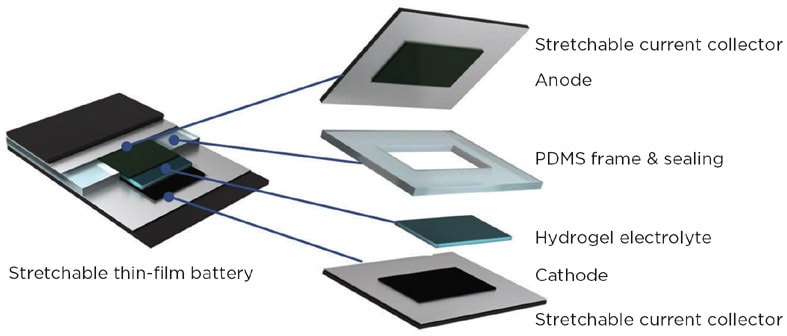
A prototype for a flexible, thin-film battery was developed that can be bent, stretched, and even twisted without interrupting the supply of power. The battery is built in layers like a sandwich and uses flexible components to keep the whole battery bendable and stretchable.
The two current collectors for the anode and the cathode consist of bendable polymer composite that contains electrically conductive carbon and that also serves as the outer shell. On the interior surface of the composite, a thin layer of micron-sized silver flakes was applied. Due to the way the flakes overlap like roof tiles, they don’t lose contact with one another when the elastomer is stretched. This guarantees the conductivity of the current collector even if it is subjected to extensive stretching. In the event that the silver flakes do lose contact with each other, the electrical current can still flow through the carbon-containing composite.

With the help of a mask, anode and cathode powder was sprayed onto a precisely defined area of the silver layer. The cathode is composed of lithium manganese oxide and the anode is a vanadium oxide. In the final step, the two current collectors were stacked with the applied electrodes on top of each other, separated by a barrier layer similar to a picture frame, while the gap in the frame was filled with the electrolyte gel.
The gel is more environmentally friendly than commercial electrolytes. It contains water with a high concentration of a lithium salt, which not only facilitates the flow of lithium ions between cathode and anode while the battery is charging or discharging, but also keeps the water from electrochemical decomposition.
For more information, contact Peter Rüegg at
More From SAE Media Group
Battery Technology
Nanostructured Alloy for Battery Anodes
Battery Technology
Semi-Liquid Metal Anode
Medical Design Briefs
Flexible High-Energy Textile Lithium Battery Designed for Wearables
Battery Technology
Low-Cost, Fast Production of Solid-State Batteries

Battery Technology
Electrolyte Design Improves Anode Capacity in Lithium-Ion Batteries
Battery & Electrification Technology
Developing Safer Batteries with Solid-State Polymer Electrolytes


Battery Technology
Tough, Solid Electrolyte Battery Component
Battery Technology
Hybrid Membrane Doubles the Lifetime of Rechargeable Batteries
Battery & Electrification Technology
Folded or Cut, This Lithium-Sulfur Battery Keeps Going

Tech Briefs
Flexible, Water-Based Lithium-Ion Batteries
Tech Briefs
Using Silicon for Battery Anodes
Tech Briefs
5 Ws of the SAFIRE Lithium-Ion Battery
Battery & Electrification Technology
Niobium: Magic Metal for Battery Anodes?
Battery Technology
Method Tracks What Happens Inside Batteries
Battery & Electrification Technology
Iron Could Be Key to Less Expensive, Greener Lithium-Ion Batteries

Battery Technology
New Materials Move Li-Ion Batteries Toward the Solid-State Endgame
Battery Technology
Design Enables Safe Storage of Lithium Ions
Battery & Electrification Technology
Material Derived from Trees Could Replace Liquid Electrolytes


Battery Technology
Cobalt-Free Cathodes for Lithium-Ion Batteries
Tech Briefs
Dry Manufacturing Process for EV Batteries
Tech Briefs
Stable, Efficient, Anode-Free Sodium Battery
Automotive Engineering
Niobium: Magic Metal for Battery Anodes?
Top Stories
INSIDERDefense
 New Raytheon and Lockheed Martin Agreements Expand Missile Defense Production
NewsAutomotive
 Ford Announces 48-Volt Architecture for Future Electric Truck
INSIDERManufacturing & Prototyping
 Active Strake System Cuts Cruise Drag, Boosts Flight Efficiency
ArticlesTransportation
 Accelerating Down the Road to Autonomy
INSIDERMaterials
 How Airbus is Using w-DED to 3D Print Larger Titanium Airplane Parts
Road ReadyTransportation

Webcasts
Electronics & Computers
 Cooling a New Generation of Aerospace and Defense Embedded...
Power
 Battery Abuse Testing: Pushing to Failure
Connectivity
 A FREE Two-Day Event Dedicated to Connected Mobility
Automotive
 Quiet, Please: NVH Improvement Opportunities in the Early Design Cycle
Transportation
 Advantages of Smart Power Distribution Unit Design for Automotive &...
Aerospace
 Sesame Solar's Nanogrid Tech Promises Major Gains in Drone Endurance