




Use of Mass-Flux Measurement and Vapor-Phase Tomography to Quantify Vadose-Zone Source Strength and Distribution
Use of advanced technologies could improve evaluation of vadose zone source impacts on groundwater and vapor intrusion, leading to improved remediation decisions.
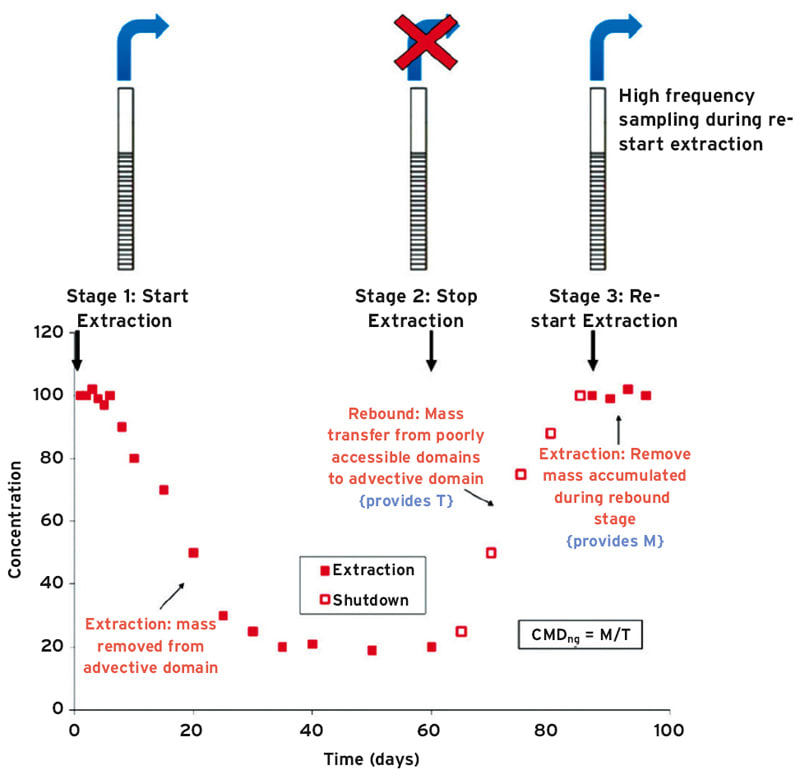
The goal of this project was to demonstrate that the multistage vapor-phase contaminant mass discharge (MS-CMD) test and vapor-phase tomography (VPT) can effectively characterize persistent volatile organic compound (VOC) sources in the vadose zone and measure their associated mass discharge. It is anticipated that these technologies will improve evaluation of vadose zone source impacts on groundwater and vapor intrusion.
The U.S. Department of Defense (DoD) has focused significant effort on characterizing and treating chlorinated solvent sources in groundwater. There are two primary concerns associated with sites that contain vadose zone volatile organic compound (VOC) sources. First, discharge of contaminant vapor from the vadose zone source may impact the underlying groundwater. Second, contaminant vapor from the vadose zone source may migrate to the land surface and transfer into buildings, thereby causing vapor intrusion. The DoD manages thousands of sites wherein the vadose zone is contaminated by chlorinated solvents and other VOCs.
Currently, the decision to require remediation of a vadose zone source is typically based on assessing the potential impact of the vadose zone source on groundwater or vapor intrusion. Concomitantly, setting appropriate vadose zone remediation goals once a remedy selection is made, as well as evaluating attainment of these remediation goals, requires evaluating these persistent sources in terms of their impact on groundwater remediation goals or vapor intrusion concerns.
These issues are of particular relevance for soil vapor extraction (SVE), which is the presumptive remedy for vadose zone systems contaminated by chlorinated solvents. Standard practices guidance manuals developed by the EPA (2001) and the USACE (2002) outline procedures for assessing transition/closure of SVE systems using several types of analyses, including evaluating the impact of vadose zone source contamination on groundwater.
Characterizing the impact of vadose zone contaminant sources on ground-water or vapor intrusion requires determination of the contaminant mass discharge from the source. The standard approach for characterizing vapor-phase mass discharge is to measure static contaminant concentrations for vapor (soil gas survey [SGS]) or sediment (borehole cores) samples, and to use them as input for a mathematical screening model to estimate contaminant mass discharge. This approach has become widely used to evaluate the impact of vadose zone sources on ground-water or vapor intrusion. However, this approach can be subject to considerable uncertainty in the estimates obtained, depending upon the robustness of the input data as well as the simplifications employed in the development and application of the screening model.
Second, some portion of contaminant mass in the vadose zone is usually associated with regions that are poorly accessible (e.g., low permeability zones). Characterizing mass-discharge associated with these regions may often be problematic with the SGS method.
Third, the typical implementation approach for the SGS or sediment coring methods are not able to readily characterize the temporal variability of mass-transfer processes. The potential limitations associated with typical screening models for VOC transport are well documented. As a result of these and other issues, the current standard approach for characterizing vapor-phase contaminant mass discharge can be influenced by a large degree of uncertainty.
This research was conducted to demonstrate two vadose zone characterization technologies that can provide more accurate measures of vapor-phase contaminant mass discharge, characterize mass-transfer conditions, and provide a higher resolution characterization of the source distribution. These novel technologies will support improved assessment of vadose zone source impacts on groundwater and vapor intrusion. They will also support improved optimization of SVE systems, as well as
This work was done by Dr. Mark Brusseau of the University of Arizona for the Environmental Security Technology Certification Program. For more information, download the Technical Support Package (free white paper) below. ESTCP-0002
This Brief includes a Technical Support Package (TSP).
Use of Mass-Flux Measurement and Vapor-Phase Tomography to Quantify Vadose-Zone Source Strength and Distribution
(reference ESTCP-0002) is currently available for download from the TSP library.
Don't have an account?
More From SAE Media Group
Aerospace & Defense Tech Briefs
Pulsed Exposure Toxicity Testing: Method Development and Initial Evaluation for Stormwater Compliance
Tech Briefs
Wastewater Treatment and Remediation
Tech Briefs
Measuring Moon Dust to Fight Air Pollution
Tech Briefs
Using Silicone Wristbands to Measure Air Quality

Aerospace & Defense Tech Briefs
Monitoring a Nearshore Beneficial Use Site: Application of a Benthic Sled and Video Annotation
Tech Briefs
Products of Tomorrow
Test & Measurement/Sensors INSIDER
Smart Buoy Measures Water Pollutants

Tech Briefs
Smarter Parachutes Tested for Mars Landings
Aerospace & Defense Tech Briefs
Inter-Laboratory Combat Helmet Blunt Impact Test Method Comparison
Tech Briefs
Inside the Life of an Environmental Engineer
Tech Briefs
Smart Sponge for Environmental Remediation



Tech Briefs
Device Measures Toxic Lead in Minutes

Tech Briefs
Gathering Data to Preserve Kelp Forests
NASA Spinoff
Getting Water out of Snow with NASA Technology
Electronics & Sensors INSIDER
Novel Technology Enhances Measurement Reliability of Methane Gas Emissions from Rice Paddy Fields

Tech Briefs
5Ws of the Green Submarine

Aerospace & Defense Tech Briefs
Multi-Agent RF Propagation Simulator
Tech Briefs
3 Environmentally Friendly Technologies
Automotive Engineering
Inside the Quiet, Never-Ending Battle over Automotive Refrigerants
Overview
The document titled "Use of Mass-Flux Measurement and Vapor-Phase Tomography to Quantify Vadose-Zone Source Strength and Distribution" presents a comprehensive study conducted by Dr. Mark Brusseau from the University of Arizona, focusing on innovative methodologies for assessing contaminant sources in the vadose zone. This research was part of the Environmental Security Technology Certification Program and spanned from April 2011 to December 2015.
The vadose zone, the area of soil above the groundwater table, plays a critical role in environmental contamination and remediation efforts. Understanding the strength and distribution of contaminant sources within this zone is essential for effective environmental management and remediation strategies. The report outlines the objectives of the demonstration, which include developing and validating techniques to quantify mass flux and source strength of contaminants in the vadose zone.
Key methodologies discussed in the report include Multi-Stage Vapor-Phase Contaminant Mass Discharge (MS-CMD) and vapor-phase tomography. MS-CMD is a novel approach that allows for the measurement of contaminant mass flux over time, providing insights into the dynamics of contaminant release and transport. Vapor-phase tomography, on the other hand, offers a three-dimensional visualization of contaminant distribution, enhancing the understanding of spatial variability and source strength.
The report emphasizes the importance of regulatory drivers that necessitate accurate assessments of contaminant sources, particularly in the context of environmental protection and public health. It discusses the implications of the findings for remediation practices, highlighting how improved measurement techniques can lead to more effective and targeted remediation strategies.
In addition to the technical aspects, the report includes an executive summary, introduction, and detailed sections on technology description and test design. It aims to provide a thorough understanding of the methodologies employed and their relevance to current environmental challenges.
Overall, this document serves as a significant contribution to the field of environmental science, offering valuable insights into the quantification of vadose-zone contaminants and the development of advanced measurement techniques. The findings have the potential to inform future research and practical applications in environmental remediation and management.
Top Stories
INSIDERDefense
 New Raytheon and Lockheed Martin Agreements Expand Missile Defense Production
NewsAutomotive
 Ford Announces 48-Volt Architecture for Future Electric Truck
INSIDERManufacturing & Prototyping
 Active Strake System Cuts Cruise Drag, Boosts Flight Efficiency
ArticlesTransportation
 Accelerating Down the Road to Autonomy
INSIDERMaterials
 How Airbus is Using w-DED to 3D Print Larger Titanium Airplane Parts
Road ReadyTransportation

Webcasts
Electronics & Computers
 Cooling a New Generation of Aerospace and Defense Embedded...
Power
 Battery Abuse Testing: Pushing to Failure
Connectivity
 A FREE Two-Day Event Dedicated to Connected Mobility
Automotive
 Quiet, Please: NVH Improvement Opportunities in the Early Design Cycle
Transportation
 Advantages of Smart Power Distribution Unit Design for Automotive &...
Aerospace
 Sesame Solar's Nanogrid Tech Promises Major Gains in Drone Endurance