




Aerospace & Defense Technology - February 2019
Inside this issue
Overview
The February 2019 issue of Aerospace & Defense Technology presents a comprehensive overview of the latest advancements and innovations in the aerospace and defense sectors. This edition features a variety of articles that highlight key technologies, industry trends, and solutions aimed at enhancing operational efficiency and effectiveness in military and commercial applications.
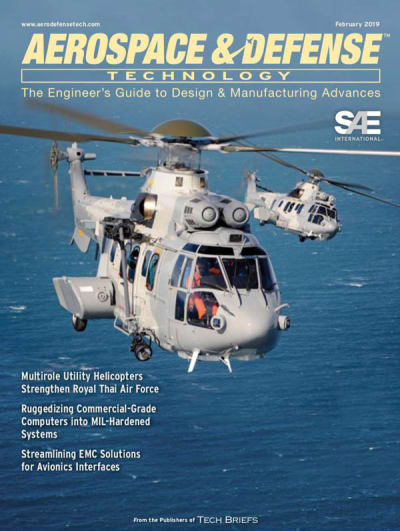
One of the standout features of this issue is the focus on multirole utility helicopters, particularly their role in strengthening the capabilities of the Royal Thai Air Force. The article discusses how these versatile aircraft are being utilized for various missions, including search and rescue, medical evacuation, and logistical support. The emphasis is on the adaptability of these helicopters to meet diverse operational requirements, showcasing their importance in modern military operations.
Another significant topic covered is the ruggedization of commercial-grade computers into MIL-hardened systems. As military operations increasingly rely on advanced computing technologies, the need for systems that can withstand harsh environments becomes critical. The article delves into the processes and technologies involved in transforming standard commercial computers into robust systems capable of operating in extreme conditions, ensuring reliability and performance in the field.
The issue also addresses the challenges of electromagnetic compatibility (EMC) in avionics interfaces. With the growing complexity of electronic systems in aircraft, ensuring that these systems can operate without interference is paramount. The article explores innovative solutions for streamlining EMC processes, including the use of advanced simulation tools. It highlights how these tools can help engineers predict and mitigate potential interference issues, ultimately leading to safer and more reliable avionics systems.
In addition to these features, the magazine includes insights into the latest trends in defense technology, such as the integration of artificial intelligence (AI) and machine learning into military systems. These technologies are being leveraged to enhance decision-making processes, improve situational awareness, and automate various tasks, thereby increasing operational efficiency.
The issue also provides a glimpse into the future of aerospace technology, with discussions on emerging concepts such as urban air mobility and the development of electric vertical takeoff and landing (eVTOL) aircraft. These innovations are poised to revolutionize transportation in urban environments, offering new solutions for congestion and mobility challenges.
Furthermore, the magazine highlights the importance of collaboration between industry and government agencies in driving innovation. It emphasizes the role of partnerships in advancing research and development efforts, ensuring that the latest technologies are effectively integrated into military and civilian applications.
Throughout the issue, readers will find profiles of key industry leaders and organizations that are making significant contributions to the aerospace and defense sectors. These profiles provide valuable insights into the vision and strategies of companies that are at the forefront of technological advancements.
The magazine also features a section dedicated to upcoming events and conferences in the aerospace and defense industries, providing readers with opportunities to engage with experts, learn about the latest developments, and network with peers.
In summary, the February 2019 issue of Aerospace & Defense Technology serves as a vital resource for professionals in the aerospace and defense sectors. It offers a wealth of information on current trends, technological advancements, and industry challenges, making it an essential read for anyone involved in these dynamic fields. The articles not only inform but also inspire innovation and collaboration, paving the way for future advancements in aerospace and defense technologies.
Features
-
Application Briefs
38 Aircraft Parachute Recovery Systems
38 Multirole Utility Helicopters
-
Articles
4 Ruggedizing Commercial-Grade Computers into MIL-Hardened Systems
10 An Introduction to PCM Heat Sinks
20 Streamlining EMC Solutions for Avionics Interfaces
24 Hardware Design of a High Dynamic Range Radio Frequency (RF) Harmonic Measurement System
Tech Briefs
-
Electronics & Computers
Novel Characterization Methods for Anisotropic and Mixed-Conduction Materials
31 Circuit Models for Robust, Adaptive Neural Control
32 Evaluation of Aeronautical Design Standard – 33 Using a UH-60A Black Hawk
34 Synthetic Aperture Radar for Helicopter Landing in Degraded Visual Environments
37 Pulsed Microwave Plasma Instrumentation for Investigation of Plasma-Tuned Multiphase Combustion
Products
-
42 New Products
Top Stories
NewsRF & Microwave Electronics
 Microvision Aquires Luminar, Plans Relationship Restoration, Multi-industry Push
INSIDERAerospace
 A Next Generation Helmet System for Navy Pilots
INSIDERDesign
 New Raytheon and Lockheed Martin Agreements Expand Missile Defense Production
INSIDERMaterials
 How Airbus is Using w-DED to 3D Print Larger Titanium Airplane Parts
NewsPower
 Ford Announces 48-Volt Architecture for Future Electric Truck
ArticlesAR/AI

Webcasts
Electronics & Computers
 Cooling a New Generation of Aerospace and Defense Embedded...
Automotive
 Battery Abuse Testing: Pushing to Failure
Power
 A FREE Two-Day Event Dedicated to Connected Mobility
Unmanned Systems
 Quiet, Please: NVH Improvement Opportunities in the Early Design Cycle
Automotive
 Advantages of Smart Power Distribution Unit Design for Automotive &...
Energy
 Sesame Solar's Nanogrid Tech Promises Major Gains in Drone Endurance