




Novel Characterization Methods for Anisotropic and Mixed-Conduction Materials
Seven new characterization methods have been developed for the specialized materials used in state-of-the-art electronic and optoelectronic devices.
State-of-the-art electronic and optoelectronic devices require electronic materials with specialized properties that cannot be characterized with standard methods, or that must be characterized with extra precision. As a result of this research, the following new materials characterization methods have been developed:
- Carrier density gradient analysis method: Semiconductor uniformity is essential for all semiconductor applications, including optoelectronic light emitters & sensors, IC's, and logic devices. This method extends the van der Pauw method of electrical characterization so that one can measure small variations in the doping density of semiconductor samples typical to semiconductor devices.
- Fourier-domain mobility spectral analysis: This method allows for electrons and holes of differing mobilities to be separated out from magnetotransport data. The experimental system of interest was lightly n-type quantum wells of Hgl-xCdxTe, which revealed ambipolar conduction of both electrons and holes.
- Heterodyne 4-point method for electrical characterization of time varying conductivities: A new method was developed to improve the sensitivity of Hall measurements by orders of magnitude. This heterodyne Hall effect technique uses ac signal multiplication to measure a pure Hall resistance Rxy (B) in arbitrarily shaped samples.
- Anisotropic conductor characterization: With five contacts, it was demonstrated in a black phosphorus nanolayer that three independent four-point resistance measurements can determine the three independent components of an inplane anisotropic resistivity tensor. Also, a detailed method for measuring in-plane and cross-plane conductivities of a superlattice has been formally described.
- Heavy-tail transient analysis: Disordered systems exhibit a range of time-scales and manifest slow switching transients, or “heavy-tail” relaxations, which limit performance. An equation was derived that fits all classes of heavy-tail functions and was experimentally applied in both the low- and high-disorder limits in 2D transistors of black phosphorus.
- Disorder scaling in non-ohmic conductivity of 2D materials: In 2D conductors, the gated conductivity is typically non-linear, with changes in the surface adsorbed gases leading to changes in both the doping level and the mobility. We demonstrate that all of the characterization curves at different adsorbate concentrations, dopings, and disorder can all be collapsed onto a single universal curve that is characteristic of that particular material.
- Percolation model for electrical and thermal conductivity in disordered media: Disordered porous media are described in a modified percolation model that is adapted for polymer composites under uniaxial pressure. Percolation is also shown to describe thermal conductivity in metal-organic frameworks fabricated by combustion synthesis.
This work was done by Matthew Grayson of Northwestern University for the Air Force Research Laboratory. AFRL-0270
This Brief includes a Technical Support Package (TSP).
Novel Characterization Methods for Anisotropic and Mixed Conduction Materials
(reference AFRL-0270) is currently available for download from the TSP library.
Don't have an account?
More From SAE Media Group
Tech Briefs
Turning Diamond into Metal
Tech Briefs
Superlattice for Sustainable Quantum Electronics

Aerospace & Defense Tech Briefs
Low Power Optical Phase Array Using Graphene on Silicon Photonics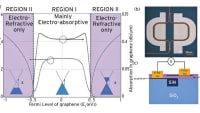
Tech Briefs
Organic Material for Printed Electronics
Tech Briefs
Smart Molecules Act as Computer Transistors
Aerospace & Defense Tech Briefs
Future Advances in Electronic Materials and Processes - Flexible Hybrid Electronics
Tech Briefs
Hybrid Material is an Efficient Photodetector

Tech Briefs
Nanosheets of Borophane are Stronger Than Steel
Electronics & Sensors INSIDER
Researchers Create First Functional Semiconductor Made from Graphene
Tech Briefs
Advances in Spintronic Devices
Tech Briefs
Coating Protects Fragile Quantum Electronics
Photonics & Imaging Technology
Measuring Surface Roughness with an Atomic Force Microscope


Tech Briefs
Stable Polymeric Ink with High Conductivity
Tech Briefs
Combined Optical Transmitter and Receiver
Tech Briefs
Products of Tomorrow
Tech Briefs
Molecular Highway for Electrons in OLEDs
Electronics & Sensors INSIDER
Scientists Create Superconducting Semiconductor Material
Aerospace & Defense Tech Briefs
Fabrication and Electrical Characterization of Correlated Oxide Field Effect Switching Devices for High Speed Electronics
Tech Briefs
Rolled 2D Heterostructures

Photonics & Imaging Technology
Photonic Integrated Circuit Testing: Accelerating R&D From Lab to Fab
Tech Briefs
Polymer-Based Electrical Insulation for Circuits
Tech Briefs
Electronics Withstand Extreme Heat

Overview
The document titled "Novel Characterization Methods for Anisotropic and Mixed-Conduction Materials" is a final performance report authored by Matthew A. Grayson from Northwestern University, covering research conducted from June 15, 2015, to June 14, 2018. The work was supported by the U.S. Air Force Office of Scientific Research and aimed to develop advanced characterization methods for electronic materials with specialized properties that cannot be adequately assessed using standard techniques.
The report highlights the importance of semiconductor uniformity in applications such as optoelectronic devices, integrated circuits, and logic devices. To address this, several innovative characterization methods were developed:
-
Carrier Density Gradient Analysis Method: This method extends the van der Pauw technique to measure small variations in doping density in semiconductor samples, crucial for ensuring uniformity.
-
Fourier-Domain Mobility Spectral Analysis: This technique allows for the separation of electrons and holes with differing mobilities from magnetotransport data, particularly in lightly n-type quantum wells of Hg1-xCdxTe, revealing ambipolar conduction.
-
Heterodyne 4-Point Method: A new approach to improve the sensitivity of Hall measurements significantly, using AC signal multiplication to measure pure Hall resistance in arbitrarily shaped samples.
-
Anisotropic Conductor Characterization: This method employs five contacts to determine the independent components of an in-plane anisotropic resistivity tensor, as demonstrated in black phosphorus nanolayers.
-
Heavy-Tail Transient Analysis: This analysis addresses slow switching transients in disordered systems, deriving an equation that fits various heavy-tail functions, applied experimentally in 2D transistors of black phosphorus.
-
Disorder Scaling in Non-Ohmic Conductivity: This method investigates the non-linear gated conductivity in 2D materials, which is essential for understanding their electrical behavior.
-
Percolation Model for Electrical and Thermal Conductivity: This model is used to analyze conductivity in disordered media, providing insights into the performance limitations of materials.
The report also notes the successful graduation of five PhD students and one MS student, along with collaborations with international partners and industry. The research resulted in three patents and eight refereed publications, including two in prestigious journals. Overall, the document emphasizes the significance of these new characterization methods in advancing the understanding and application of anisotropic and mixed-conduction materials in modern technology.
Top Stories
INSIDERMaterials
 How Airbus is Using w-DED to 3D Print Larger Titanium Airplane Parts
NewsSensors/Data Acquisition
 Microvision Aquires Luminar, Plans Relationship Restoration, Multi-industry Push
INSIDERDesign
 A Next Generation Helmet System for Navy Pilots
NewsManned Systems
 Accelerating Down the Road to Autonomy
INSIDERWeapons Systems
 New Raytheon and Lockheed Martin Agreements Expand Missile Defense Production
ArticlesDesign
 CES 2026: Bosch is Ready to Bring AI to Your (Likely ICE-powered) Vehicle
Webcasts
Transportation
 Advantages of Smart Power Distribution Unit Design for Automotive...
Automotive
 Quiet, Please: NVH Improvement Opportunities in the Early Design...
Electronics & Computers
 Cooling a New Generation of Aerospace and Defense Embedded...
Power
 Battery Abuse Testing: Pushing to Failure
AR/AI
 A FREE Two-Day Event Dedicated to Connected Mobility
