




Technology Impact Forecasting for Multi-Functional Composites
Multi-functional composites offer a possible solution to the conflicting design goals of making new aircraft lighter, stronger, faster, and more environmentally sustainable.

To survive within today's stringent economic environment, aircraft design, particularly military aircraft design, has been experiencing a paradigm shift from an emphasis on design for optimum performance to design for system effectiveness. As a consequence, designers and manufacturers are increasingly considering the addition of new technologies to aircraft design to reduce their cost, increase their operating capacities, and optimize new capabilities.
For next generation aircraft design, there are many innovative technologies to be developed that are financially constrained. However, infusion of a new technology (or technologies) are leading to another challenge: how does this new technology affect the aircraft system both in capability and economically?
This is especially difficult because this new technology may not be completely defined until product implementation and service exposure occur. But in today's tight economic and limited resources environment, it is not possible to allow the designers to try out every technology on the aircraft system as this will result in low efficiency, time consumption, and cost ineffectiveness. This issue is leading to another question: how to select an appropriate technology for the aircraft system before committing to the expense and risk of its full development?
Obviously, it is essential to understand the benefits and/or penalties of a new technology to the system response before it is selected in order to reduce the research risk and budget. Therefore, designers need a forecasting environment which is able to rapidly assess the technical feasibility and economic viability for a given system before the technology is selected.
In addition, the life cycle phases of an aircraft design include conceptual, preliminary, detailed design, production, service and retirement, as shown in the accompanying figure. In the conceptual phase of the aircraft design, the design freedom is fully open for designers, yet only limited information is available for the new aircraft design. However, as design decisions are made, the design freedom rapidly decreases, while cost commitments increase. Therefore, the key to success is “making educated decisions (increased knowledge) early on and maintaining the ability to carry along a family of alternatives (design freedom)”.
In response, a new methodology process known as Technology Impact Forecasting (TIF) has emerged, which is able to rapidly assesses the technical feasibility and economic viability of a new technology for a given system before this technology has been selected, thereby giving direction to further resource allocation. This technique was developed about ten years ago and has mainly been applied to aircraft systems. TIF is a probabilistic method that not only emphasizes modelling and assessing the impact of technology infusion on a given baseline system, but also seeks to bring more knowledge about the system at an earlier stage of the design process. Although a solid background in initial TIF methods has been developed to mid Technology Readiness Levels (TRL), it has never been applied to extremely low TRL technologies. Therefore, one of the goals of this research will be to assess whether the TIF process can be applied to low TRL technologies, or even to a notional technology, and still provide useful guidance for decision-makers, or whether the process needs to be substantially modified in order to be useful.
This work was done by Danielle Soban of Queen's University Belfast for the Air Force Research Laboratory. AFRL-0280
This Brief includes a Technical Support Package (TSP).
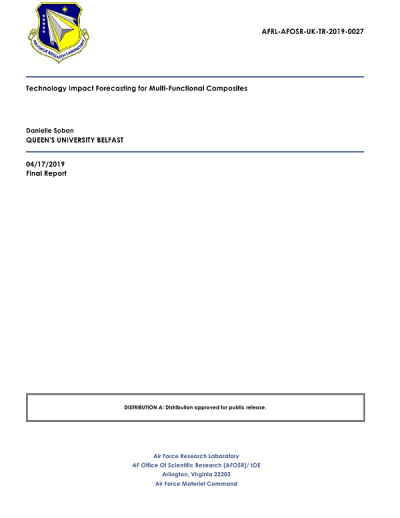
Technology Impact Forecasting for Multi-Functional Composites
(reference AFRL-0280) is currently available for download from the TSP library.
Don't have an account?
More From SAE Media Group
Aerospace & Defense Tech Briefs
Lockheed Martin and Arconic Collaborate on 3D Printing and Advanced Aerospace Materials
Aerospace & Defense Tech Briefs
Deep Reinforcement Learning Achieves Multifunctional Morphing Airfoil Control
Aerospace & Defense Tech Briefs
Cold Spray Technology
Aerospace & Defense Tech Briefs
Using Thermoplastics in Aerospace Applications
Tech Briefs
Compact, Lightweight, CMC-Based Acoustic Liner
Aerospace & Defense Tech Briefs
Centre for Modelling & Simulation to Develop Digital Twins for GKN Aerospace Additive, Composite, and Industry 4.0 Technologies
Aerospace & Defense Tech Briefs
Autonomous Collaborative Platform
Aerospace & Defense Tech Briefs
Advances in Adhesive Joining of Structural Components Focus of New Book from SAE International

Aerospace & Defense Tech Briefs
Robotic Paint Removal System
Aerospace & Defense Tech Briefs
3D Printing Aerodynamic Improvements
Aerospace & Defense Tech Briefs
Composite Repair Engineering Case Studies for U.S. Army Aerostructures
Aerospace & Defense Tech Briefs
SAE International Extends Call for Abstracts, Seeks Submissions for AeroTech Conference
Aerospace & Defense Tech Briefs
Industry Invited to Participate in AeroTech Aerospace and Defense Technical Program
Aerospace & Defense Tech Briefs
Developing Thermoplastic Composites for Use in Commercial Aircraft
Aerospace & Defense Tech Briefs
Fiber-Reinforced Thermoplastic Composites
Aerospace & Defense Tech Briefs
Assessment of Noncommercial Icing Prediction Capabilities for Army Applications
Aerospace & Defense Tech Briefs
Next Generation Airborne Navigation System
Tech Briefs
Thin Heat Shield for Superfast Aircraft
Tech Briefs
Sensor Film for Aerospace

Aerospace & Defense Tech Briefs
Flight Testing Microvanes and Riblets
Aerospace & Defense Tech Briefs
Mobile Counter Unmanned Aircraft System
Aerospace & Defense Tech Briefs
3D-Printed NACA Inlet
Aerospace & Defense Tech Briefs
High-Speed Data Cables for Fighter Aircraft
Aerospace & Defense Tech Briefs
Nomination Period Now Open for SAE International Aerospace Engineering Awards
Aerospace & Defense Tech Briefs
F/A-18 Infrared Search and Rescue System
Tech Briefs
Air Force Research Laboratory
Tech Briefs
The Problem of Obsolete Avionics
Overview
The document titled "Technology Impact Forecasting for Multi-Functional Composites" by Danielle Soban, produced by Queen's University Belfast, addresses the evolving demands in aircraft design, which require new materials to be lighter, stronger, faster, and more environmentally friendly while also reducing operating costs. The report emphasizes the potential of multi-functional composites as a solution to these conflicting design goals.
The research highlights several bespoke capabilities that multi-functional composites can offer, including self-healing properties, damage detection, enhanced lightning strike protection, morphing wing shapes, and ice detection and prevention. These capabilities are particularly relevant as the aerospace industry seeks to innovate and improve performance in response to stringent regulatory and market pressures.
A significant challenge identified in the report is the extraction of meaningful data from technologies that are still in their early stages of development (low Technology Readiness Level, or TRL). The report discusses the need for effective methods to statistically extrapolate data from small experimental datasets, which is crucial for making informed decisions in engineering design. The field of Technology Impact Forecasting (TIF) is still in its infancy, particularly within engineering disciplines like aerospace, and the report outlines the gaps in current methodologies.
Key areas of focus include the mathematical representation of the combined impacts of various multi-functional technologies and the merging of probability distributions for different technologies while maintaining their individual characteristics. The report also discusses the importance of knowledge extraction from technology experts to enhance the understanding and application of these emerging technologies.
The document is structured to provide a comprehensive overview of TIF methods, the application of these methods to self-healing materials, and the modeling environment used for analysis. It includes sections on baseline aircraft models, model assumptions, variables and responses, and results from various modeling scenarios, including self-healing and wing models.
In conclusion, the report underscores the importance of developing a robust framework for assessing the system-level impact of low TRL technologies, which can facilitate superior engineering design and guide resource allocation in aerospace innovation. The findings aim to contribute to the advancement of multi-functional composites and their integration into future aircraft designs.
Top Stories
INSIDERManufacturing & Prototyping
 How Airbus is Using w-DED to 3D Print Larger Titanium Airplane Parts
INSIDERManned Systems
 FAA to Replace Aging Network of Ground-Based Radars
NewsTransportation
 CES 2026: Bosch is Ready to Bring AI to Your (Likely ICE-powered) Vehicle
NewsSoftware
 Accelerating Down the Road to Autonomy
EditorialDesign
 DarkSky One Wants to Make the World a Darker Place
INSIDERMaterials
 Can This Self-Healing Composite Make Airplane and Spacecraft Components Last...
Webcasts
Defense
 How Sift's Unified Observability Platform Accelerates Drone Innovation
Automotive
 E/E Architecture Redefined: Building Smarter, Safer, and Scalable...
Power
 Hydrogen Engines Are Heating Up for Heavy Duty
Electronics & Computers
 Advantages of Smart Power Distribution Unit Design for Automotive...
Unmanned Systems
 Quiet, Please: NVH Improvement Opportunities in the Early Design...
