




SnowMicroPenetrometer Applications for Winter Vehicle Mobility
Characterizing the mechanical properties of snow and their impact on vehicle performance could improve vehicle winter mobility modeling.
The U.S. Engineer Research and Development Center (ERDC) Military Engineering Program on Remote Assessment of Infrastructure for Ensured Maneuver (RAFTER) Boreal Aspects of Ensured Maneuver (BAEM) identifies the need for modeling over-snow vehicle performance, as many factors related to vehicle setup and land surface condition contribute to vehicle efficiency. Accurately estimating snow macromechanical characteristics—such as elastic modulus, stiffness, and strength—is critical for understanding how effectively a vehicle will travel over snow-covered terrain.
Vehicle instrumentation data (inertial measurement units and vehicle telemetry) and observations of the snowpack (both satellite and ground-based) are necessary to improve the modeled estimates of winter vehicle performance. Currently, performance index is driven by snow depth and bulk snow density alone.
The snow characterization research effort deploys a capability jointly developed by the ERDC Cold Regions Research and Engineering Laboratory (CRREL) and the Swiss Federal Institute for Snow and Avalanche Research (SLF) two decades ago—the SnowMicroPenetrometer (SMP). This research used an SMP with a force sensor range of 0–500 N to measure hard, vehicle-compacted snow and processed or groomed snow roads. Median values of the high-resolution snow structural profiles from the SMP are linearly related to Rammsonde (ram), shear strength test vane, and Light Weight Deflectometer (LWD) by correlating values over the depth range of each independent in situ measurement. Statistically significant correlation shows the value of the SMP as a tool for future mobility studies in different snow types. By also understanding results that lack significant correlations, we gain insight for improving the SMP hardware, the penetration theory used, and the micro-to-macro scaling laws.
Winter vehicle mobility studies by CRREL have evaluated vehicle setup and snow condition; however, the SMP has not previously been applied to a mobility study. This work is the first winter vehicle mobility study to examine the usefulness of the SMP for research on military vehicle efficiency.
Characterizing the snow mechanical properties and their impact on vehicle mobility is challenging and requires varied field instruments and specialists with a wide range of expertise. Four instruments were used to characterize snow for the BAEM project—the SMP, ram, shear vane, and LWD—and assesses required load-cell ranges of the SMP for its application to hard, vehicle-compacted snow. The microphysical parameters estimated from SMP measurements were correlated to those from a suite of instruments designed or tested to measure snow mechanical properties. The results of this study aim to bridge micro-to-macro snow physics with the ultimate intent to infer snow structure from satellite imagery for use as initial and boundary conditions for vehicle mobility models.
This work was done by Tate G. Meehan, Hans-Peter Marshall, Elias J. Deeb, and Sally A. Shoop for the Army Engineer Research and Development Center. ERDC-0008
This Brief includes a Technical Support Package (TSP).
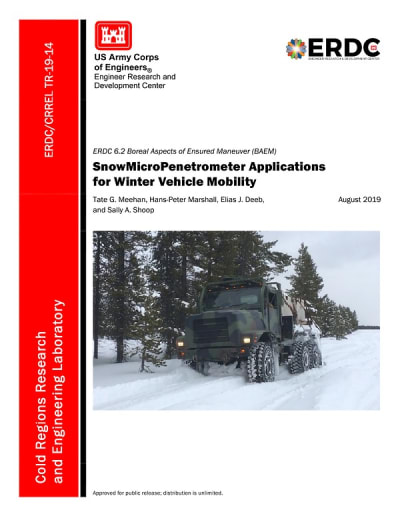
SnowMicroPenetrometer Applications for Winter Vehicle Mobility
(reference ERDC-0008) is currently available for download from the TSP library.
Don't have an account?
More From SAE Media Group
Aerospace & Defense Tech Briefs
Ensure Aerospace Composite Quality with Force Measurement, Material Testing
Aerospace & Defense Tech Briefs
Testing Military Vehicle Steering Systems
Aerospace & Defense Tech Briefs
SAE International Extends Call for Abstracts, Seeks Submissions for AeroTech Conference
Battery Technology
An Immersive Solution for Thermally Safer EV Batteries

Battery Technology
Venting for EV Battery Packs
Tech Briefs
Facility Focus: Army Test and Evaluation Command
Automotive Engineering
Surviving Nature’s Worst: Why IP Ratings Matter for Bevel Boxes in Harsh Environment
Motion Design INSIDER
NIST is Calibrating Gear Artifacts

Tech Briefs
Facility Focus: Georgia Tech Research Institute
Aerospace Manufacturing and Machining
Does Your Coating Thickness Meet Spec?
Sensor Technology
New Products
Aerospace & Defense Tech Briefs
Industry Invited to Participate in AeroTech Aerospace and Defense Technical Program
NASA Spinoff
Shuttle Tire Sensors Warn Drivers of Flat Tires


Tech Briefs
Compact, Lightweight, CMC-Based Acoustic Liner

Photonics & Imaging Technology
Optical Distance Measurement at Record-High Speed
Power Electronics INSIDER
Precise Diagnosis of Electric Vehicle Batteries Using Small Currents
Tech Briefs
Facility Focus: National Science Foundation
Tech Briefs
Soft Mate Lifting Device
Motion Design
Built-In Vibration Control to Soundproof Spaces

Overview
The document titled "SnowMicroPenetrometer Applications for Winter Vehicle Mobility" (ERDC/CRREL TR-19-14) presents research conducted by the U.S. Army Engineer Research and Development Center (ERDC) focused on enhancing vehicle mobility over snow-covered terrain. The overarching objective of the study is to improve vehicle mobility modeling by incorporating advanced snow physics, which is crucial for military operations in cold environments.
The introduction outlines the necessity for accurate modeling of over-snow vehicle performance, emphasizing that various factors, including vehicle setup and land surface conditions, significantly influence vehicle efficiency. A key aspect of this research is the accurate estimation of snow macromechanical characteristics—such as elastic modulus, stiffness, and strength—which are essential for understanding how effectively vehicles can traverse snow.
The report details the methodology employed in the research, including field campaigns and data acquisition techniques. It describes the use of the SnowMicroPenetrometer (SMP), a specialized instrument designed to measure snow properties, alongside other tools like the Rammsonde penetrometer, shear vane, and Light Weight Deflectometer. These instruments facilitate the collection of data on snow microstructural and micromechanical properties, which are critical for analyzing vehicle performance.
Data analysis is a significant component of the report, with sections dedicated to automated signal processing, corrections for instrument drift, and the inversion of SMP data to derive microstructural parameters. The document also discusses the theoretical underpinnings of the analysis and the application of linear correlation to assess instrument observations.
Results and discussions in the report highlight the findings from the various instruments used, providing insights into how different snow characteristics affect vehicle mobility. The conclusions drawn from the research emphasize the importance of integrating detailed snow physics into vehicle mobility models to enhance operational effectiveness in winter conditions.
Overall, this technical report serves as a comprehensive resource for understanding the complexities of vehicle mobility in snowy environments and the methodologies used to improve predictive modeling. It underscores the critical role of accurate snow characterization in ensuring the success of military operations in cold regions.
Top Stories
INSIDERManufacturing & Prototyping
 How Airbus is Using w-DED to 3D Print Larger Titanium Airplane Parts
NewsAutomotive
 Microvision Aquires Luminar, Plans Relationship Restoration, Multi-industry Push
INSIDERAerospace
 A Next Generation Helmet System for Navy Pilots
INSIDERDesign
 New Raytheon and Lockheed Martin Agreements Expand Missile Defense Production
ArticlesAR/AI
 CES 2026: Bosch is Ready to Bring AI to Your (Likely ICE-powered) Vehicle
Road ReadyDesign

Webcasts
Semiconductors & ICs
 Advantages of Smart Power Distribution Unit Design for Automotive...
Unmanned Systems
 Quiet, Please: NVH Improvement Opportunities in the Early Design...
Electronics & Computers
 Cooling a New Generation of Aerospace and Defense Embedded...
Power
 Battery Abuse Testing: Pushing to Failure
AR/AI
 A FREE Two-Day Event Dedicated to Connected Mobility
