




AFRL Achieves “Shocking” Materials Technology Breakthrough
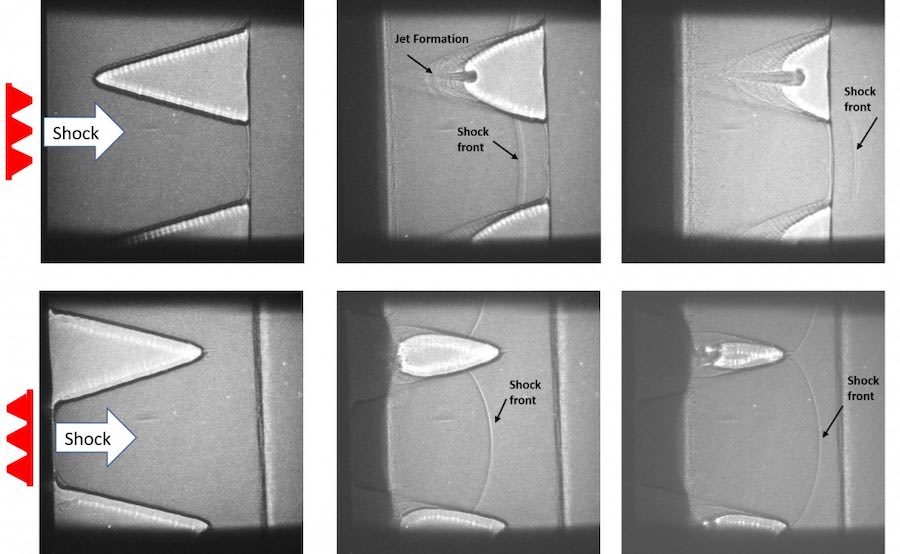
The Air Force Research Laboratory, along with research partners at Los Alamos National Laboratory, are working to change the shape of materials technology with a breakthrough development that could open up a new range of possibilities for the military and beyond. The collaborative team has developed a 3-D printed polymer-based foam structure that responds to the force of a shock wave to act as a one-way switch, a long sought-after goal in shock research.
According to AFRL Senior Materials Research Engineer Dr. Jonathan Spowart, this novel material configuration, although in the early stages of development, has the potential to be scaled up in order to be used in different ways for a variety of applications, including for the protection of structures.
Spowart describes the material as a foam-like structure that contains a series of specifically-engineered tiny holes that determine the overall behavioral characteristics. Over a period of months, AFRL experts used computer modeling to run trials to determine the most effective hole geometries to achieve the desired material response. When they would arrive at a promising configuration, Spowart says the team would print a small test article, a flat plate not much bigger than a pencil eraser. With the help of Los Alamos National Laboratory, working on-site at the Dynamic Compression Sector user facility at Argonne National Laboratory, they would then conduct tests and image the specimen using X-rays to determine performance.
From there, the AFRL team would review results and fine-tune the material configuration to further refine the product through additional modeling and testing. Spowart described the end product as containing a series of hollow cones. When these cones encounter a shock wave, they collapse inward, forming jet protrusions that project from the opposite side. These jets localize the shock wave energy, which is the origin of the material’s unique directional behavior.
Spowart said the team plans to publish their findings and work toward transitioning the technology for further maturation and integration into existing systems, where he believes this technology has tremendous potential.
More From SAE Media Group


Aerospace INSIDER
Air Force Explores Use of Thermoplastic Fin for F-16
Aerospace & Defense Tech Briefs
Portable 3D Printing Factory


Tech Briefs
Pacific Northwest National Laboratory
Aerospace & Defense Tech Briefs
Metal-Plated, High-Temperature Plastics

Automotive Engineering
Accelerating Materials Development with Quantum Computing
Tech Briefs
Automated Tow/Tape Placement System

Tech Briefs
How Much Do You Know About Materials?

Defense INSIDER
New 3D-Printed Antenna Designs Reduce Cost, Weight and Size
Tech Briefs
Pearl-Like Coating Enhances Lightweight Armor
Aerospace Manufacturing and Machining INSIDER
Thermoplastic Drive Shaft System Developed for Aerospace Applications
Aerospace & Defense Tech Briefs
Rolls-Royce and Superdielectrics Explore Supercapacitor Technology
Aerospace & Defense Tech Briefs
Cold Spray Technology
Aerospace Manufacturing and Machining INSIDER
Researchers Push Limits in High-Temp, Polymer Additive Manufacturing
Aerospace Manufacturing and Machining
Optimizing Plasma Treatments to RESOLVE Challenging Adhesion Issues


Aerospace & Defense Tech Briefs
Ruggedized Bioprinter

Tech Briefs
Color-Changing Dyes Visualize Stress in Plastics

Tech Briefs
Extrans Permeation Measurement System

Tech Briefs
AM2 Coating for Better Aircraft Landing Surfaces
Top Stories
INSIDERManufacturing & Prototyping
 How Airbus is Using w-DED to 3D Print Larger Titanium Airplane Parts
INSIDERManned Systems
 FAA to Replace Aging Network of Ground-Based Radars
NewsTransportation
 CES 2026: Bosch is Ready to Bring AI to Your (Likely ICE-powered) Vehicle
NewsSoftware
 Accelerating Down the Road to Autonomy
EditorialDesign
 DarkSky One Wants to Make the World a Darker Place
INSIDERMaterials
 Can This Self-Healing Composite Make Airplane and Spacecraft Components Last...
Webcasts
Defense
 How Sift's Unified Observability Platform Accelerates Drone Innovation
Automotive
 E/E Architecture Redefined: Building Smarter, Safer, and Scalable...
Power
 Hydrogen Engines Are Heating Up for Heavy Duty
Electronics & Computers
 Advantages of Smart Power Distribution Unit Design for Automotive...
Unmanned Systems
 Quiet, Please: NVH Improvement Opportunities in the Early Design...
