




Sound Attenuation of Neoprene Wetsuit Hoods as a Function of Dive Depth and Acoustic Frequency: Hyperbaric Chamber Trials
Data gathered during testing will help develop strategies to protect Navy divers from loud underwater sounds.
The U.S. Navy is interested in strategies that divers could employ to protect them from loud underwater sounds. Sonar transmissions and other forms of underwater sound, such as that produced by noisy underwater tools, are an occupational hazard for U.S. Navy divers.
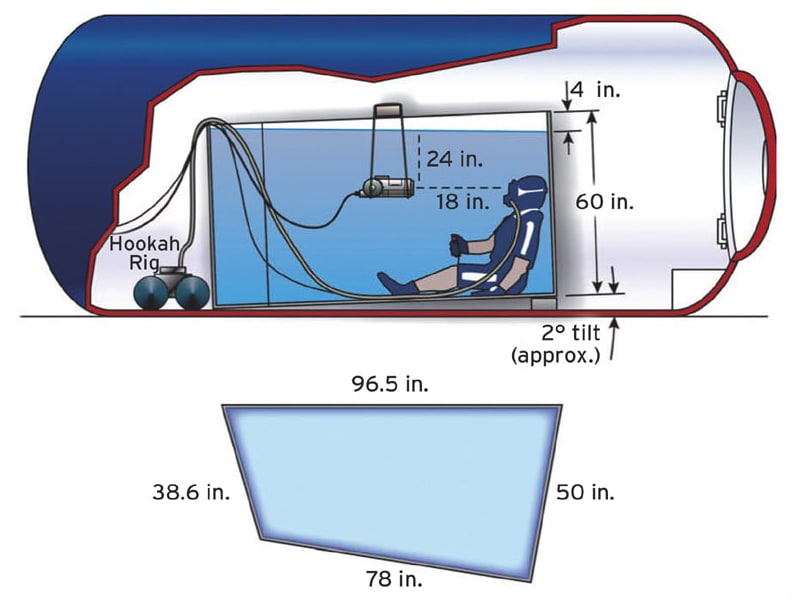
At the time this research was conducted, the U.S. Navy guidance for diver exposure to underwater sound accounted for the diver wearing a wetsuit hood but did not account for any changes in the hood’s sound attenuation properties with dive depth. Characterizing how the hood’s attenuation properties change with depth and frequency is critical to creating appropriate guidance for diver’s exposure to underwater sound.
Underwater hearing thresholds were collected from 13 U.S. Navy trained divers while bare-headed and while wearing a 7 mm neoprene wetsuit hood. Testing frequencies and depths ranged from 100 Hz to 12,000 Hz and from near surface to 132 feet of sea water (fsw), respectively. All dives were conducted in a small immersion tank in NSMRL’s hyperbaric chamber.
Wetsuit hood attenuation was calculated from the difference between hooded and unhooded hearing thresholds. The attenuation of underwater sound provided by a 7 mm neoprene wetsuit hood at the threshold of hearing was measured as being from 0 dB to approximately 34 dB. The amount of attenuation is dependent on at least two factors: frequency of the sound and ambient pressure (simulating depth). In general, the lower frequency sounds are attenuated less and the higher frequency sounds are attenuated more when a neoprene wetsuit hood is worn. The greatest attenuation (~20-34 dB) was above 4000 Hz; and almost no attenuation was measured at 100 and 250 Hz. From 500 to 1000 Hz, the amount of sound attenuation decreased as the ambient pressure increased.
This work was done by David M. Fothergill, Ph.D.; Edward A. Cudahy, Ph.D.; Derek W. Schwaller; Olha Townsend; and Michael K. Qin, Ph.D. NAVSYS-0004
This Brief includes a Technical Support Package (TSP).
Sound Attenuation of Neoprene Wetsuit Hoods as a Function of Dive Depth and Acoustic Frequency: Hyperbaric Chamber Trials
(reference NAVSYS-0004) is currently available for download from the TSP library.
Don't have an account?
More From SAE Media Group

Photonics & Imaging Technology
Monitoring Additive Manufacturing with an Optical Microphone
Aerospace & Defense Tech Briefs
SAE International Extends Call for Abstracts, Seeks Submissions for AeroTech Conference
Tech Briefs
Extrans Permeation Measurement System
Tech Briefs
NASA at 60: From Space to Earth
Aerospace & Defense Tech Briefs
Real Time Physiological Status Monitoring

Aerospace & Defense Tech Briefs
Inter-Laboratory Combat Helmet Blunt Impact Test Method Comparison


Aerospace & Defense Tech Briefs
New Products
Aerospace INSIDER
Engineers Assess Flow Quality in Wind Tunnel Test Facility
Aerospace & Defense Tech Briefs
Portable Diver Detection Sonar System
Automotive Engineering
Turning the Vehicle into a Giant Microphone
Aerospace INSIDER
Research Could Lead to Noise Reduction in Aircraft Engines
Sensor Technology
For Power-Efficient Wireless Sensing, Start with Analog Processing

Tech Briefs
Force/Torque Sensor Helps Rover Sample Mars
Aerospace INSIDER
Students Engineer a Quieter Future for Drones and Flying Cars
Motion Design
Built-In Vibration Control to Soundproof Spaces
Aerospace INSIDER
Germany's New Military Surveillance Jet Completes First Flight
Aerospace & Defense Tech Briefs
Industry Invited to Participate in AeroTech Aerospace and Defense Technical Program
Aerospace & Defense Tech Briefs
Hydraulic Cylinder Position Sensor Technology
Aerospace & Defense Tech Briefs
Underwater Acoustic Communication System
Aerospace & Defense Tech Briefs
Towed Array Sonar System
Aerospace & Defense Tech Briefs
Sensing Applied Load and Damage Effects in Composites with Nondestructive Techniques
Aerospace & Defense Tech Briefs
Data Recorder and Mission Computer

Sensor Technology
A Better Way to Measure Acceleration
Overview
The document presents a research study conducted at the Naval Submarine Medical Research Laboratory, focusing on the sound attenuation properties of neoprene wetsuit hoods under different dive depths and acoustic frequencies. The study aims to understand how these factors influence underwater hearing, which is crucial for submarine operations and safety.
The research is structured into several key sections, beginning with an introduction that outlines the significance of underwater acoustics and the potential impact of wetsuit hoods on sound perception. The methods section details the experimental design, including the subjects involved, test conditions, and the specific dive profiles used during the trials. The study examines various depths and stimulus frequencies to assess how sound attenuation varies in these conditions.
Data analysis is conducted to interpret the results, which are summarized in a dedicated section. The findings indicate that wetsuit hoods do affect sound attenuation, with variations observed based on depth and frequency. This has implications for divers and submariners, as it can influence communication and situational awareness underwater.
The discussion section delves into the implications of the results, considering factors such as cognitive fatigue and the importance of auditory cues in underwater environments. The study suggests that further research could enhance understanding of these dynamics, particularly in relation to cognitive load during dives.
The document concludes with a summary of the findings and their relevance to underwater operations, emphasizing the need for continued investigation into sound attenuation and its effects on divers' performance and safety. Appendices provide additional data, including calibration information and detailed attenuation results by depth condition.
Overall, this research contributes valuable insights into the acoustic properties of wetsuit hoods, highlighting their significance in underwater environments and the necessity for optimizing equipment for improved auditory performance in diving scenarios.
Top Stories
INSIDERWearables
 A Next Generation Helmet System for Navy Pilots
INSIDERWeapons Systems
 New Raytheon and Lockheed Martin Agreements Expand Missile Defense Production
NewsAutomotive
 Ford Announces 48-Volt Architecture for Future Electric Truck
INSIDERAerospace
 Active Strake System Cuts Cruise Drag, Boosts Flight Efficiency
ArticlesTransportation
 Accelerating Down the Road to Autonomy
NewsUnmanned Systems
 Microvision Aquires Luminar, Plans Relationship Restoration, Multi-industry Push
Webcasts
Electronics & Computers
 Cooling a New Generation of Aerospace and Defense Embedded...
Power
 Battery Abuse Testing: Pushing to Failure
Communications
 A FREE Two-Day Event Dedicated to Connected Mobility
Unmanned Systems
 Quiet, Please: NVH Improvement Opportunities in the Early Design Cycle
Transportation
 Advantages of Smart Power Distribution Unit Design for Automotive &...
Aerospace
 Sesame Solar's Nanogrid Tech Promises Major Gains in Drone Endurance