




Deep Installation Method for Three-Component Seismic Sensors
Standardized procedure for installing seismic sensors in a soil environment will allow non-experts to execute successfully with minimal training.
Successful sensor installation is important, as it directly affects how the sensor will perform. If conducted incorrectly, it could seriously degrade the data received and collective system performance. This is especially pertinent for three-component (3C) seismic sensors that have the additional parameters of orientation and leveling in addition to the need to be well-coupled to the surrounding media.
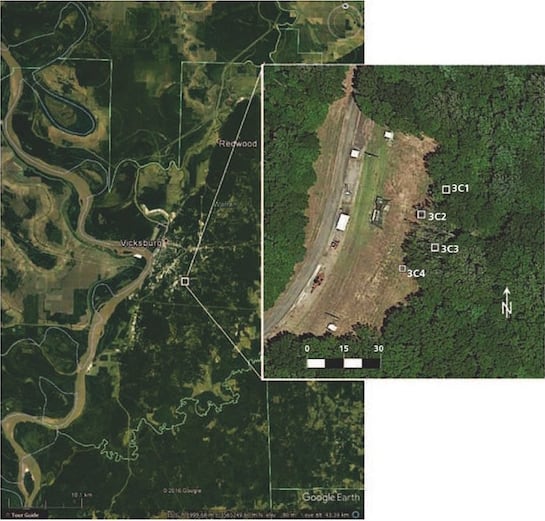
Installations at several meters’ depth within a borehole are more challenging, since achieving coupling and orientation underground cannot be easily confirmed. Protecting the sensor cable and connection on the surface while working at several meters’ separation from the sensor in a borehole is an added challenge. Three-component seismic sensors are of interest, as they have additional advantages over their one-component counterparts because they sense motion in XYZ directions commonly used as vertical, east-west, and north-south directions; whereas one-component geophones sense only a single component, typically vertical motion.
Sensor installations need to be adapted to their specific geologic or environmental setting to ensure proper installation and optimal sensor performance. Installation procedures should be tested and evaluated for that specific environment prior to sensor deployment, especially when those sensors have a potential for long-term, several-year usage.
There is no commercially available installation tool for the specific 3C seismic sensor used in this test. An installation process and hardware were developed by Raytheon BBN Technologies for a previous government experiment to ensure that the sensor was oriented correctly and coupled to the surrounding rock at several meters’ depth. This research details the process used to install the sensors in a cohesive soil environment, which had never been tried before.
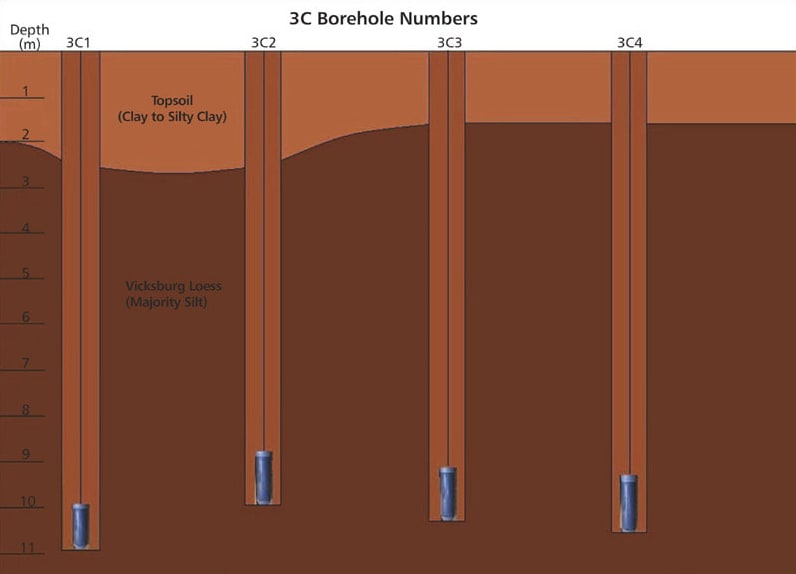
The target scenario for these sensors is that the source and receivers are in the near-surface (e.g. 100m or less) and the signals of interest are high-frequency (e.g. 10-500Hz). Near-surface maximum depth extent is not an absolute value definition that applies to any or all near-surface applications and the bottom depth of near-surface will vary depending on the focus of the target. The sensors are buried in the near-surface with the purpose of being closer to near-surface sources as well as minimizing surface noise; both aspects improve the overall signal-to-noise ratio.
High-frequency signals attenuate quickly with distance; therefore, sensor placement needs to be close to the target source in order to capture relevant signals. As the propagation path is in the near-surface, this installation method has an objective to not change or have minimum impact on the native conditions of the subsurface. This extends to, for soil settings, the sensor installation using native materials for coupling and backfilling and typically not using a permanent cased borehole or drill mud for installation. This style of installation has a tradeoff as once the sensor is buried (installed) there is a minimal surface footprint; however, it is not possible to recalibrate, easily recover, or repair a buried sensor.
The seismological community are the most common users of borehole installations for their instrumentation; it is for different reasons, however. For example, their objective sensor condition is a stable thermal and pressure environment that their sensors need for optimal operation and to escape surface noise. They utilize boreholes tens to hundreds of meters deep in bedrock to provide these conditions. In addition, the sources they are trying to locate (e.g. earthquakes) are at kilometers to global distances where they use low frequency signals (0.008 to 50Hz) with their sensor responses focused on low frequencies. As their end goals are different, their guidance is not used in this installation method as it is not immediately applicable to the objective sensor use and near-surface target scenario discussed in this report.
This work was done by Alanna P. Lester, Erin P. Simpson, Gabrielle J. Rigaud, and Jennifer R. Picucci for the Army Engineer Research and Development Center. ERDC-0004
This Brief includes a Technical Support Package (TSP).
Deep Installation Method for Three-Component Seismic Sensors
(reference ERDC-0004) is currently available for download from the TSP library.
Don't have an account?
More From SAE Media Group

Tech Briefs
Products of Tomorrow
Tech Briefs
Quantum Error Correction Method
Sensor Technology
New Sensor Could Shake Up Earthquake Response Efforts
Medical Design Briefs
Sensor Uses Computer Vision-Based Optical Strain Technology
Photonics & Imaging Technology
Standard Digital Camera and AI to Monitor Soil Moisture
Medical Design Briefs
E-Health Patches Monitor Pulse and Blood Pressure
Medical Design Briefs
New Microchip Sensor Measures Stress Hormones from Drop of Blood


Aerospace & Defense Tech Briefs
3D Data Acquisition Platform for Human Activity Understanding

Motion Design
Insect-Inspired Motion Sensing
Medical Design Briefs
New Sensor Enables Precise, Sensitive Brain Imaging Tool

Tech Briefs
Ultra-Sensitive Flow Microsensors
Sensor Technology
New Sensor May Be Groundbreaking Tool for Soil Health
Aerospace & Defense Tech Briefs
Unmanned Aerial Systems Electromagnetic Induction Sensor Development


Medical Design Briefs
Flexible Sensor Offers Less Hysteresis
Aerospace & Defense Tech Briefs
Real Time Physiological Status Monitoring
Tech Briefs
Ultrathin Pressure Sensor Attaches to Skin
Tech Briefs
NASA at 60: From Space to Earth
Aerospace & Defense Tech Briefs
Low-Cost Ground Sensor Network for Intrusion Detection
Medical Design Briefs
Ultra-Sensitive, Small Optomechanical Ultrasound Sensor
Tech Briefs
Imitating Human Hands to Make Better Sensors
Medical Design Briefs
EIT-Based Tactile Sensor
Overview
The document titled "Deep Installation Method for Three-Component Seismic Sensors" presents a comprehensive study on the installation of three-component seismic sensors at depths of several meters, particularly in soil environments. The report emphasizes the critical importance of optimal sensor installation, which directly influences sensor performance and the quality of recorded seismic signals.
The background section highlights that successful sensor installation is essential for effective operation, as it ensures proper orientation and coupling with the surrounding medium. The report notes that while certain applications necessitate the installation of these sensors within boreholes, standardized procedures for such installations are lacking.
The study builds on previous experiments conducted in hard rock environments, where an installation procedure was developed. By adapting this process, the researchers successfully installed four three-component seismic sensors at a depth of 10 meters in a soil environment. Subsequent testing confirmed that the sensors were operational, validating the effectiveness of the installation procedure.
The document details the installation process, including the challenges faced, such as ensuring proper sensor orientation and preserving cabling while using surface tools. It also discusses the geological setting of the test site, which includes a topsoil layer followed by a silt layer known as the Vicksburg Loess. The report provides insights into the subsurface material and conditions that were encountered during the installation, which can inform future projects in varying geological contexts.
Lessons learned from the installation process are documented, along with recommendations for improvements. The authors suggest adaptations to the installation tools, such as creating a bubble level and compass sleeve for better orientation during installation. The report aims to serve as a foundational resource for future installations of deep three-component seismic sensors and to develop procedures that can be executed by non-experts with minimal training.
In conclusion, this report not only documents a successful installation method but also contributes to the broader field of geophysical sensor deployment, offering valuable insights for researchers and practitioners involved in seismic monitoring and related applications.
Top Stories
INSIDERDefense
 New Raytheon and Lockheed Martin Agreements Expand Missile Defense Production
NewsAutomotive
 Ford Announces 48-Volt Architecture for Future Electric Truck
INSIDERManufacturing & Prototyping
 Active Strake System Cuts Cruise Drag, Boosts Flight Efficiency
ArticlesTransportation
 Accelerating Down the Road to Autonomy
INSIDERMaterials
 How Airbus is Using w-DED to 3D Print Larger Titanium Airplane Parts
Road ReadyTransportation

Webcasts
Electronics & Computers
 Cooling a New Generation of Aerospace and Defense Embedded...
Power
 Battery Abuse Testing: Pushing to Failure
Connectivity
 A FREE Two-Day Event Dedicated to Connected Mobility
Automotive
 Quiet, Please: NVH Improvement Opportunities in the Early Design Cycle
Transportation
 Advantages of Smart Power Distribution Unit Design for Automotive &...
Aerospace
 Sesame Solar's Nanogrid Tech Promises Major Gains in Drone Endurance