




Boeing, ELG Carbon Fibre Find New Life for Airplane Structure Material

Boeing and ELG Carbon Fibre recently announced a partnership to recycle excess aerospace-grade composite material, which will be used by other companies to make products such as electronic accessories and automotive equipment. The agreement – the first of its kind for the aerospace industry – covers excess carbon fiber from 11 Boeing airplane manufacturing sites and will reduce solid waste by more than one million pounds a year.
Carbon-fiber reinforced material is extremely strong and lightweight, making it attractive for a variety of uses, including in building the super-efficient 787 Dreamliner and the all-new 777X airplane. As the largest user of aerospace-grade composites from its commercial and defense programs, Boeing has been working for several years to create an economically viable carbon fiber reuse industry. The company improved its production methods to minimize excess and developed a model for collecting scrap material.
But technical barriers stood in the way of repurposing material that had already been "cured" or prepped for use in the airplane manufacturing process. UK-based ELG developed a proprietary method to recycle "cured" composites so they do not have to be thrown out.
To prove that the recycling method can be applied on a grand scale, Boeing and ELG conducted a pilot project where they recycled excess material from Boeing's Composite Wing Center in Everett, Wash., where the massive wings for the 777X airplane are made. ELG put the excess materials through treatment in a furnace, which vaporizes the resin that holds the carbon fiber layers together and leaves behind clean material. Over the course of 18 months, the companies saved 380,000 pounds of carbon fiber, which was cleaned and sold to companies in the electronics and ground transportation industries.
Based on the success of the pilot project, Boeing says the new agreement should save a majority of the excess composite material from its 11 sites, which will support the company's goal to reduce solid waste going to landfills 20 percent by 2025. Boeing and ELG are considering expanding the agreement to include excess material from three additional Boeing sites in Canada, China and Malaysia.
More From SAE Media Group
Aerospace Manufacturing and Machining INSIDER
Can This Self-Healing Composite Make Airplane and Spacecraft Components Last for Centuries?
Aerospace INSIDER
A New Approach to 3D Printing Tool Recycling for Aerospace Manufacturers
Aerospace Manufacturing and Machining INSIDER
Thermoplastic Drive Shaft System Developed for Aerospace Applications
Aerospace INSIDER
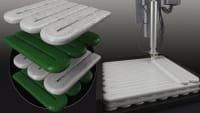
Technique Enables 3D Printing of Aerospace-Grade Carbon Fiber Composites
Aerospace INSIDER
A New Aircraft Recycling Program for Thermoplastic Composites
Aerospace Manufacturing and Machining INSIDER
Researchers Push Limits in High-Temp, Polymer Additive Manufacturing

Aerospace & Defense Tech Briefs
How Advanced Vacuum Bag Kits Streamline Composite Parts Manufacturing
Aerospace & Defense Tech Briefs
‘Nanostitches’ Enable Lighter and Tougher Composite Materials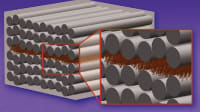


Aerospace & Defense Tech Briefs
Aerospace Composites Experts Will Meet in Wichita This Month, Focusing on Validating Repairs Techniques

Aerospace Manufacturing and Machining INSIDER
Clean Sky Demonstrator Fuselage Shows Potential of Thermoplastics in Aircraft Production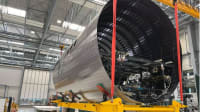
Aerospace INSIDER
How Aerospace Manufacturers are Adjusting to Ongoing Tariff Changes
Tech Briefs
Automated Tow/Tape Placement System
Aerospace INSIDER
Air Force Explores Use of Thermoplastic Fin for F-16
Aerospace Manufacturing and Machining INSIDER
NASA to Increase Sustainable Aircraft Manufacturing with HiCAM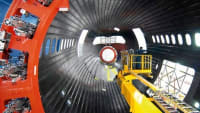

Aerospace INSIDER
Boeing to End 767 Production, Reduce Workforce Amid Ongoing Union Strike

Aerospace Manufacturing and Machining INSIDER
How Airbus is Using w-DED to 3D Print Larger Titanium Airplane Parts
Aerospace & Defense Tech Briefs
Metal-Plated, High-Temperature Plastics
Aerospace & Defense Tech Briefs
Robotic Rotational Molding Creates New Opportunities for Military and Aerospace Applications
Aerospace Manufacturing and Machining
Aerospace Work Platforms — More than Meets the Eye

Aerospace Manufacturing and Machining INSIDER
3D-Printed C-17 Replacement Part Saves Thousands for Air Force
Top Stories
INSIDERManufacturing & Prototyping
 How Airbus is Using w-DED to 3D Print Larger Titanium Airplane Parts
INSIDERManned Systems
 FAA to Replace Aging Network of Ground-Based Radars
NewsTransportation
 CES 2026: Bosch is Ready to Bring AI to Your (Likely ICE-powered) Vehicle
NewsSoftware
 Accelerating Down the Road to Autonomy
EditorialDesign
 DarkSky One Wants to Make the World a Darker Place
INSIDERMaterials
 Can This Self-Healing Composite Make Airplane and Spacecraft Components Last...
Webcasts
Defense
 How Sift's Unified Observability Platform Accelerates Drone Innovation
Automotive
 E/E Architecture Redefined: Building Smarter, Safer, and Scalable...
Power
 Hydrogen Engines Are Heating Up for Heavy Duty
Electronics & Computers
 Advantages of Smart Power Distribution Unit Design for Automotive...
Unmanned Systems
 Quiet, Please: NVH Improvement Opportunities in the Early Design...
