




Insect-Inspired Drone Deforms on Impact

A hybrid origami drone can be stiff or flexible depending on the circumstances. When airborne, the structure is stiff enough to carry its own weight and withstand the thrust of the propellers. But if the drone runs into something, it becomes flexible in order to absorb the shock and therefore minimize any damage.
The drone’s resilience comes from a unique combination of stiff and elastic layers. An elastomer membrane is stretched and then sandwiched between rigid plates. When the system is at rest, the plates hold together and give the structure its stiffness. But when enough force is applied, the plates draw apart and the structure can bend.
More From SAE Media Group
Tech Briefs
Insect-Inspired Drone Deforms Upon Impact

Tech Briefs
Force Testing Profile Stings
Tech Briefs
Origami-Inspired Material Softens Impact Forces
Tech Briefs
Cord Tension Measurement Device

Tech Briefs
Product of the Month
Aerospace INSIDER
New Coating Repels Ice from Any Surface
Motion Design
Flexure for Self-Assembly
Aerospace Manufacturing and Machining INSIDER
Can This Self-Healing Composite Make Airplane and Spacecraft Components Last for Centuries?
Aerospace & Defense Tech Briefs
Measuring Propellant Stress Relaxation Modulus Using Dynamic Mechanical Analyzer
Aerospace & Defense Tech Briefs
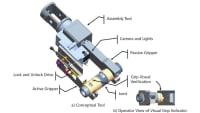
Molecular Engineering for Mechanically Resilient and Stretchable Electronic Polymers and Composites
Aerospace & Defense Tech Briefs
Redesign of composite parts for structural integrity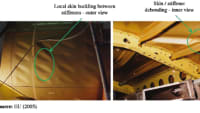
Tech Briefs
5 Ws of Ice-Shedding Coating
Aerospace INSIDER
Pinpointing Cracks Long Before They Turn Catastrophic
Aerospace INSIDER
Tests Show How Plastic Parts Deform During Flight
Aerospace & Defense Tech Briefs
Evaluation of Additively Manufactured Ultrahard Steels
Aerospace & Defense Tech Briefs
‘Nanostitches’ Enable Lighter and Tougher Composite Materials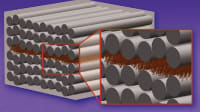

Aerospace & Defense Tech Briefs
Designing Sensory and Adaptive Composite Materials
Aerospace & Defense Tech Briefs
Beyond Boundaries: Elevating Aerospace Design with Fluorosilicones

Tech Briefs
Strain Gage Webinar
Aerospace & Defense Tech Briefs
Peridynamic Modeling: An Alternative Approach to Analyzing Material Failure
Aerospace & Defense Tech Briefs
Energy Harvesting for Soft-Matter Machines and Electronics
Tech Briefs
Deployable Composite Boom
Tech Briefs
Shape Memory Alloy Art (SMArt)
Top Stories
INSIDERManufacturing & Prototyping
 How Airbus is Using w-DED to 3D Print Larger Titanium Airplane Parts
INSIDERManned Systems
 FAA to Replace Aging Network of Ground-Based Radars
NewsTransportation
 CES 2026: Bosch is Ready to Bring AI to Your (Likely ICE-powered) Vehicle
NewsSoftware
 Accelerating Down the Road to Autonomy
EditorialDesign
 DarkSky One Wants to Make the World a Darker Place
INSIDERMaterials
 Can This Self-Healing Composite Make Airplane and Spacecraft Components Last...
Webcasts
Defense
 How Sift's Unified Observability Platform Accelerates Drone Innovation
Automotive
 E/E Architecture Redefined: Building Smarter, Safer, and Scalable...
Power
 Hydrogen Engines Are Heating Up for Heavy Duty
Electronics & Computers
 Advantages of Smart Power Distribution Unit Design for Automotive...
Unmanned Systems
 Quiet, Please: NVH Improvement Opportunities in the Early Design...
