




Wave Glider Surfs Across Stormy Drake Passage in Antarctica

The Southern Ocean is key to Earth’s climate, but the same gusting winds, big waves and strong currents that are important to ocean physics make it perilous for oceanographers. So instead their job is increasingly being given to ocean drones, the autonomous floating vehicles that collect data from the world’s oceans. With an urgent need to better understand climate to predict how it will shift with more heat-trapping gases, scientists are developing new tools to measure waters below where satellites can penetrate, and in places that are too dangerous or expensive to reach regularly by research ship. They are also sending those instruments on increasingly ambitious missions.
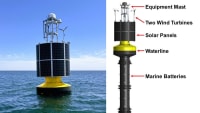
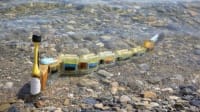
Many of these new tools look like robotic fish, but the University of Washington sent a robotic surf board to ride the waves collecting data from Antarctica to South America. The Wave Glider, a long-duration ocean robot designed to operate in stormy conditions and high latitudes, can stay at sea for months patrolling for illegal fishing, listening for seismic events, collecting weather or ocean data and monitoring the environment. Last December, UW researchers sent it out on a first-ever attempt to cross the terrifically turbulent waters of Drake Passage, a roughly 500-mile channel off the tip of South America.
The currents circling Antarctica that pose a challenge to mariners also mix significant heat energy from all the world’s oceans. Most of that mixing happens in the top few hundred feet, where winds and waves basically put the surface layer on a spin cycle.
The UW oceanographers used a commercial Wave Glider made by Liquid Robotics, a California-based subsidiary of the Boeing Co., to surf along the water’s surface gathering observations. The researchers added extra sensors for temperature, salinity, air pressure, humidity and wind to the commercial model. After a test run in summer 2016 off Washington’s coast, the instrument was deployed off the Antarctic Peninsula in December. It spent about three months zigzagging its way across the fabled Drake Passage, while the researchers occasionally piloted the instrument remotely from shore.
A Wave Glider harnesses energy from the waves, using the shape of the water motion below the surface to drive the vehicle forward with minimal power. With wave energy for motion and solar panels charging batteries to power its sensors, the board can operate for months without maintenance. Even so, the late-summer sun so far south did not provide enough energy to recharge batteries late into the expedition, and a research ship retrieved the instrument and its data near Argentina in late March. Though the board didn’t reach South America, the real goal was the data it collected.
More From SAE Media Group

Motion Design INSIDER
Building Bionic Jellyfish for Ocean Exploration

Motion Design INSIDER
Self-Navigating Catamaran Can Carry Cargo into War Zones



Aerospace & Defense Tech Briefs
Monitoring a Nearshore Beneficial Use Site: Application of a Benthic Sled and Video Annotation

Green Design & Manufacturing
Measuring Air-Sea Exchange of Carbon Dioxide in the Open Ocean
Robotics & Automation INSIDER
Autonomous Robotic Rover Helps Monitor Climate Change
Robotics & Automation INSIDER
New Imaging Technique Reconstructs the Shapes of Hidden Objects
Motion Design INSIDER
A New Window into Earth’s Upper Atmosphere
Sensing Technology
FAU Engineers Design New Autonomous System to Monitor Arctic Ice Melt

Aerospace & Defense Tech Briefs
Stratasys Unveils High-Production Additive Manufacturing Spin-Off

Tech Briefs
ROV Icefin Ascertains How Ice Melts
Robotics & Automation INSIDER
Smallest Walking Robot Makes Microscale Measurements
Robotics & Automation INSIDER
A New Home for Sustainability Robotics
Aerospace & Defense Tech Briefs
Playing Defense — Uncertain Regulations Stall the Implementation of Counter-UAS Technology in The U.S.
Aerospace & Defense Tech Briefs
Drone Swarms: A Transformational Technology
Tech Briefs
Gathering Data to Preserve Kelp Forests
Tech Briefs
Optimal Paths for Automated Underwater Vehicles
Defense INSIDER
Army Technique Enhances Robot Battlefield Operations
Top Stories
INSIDERDefense
 New Raytheon and Lockheed Martin Agreements Expand Missile Defense Production
NewsAutomotive
 Ford Announces 48-Volt Architecture for Future Electric Truck
INSIDERManufacturing & Prototyping
 Active Strake System Cuts Cruise Drag, Boosts Flight Efficiency
ArticlesTransportation
 Accelerating Down the Road to Autonomy
INSIDERMaterials
 How Airbus is Using w-DED to 3D Print Larger Titanium Airplane Parts
Road ReadyTransportation

Webcasts
Electronics & Computers
 Cooling a New Generation of Aerospace and Defense Embedded...
Power
 Battery Abuse Testing: Pushing to Failure
Connectivity
 A FREE Two-Day Event Dedicated to Connected Mobility
Automotive
 Quiet, Please: NVH Improvement Opportunities in the Early Design Cycle
Transportation
 Advantages of Smart Power Distribution Unit Design for Automotive &...
Aerospace
 Sesame Solar's Nanogrid Tech Promises Major Gains in Drone Endurance