




Erbium Doped GaN Lasers by Optical Pumping
Studying ER:GaN materials under 980 nm resonant excitation could guide future crystal growth.
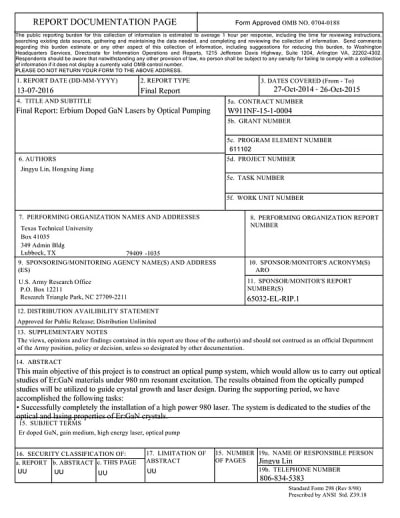
The main objective of this research was to construct an optical pump system that would allow the study of Er:GaN materials under 980 nm resonant excitation to be carried out. The results obtained from the optically pumped studies could then be utilized to guide crystal growth and laser design.
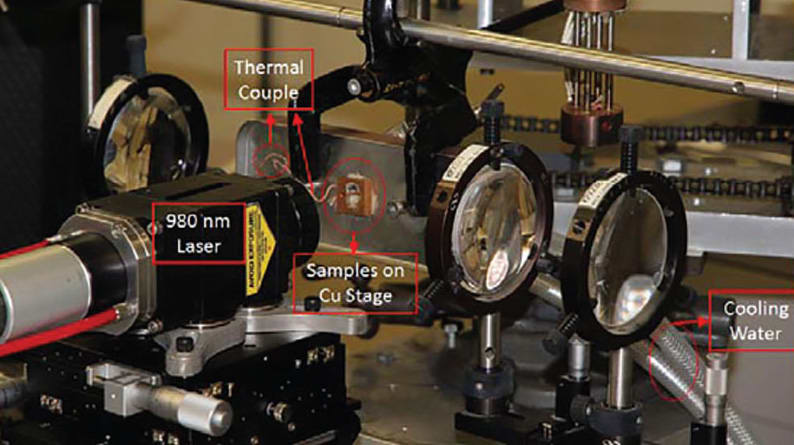
High energy and high power solid-state lasers have enabled a variety of applications which have had, and will continue to have, profound and far-reaching impacts on emerging technologies. The optical gain medium is the heart of a high energy laser (HEL) system.
Compared to the presently dominant gain material for HEL, which is Nd doped yttrium aluminum garnet (Nd:YAG), the most outstanding property of GaN as a host material for HEL application is its outstanding thermal properties. The thermal conductivity of GaN is very high (κ = 230 W/m·K) and is more than one order of magnitude higher than YAG (κ = 14 W/m·K), while its thermal expansion coefficient (α ≈ 4 × 10⁻⁶ °C-1) is about 2 times smaller than that of YAG (κ ≈ 8 × 10⁻⁶ °C-1). These together make Er doped GaN (Er:GaN) an excellent gain material with a potential to outperform Nd:YAG lasers by a factor of about 60 – 120.
Another important advantage of GaN for HEL application is its significantly higher fracture toughness figure compared to YAG. Moreover, the 1.54 μm emission resulting from the intra-4f transition from the first excited manifold (4|13/2) to the ground state (4|15/2) in Er 3+ ions is a relatively eye-safe wavelength, in that the upper limit of eye-safe laser exposure at 1.5 μm is more than 4 orders of magnitude higher than that of the wavelength range below or close to 1 μm.
To realize the full potential of Er:GaN as a gain medium for HEL, however, Er:GaN bulk crystals in large wafer sizes are required to enable the fabrication of gain media in disk, rod or slab geometry to provide high energy and high power operation. Furthermore, a resonant excitation (e.g. 980 nm) is more desirable than a non-resonant excitation as resonant excitation involves direct transition between the ground state to a higher-lying inner 4f manifold in Er3+ ions without invoking a non-radiative energy transfer, hence generating a much smaller amount of heat than a non-resonant excitation. Additionally, 980 nm pump appears to be a preferred pump wavelength in terms of providing the best trade-off between the optical absorption length, minimizing the quantum defect and managing the constraints in hydride vapor phase epitaxy (HVPE) growth for obtaining Er:GaN crystals with a reasonable thickness. Furthermore, the absorption cross section of Yb3+ at 980 nm is about an order of magnitude larger than that of Er3+. Under 980 nm pump, in an Er and Yb co-doped GaN, from Yb 3+ the energy can be transferred resonantly to the 4|11/2 state of Er3+. Therefore, under 980 nm pump, Yb and Er co-doping can enhance the effective excitation cross section by at least one order of magnitude.
This work was done by Jingyu Lin and Hongxing Jiang of Texas Technical University for the Army Research Laboratory. ARL-0203
This Brief includes a Technical Support Package (TSP).
Erbium Doped GaN Lasers by Optical Pumping
(reference ARL-0203) is currently available for download from the TSP library.
Don't have an account?
More From SAE Media Group
Photonics & Imaging Technology
Creating High-Precision Glass for NIR Lasers
Photonics & Imaging Technology
A Primer on Solid-State Lasers
Photonics & Imaging Technology
Continuous and Stable Lasing Achieved From Low-Cost Perovskites at Room Temperature
Photonics & Imaging Technology
Challenges of Fabricating and Coating Laser Crystals
Photonics & Imaging Technology INSIDER
Nano-Particles Used to Increase Power, Improve Eye Safety of Fiber Lasers
Photonics & Imaging Technology
Ultrafast Laser Micromachining
Photonics & Imaging Technology
A First-Of-Its-Kind Integrated Optical Isolator
Photonics & Imaging Technology
How to Innovate and Overcome the Challenges of Blue Laser Beam Shaping
Tech Briefs
Material Increases Efficiency of LED Devices
Photonics & Imaging Technology
Blue Lasers: Leveraging Fundamental Physics for High Performance

Photonics & Imaging Technology
Nanoscale Machines Convert Light into Work
Tech Briefs
Laser Spark Distribution and Ignition System
Tech Briefs
Free-Space Fiber Optic Laser Rod
Photonics & Imaging Technology
Silicon Carbide Optics for High-Energy Applications
Sensor Technology
Acoustic Monitoring of Laser Welds
Photonics Tech Briefs
Four-Pass Coupler for Laser-Diode-Pumped Solid-State Laser
Tech Briefs
New Family of Glass for Lens Applications
Photonics & Imaging Technology
OPO Lasers Put Optical Components to the Test
Photonics & Imaging Technology
Optical Coatings Technology
Medical Design Briefs
OPO Lasers Spur Advances in Mass Spectrometry Diagnostics
Photonics & Imaging Technology INSIDER
Quantum Dot Breakthrough Could Create Cheaper Infrared Sensors
Photonics & Imaging Technology
Fiber Lasers for Powertrain Welding Applications
Photonics & Imaging Technology
High-Power Fiber Lasers
Photonics Tech Briefs
Diffractive Combiner of Single-Mode Pump Laser-Diode Beams
Medical Design Briefs
Developing a Miniaturized Laser Diode Solution for the Medical Market

Photonics & Imaging Technology
Blue Laser Power Beaming for Planetary Exploration
Overview
The document is a final report on a project focused on the development of erbium-doped gallium nitride (Er:GaN) lasers through optical pumping. The primary objective of the project was to construct an optical pump system capable of conducting studies on the optical and lasing properties of Er:GaN materials under 980 nm resonant excitation. This research is significant as it aims to enhance the understanding and application of Er:GaN as a gain medium in laser technology.
Key accomplishments during the project included the successful installation of a high-power 980 nm laser, which is essential for the optical studies of Er:GaN crystals. The report highlights that an erbium doping level of 1.4 × 10^20 atoms/cm³ was confirmed through secondary ion mass spectrometry. The optical studies were conducted using this laser, allowing researchers to explore the photoluminescence (PL) emission spectra of the Er:GaN samples.
The document provides detailed descriptions of the experimental setup and the materials used, including a freestanding 2-inch Er:GaN wafer with a thickness of 1.2 mm, which was obtained through hydride vapor phase epitaxy (HVPE) followed by laser lift-off (LLO) processing. After polishing, the wafer's thickness was reduced to 1.0 mm. The report includes optical images and cross-sectional views of the samples, illustrating the quality and structure of the Er:GaN wafers.
Additionally, the report discusses the challenges faced during the project, particularly regarding heat management during optical excitation for larger samples. The authors are actively working on improving both the material quality and the cooling mechanisms to enhance the performance of the optical pump system.
The findings from the optical studies are expected to provide valuable insights that will guide future crystal growth and laser design efforts. The report concludes with a reference to a publication submitted to "Applied Physics Letters," which discusses the potential of Er:GaN bulk crystals as a gain medium.
Overall, this report encapsulates the progress made in the field of erbium-doped GaN lasers, emphasizing the importance of optical pumping studies in advancing laser technology and material science.
Top Stories
INSIDERDefense
 New Raytheon and Lockheed Martin Agreements Expand Missile Defense Production
NewsAutomotive
 Ford Announces 48-Volt Architecture for Future Electric Truck
INSIDERManufacturing & Prototyping
 Active Strake System Cuts Cruise Drag, Boosts Flight Efficiency
ArticlesTransportation
 Accelerating Down the Road to Autonomy
INSIDERMaterials
 How Airbus is Using w-DED to 3D Print Larger Titanium Airplane Parts
Road ReadyTransportation

Webcasts
Electronics & Computers
 Cooling a New Generation of Aerospace and Defense Embedded...
Power
 Battery Abuse Testing: Pushing to Failure
Connectivity
 A FREE Two-Day Event Dedicated to Connected Mobility
Automotive
 Quiet, Please: NVH Improvement Opportunities in the Early Design Cycle
Transportation
 Advantages of Smart Power Distribution Unit Design for Automotive &...
Aerospace
 Sesame Solar's Nanogrid Tech Promises Major Gains in Drone Endurance