




Identifying the Flow Physics and Modeling Transient Forces on Two-Dimensional Wings
Using mathematics and modeling to understand the flow physics of aircraft wings undergoing highly unsteady maneuvers.
The main objective of this research was to better understand the flow physics of aircraft wings undergoing highly unsteady maneuvers. Reduced-order models play a central role in this study, both to elucidate the overall dynamical mechanisms behind various flow phenomena (such as dynamic stall and vortex shedding), and ultimately to guide flight control design for vehicles for which these unsteady phenomena are important.
Unsteady phenomena are of increasing interest to the Air Force, as lightweight unmanned air vehicles become more prevalent. With increasingly smaller and lighter vehicles envisioned in the future, understanding unsteady aerodynamics will become even more important, in order to design control systems that can respond to severe gusts, or perform highly agile maneuvers. The flight of small, highly maneuverable aircraft, whether biological or man-made, is greatly impacted by unsteady aerodynamic effects, which can be either beneficial or detrimental to flight. Accurate understanding of such effects can allow for the design of aircraft that are more efficient, responsive, and robust.
With advances in both experimental techniques and equipment, and computational power and storage capacity, researchers in fluid dynamics can now generate more high-fidelity data than ever before. The presence of increasingly large data sets calls for appropriate data analysis techniques, that are able to extract tractable and physically relevant information from the data. In particular, a much-desired goal in fluid mechanics, and indeed many other fields, is to obtain simple models that are capable of predicting the behavior of seemingly complex systems. Low-dimensional models can not only improve our fundamental understanding of such systems, but are often required for the purpose of efficient and accurate prediction, estimation and control.
Broadly speaking, one can obtain low-dimensional information about a system (whether it be in the form of a reduced-order model, or simply spatial modes corresponding to certain energetic or dynamic characteristics) in numerous ways, potentially using some combination of data collected from simulations and experiments, and theoretical knowledge of the system, such as the governing partial differential equations (PDEs).
Purely data-driven methods can include those developed particularly for fluids applications, such as the dynamic mode decomposition (DMD), or those which are appropriated from other communities, such as the eigensystem realization algorithm (ERA), which was first applied to study spacecraft structures, but has more recently been appropriated to model a wide range of fluids systems.
Dynamic mode decomposition allows for the identification and analysis of dynamical features of time-evolving fluid flows, using data obtained from either experiments or simulations. In contrast to other data-driven modal decompositions such as the proper orthogonal decomposition (POD), DMD allows for spatial modes to be identified that can be directly associated with characteristic frequencies and growth/decay rates. Following its conception, DMD was quickly shown to be useful in extracting dynamical features in both experimental and numerical data. It has subsequently been used to gain dynamic insight on a wide range of problems arising in fluid mechanics and other fields.
One of the major advantages of DMD over techniques such as global stability analysis is that it can be applied directly to data, without the need for the knowledge or construction of the system matrix, which is typically not available for experiments. For this reason, analysis of the sensitivity of DMD to the type of noise typically found in experimental results is of particular importance.
This work was done by Clarence W. Rowley and David R. Williams of Princeton University for the Air Force Research Laboratory. AFRL-0250
This Brief includes a Technical Support Package (TSP).
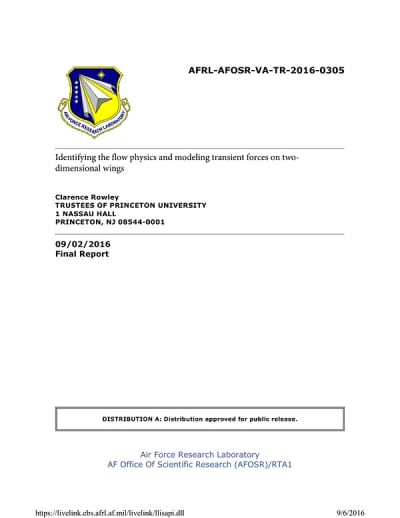
Identifying the ow physics and modeling transient forces on two-dimensional wings
(reference AFRL-0250) is currently available for download from the TSP library.
Don't have an account?
More From SAE Media Group
Tech Briefs
Algorithms Improve Quadrotor Drone Performance
Aerospace & Defense Tech Briefs
A Simpler Method for Learning to Control a Robot
Tech Briefs
Flying Robot Mimics Rapid Insect Flight

Aerospace & Defense Tech Briefs
Digital Twins: How The Digital Replica Concept Is Used By Robotic Systems
Aerospace & Defense Tech Briefs
Investigation of Flight Dynamics and Controls for a Solar-Tracker-Mounted UAV



Aerospace & Defense Tech Briefs
Fabrication and Testing of High-Speed Single-Rotor and Compound-Rotor Systems
Aerospace & Defense Tech Briefs
Development of a Vision-Based Situational Awareness Capability for Unmanned Surface Vessels
Aerospace & Defense Tech Briefs
Report on Human Factors Issues Likely to Affect Air-Launched Effects
Tech Briefs
Approach Makes Unmanned Agents Self-Sufficient

Aerospace & Defense Tech Briefs
DDDAMS-based Urban Surveillance and Crowd Control via UAVs and UGVs
Robotics & Automation INSIDER
MIT Engineers Help Multirobot Systems Stay In the Safety Zone
Tech Briefs
Drones Change Shape Mid-Flight
Aerospace & Defense Tech Briefs
New Cyber Algorithm Shuts Down Malicious Robotic Attacks
Aerospace & Defense Tech Briefs
AI-Trained Vehicles Can Adjust to Extreme Turbulence on the Fly
Aerospace & Defense Tech Briefs
Drone Swarms: A Transformational Technology
Tech Briefs
Algorithm Gives Robots a Faster Grasp
Tech Briefs
Insect-Sized Agile Drones
Aerospace & Defense Tech Briefs
One Person Can Supervise a Swarm of 100 Unmanned Autonomous Vehicles
Aerospace & Defense Tech Briefs
DEVCOM ARL FY22 Industry Autonomy Technology Assessment Final Report on Security and Mobility
Aerospace & Defense Tech Briefs
Industry Invited to Participate in AeroTech Aerospace and Defense Technical Program
Aerospace & Defense Tech Briefs
3D Data Acquisition Platform for Human Activity Understanding
Overview
The report titled "Identifying the Flow Physics and Modeling Transient Forces on Two-Dimensional Wings," authored by Clarence Rowley and David R. Williams from Princeton University, presents a comprehensive study aimed at understanding the complex flow dynamics associated with aircraft wings during highly unsteady maneuvers. The research was conducted under the auspices of the Air Force Office of Scientific Research from March 2012 to September 2015.
The primary objective of the study is to elucidate the flow physics that govern phenomena such as dynamic stall and vortex shedding, which are critical for the performance and control of aircraft, particularly lightweight unmanned aerial vehicles (UAVs). As the demand for smaller and more agile aircraft increases, understanding unsteady aerodynamics becomes essential for designing effective flight control systems capable of responding to severe gusts and executing rapid maneuvers.
The report emphasizes the importance of reduced-order models in analyzing the dynamics of airflow over wings. These models serve as tools to simplify the complex interactions between the wing and the surrounding air, allowing researchers to identify key mechanisms that influence aerodynamic forces. By focusing on transient forces, the study aims to provide insights that can lead to improved control strategies for aircraft operating in challenging conditions.
The findings of this research are particularly relevant to the Air Force, as they align with the growing interest in developing advanced UAVs that can perform under unsteady aerodynamic conditions. The report highlights the need for innovative approaches to flight control design that take into account the unique challenges posed by unsteady flow phenomena.
In summary, this report contributes to the field of aerodynamics by providing a deeper understanding of the flow physics involved in the behavior of two-dimensional wings during unsteady maneuvers. The insights gained from this research are expected to inform the development of more effective control systems for future aircraft, enhancing their performance and operational capabilities in dynamic environments. The work underscores the significance of continued research in unsteady aerodynamics as the aerospace industry evolves towards more sophisticated and capable aerial vehicles.
Top Stories
INSIDERManufacturing & Prototyping
 How Airbus is Using w-DED to 3D Print Larger Titanium Airplane Parts
NewsAutomotive
 Microvision Aquires Luminar, Plans Relationship Restoration, Multi-industry Push
INSIDERAerospace
 A Next Generation Helmet System for Navy Pilots
INSIDERDesign
 New Raytheon and Lockheed Martin Agreements Expand Missile Defense Production
ArticlesAR/AI
 CES 2026: Bosch is Ready to Bring AI to Your (Likely ICE-powered) Vehicle
Road ReadyDesign

Webcasts
Semiconductors & ICs
 Advantages of Smart Power Distribution Unit Design for Automotive...
Unmanned Systems
 Quiet, Please: NVH Improvement Opportunities in the Early Design...
Electronics & Computers
 Cooling a New Generation of Aerospace and Defense Embedded...
Power
 Battery Abuse Testing: Pushing to Failure
AR/AI
 A FREE Two-Day Event Dedicated to Connected Mobility
