




Remote-Controlled Weapons Augment Soldiers on Perimeter Security
Remotely-controlled weapons systems have drastically reduced the number of soldiers needed for perimeter security at an expeditionary base camp.
"Every Soldier I have assigned to securing the perimeter is one I don't have that can execute support missions," said Lt. Col. Raphael Heflin, commander, 142nd Combat Service Support Battalion, or CSSB, 1st Armored Division.
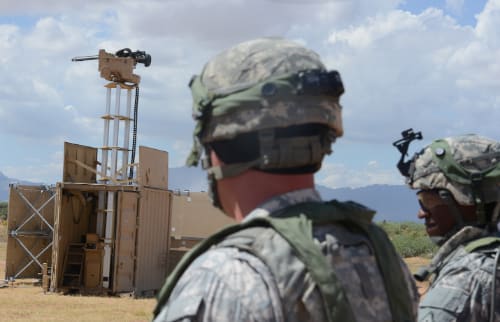
At a conventional combat outpost, it takes four to six soldiers doing eight- or 12-hour shifts to man one weapons system on the perimeter, he said. Using relatively new remote control weapons systems, he said, pointing to a series of unmanned, weaponized towers at the edge of the razor wire, two soldiers inside the base camp tactical operation center can do the security work once done by 10.
The 142nd CSSB is among the many Army and other military service units – along with a 14-member coalition from mostly NATO nations - participating in Network Integration Evaluation 16.1, also called an NIE. In all, about 9,000 participants are evaluating new and emerging network solutions.
Capt. Robert Scott, officer-in-charge of the 142nd CSSB's base defense operation center, explained how the remote-control weapons system works. The systems, including the expeditionary towers atop which they're mounted, are known as containerized weapons systems. One expeditionary tower "can be put together by six soldiers in less than an hour, with minimal training," Scott said. When it's time to pack up and leave, everything fits neatly back inside the container.
While just about any gun system can be mounted on the tower, the two Scott pointed out were fitted with a Browning M-2 50-caliber machine gun and a 338 Lapua sniper rifle. The weapons can be raised, lowered, rotated by 360- degrees and fired remotely, he said. The operators who run the systems sit inside a container with multiple large screens in front of them. To control the weapons, they use software called the Joint All Hazard Command Control System, which Scott said serves as the brains of the "Tower Hawk System." On their screens are views outside the perimeter, including normal video feeds as well as thermal and infrared views.
Scott said that the weapons systems are even more effective at night. "Anything moving at night we see long before they see us," he said, adding that "they" refers to the bad guys. The system even differentiates between good and bad guys. Once the enemy is detected, the system plots coordinates, allowing the operator to take out the target, be it personnel or vehicles.
More From SAE Media Group
Aerospace & Defense Tech Briefs
Cutting-Edge Drone Killer Radio Wave Weapon Developing at Pace


Aerospace & Defense Tech Briefs
Counter Unmanned Aircraft System
Aerospace INSIDER
EA-37B Compass Call: The US Air Force's New Electronic Attack Aircraft
Aerospace INSIDER
First F-15Es Equipped With EPAWSS Ready for Flight
Defense INSIDER
Conference to Focus on Counter-Drone Technology
Aerospace INSIDER
Bombardier to Start Building New Army HADES Prototype Spy Plane
Defense INSIDER
DoD Signs New Strategy for Countering Unmanned Systems
Aerospace INSIDER
Honeywell Launches New System to Counter Drone Swarms
Aerospace & Defense Tech Briefs
Quality Gearing Keeps Mission-Critical Systems Rotating for Combat
Aerospace & Defense Tech Briefs
Missile System Team Trainer
Aerospace & Defense Tech Briefs
Mobile Howitzer
Aerospace & Defense Tech Briefs
Register Now: Counter UAS Technology 2021
Aerospace & Defense Tech Briefs
Mobile Counter Unmanned Aircraft System
Defense INSIDER
Army Gets a Clearer View of Multi-Domain Battlefield
Aerospace & Defense Tech Briefs
Battle Command System

Aerospace & Defense Tech Briefs
RF-Cyber for Counter-UAS

Aerospace & Defense Tech Briefs
Perimeter Security Sensor System
Defense INSIDER
Army Tests Newest 120mm Abrams Main Battle Tank Round
Aerospace & Defense Tech Briefs
Remotely Piloted Air Systems
Defense INSIDER
Anduril Becomes Third US Supplier of Solid Rocket Motors

Aerospace INSIDER
Germany's New Military Surveillance Jet Completes First Flight
Aerospace & Defense Tech Briefs
Multi-Sensor Electro-Optic Platform
Top Stories
INSIDERManufacturing & Prototyping
 How Airbus is Using w-DED to 3D Print Larger Titanium Airplane Parts
NewsAutomotive
 Microvision Aquires Luminar, Plans Relationship Restoration, Multi-industry Push
INSIDERAerospace
 A Next Generation Helmet System for Navy Pilots
INSIDERDesign
 New Raytheon and Lockheed Martin Agreements Expand Missile Defense Production
ArticlesAR/AI
 CES 2026: Bosch is Ready to Bring AI to Your (Likely ICE-powered) Vehicle
Road ReadyDesign

Webcasts
Semiconductors & ICs
 Advantages of Smart Power Distribution Unit Design for Automotive...
Unmanned Systems
 Quiet, Please: NVH Improvement Opportunities in the Early Design...
Electronics & Computers
 Cooling a New Generation of Aerospace and Defense Embedded...
Power
 Battery Abuse Testing: Pushing to Failure
AR/AI
 A FREE Two-Day Event Dedicated to Connected Mobility
