




UAV Circuit Boards
Sunstone Circuits
Mulino, OR
503-829-9108
www.sunstone.com
Miki Szmuk is an aerospace engineer with big ideas for building better unmanned aerial vehicles (UAVs). As a doctoral student from the Controls Lab for Distributed and Uncertain Systems (C-DUS) of the Department of Aerospace Engineering at the University of Texas (UT) in Austin, Szmuk specializes in the engineering of small, sophisticated UAVs.
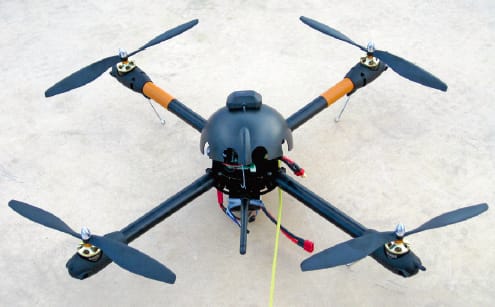 Szmuk and the rest of the C-DUS research group, who are advised by Dr. Maruthi Akella, focus on addressing fundamental engineering problems in nonlinear dynamical systems, measurements, and control. This includes the coordinated operation of distributed multi-vehicle swarms. Consequently, the C-DUS research group employs UAVs in demonstrating various control and estimation algorithms that it develops.
These crafts are not easy to build. Weighing only a few pounds, UAVs must travel long distances, reliably collecting and processing data along the way. In order to meet the always evolving needs of the UAV industry, Szmuk recognized the need to develop PCB design skills. Without them, it would be difficult to costeffectively improve functionality of his department’s drones and get in front of industry expansion.
Szmuk first reached out to Sunstone as an undergrad at UT. “I was working on a UAV with a two and a half pound autopilot system,” said Szmuk. The vehicle’s overall size is a function of the payload it must carry and it took a twenty-five to thirty pound UAV just to accommodate the oversized autopilot. “That was simply too big for what we needed this plane to do,” said Szmuk.
Issues with size compound quickly when building a UAV. If the autopilot is too big, that impacts the wing area and fuselage size. The result is an oversized craft with less functionality and a higher cost. The cumbersome, original UAV design was done component by component, thus the oversized end product. Szmuk took it upon himself to look at the bigger picture.
Szmuk called Sunstone, looking not just for someone to manufacture boards but for a way to design them himself. With their help, he designed his first PCB—a small board that routed the plane’s wiring in a more organized and efficient way. The board helped reduce the size of the autopilot and enabled other refinements such as the replacement of a baseballsize sensor with a small chip. As the autopilot design evolved, the system shrank from its original weight of over two pounds down to just thirteen grams. As a result, the next version of the craft weighed just 20% of its predecessor.
Szmuk continues to develop smaller, higher performance UAVs. Using PCB123 and Sunstone, he has made increasingly complex circuits to trim bulk and increase capabilities. A project funded through NASA required Szmuk to demonstrate novel guidance algorithms and build his smallest UAV to that point. These algorithms were geared towards improving the autonomy of unmanned climate science missions in the Arctic.
For Free Info Click Here
More From SAE Media Group
Aerospace & Defense Tech Briefs
Air Force Tests Fully Autonomous UAS Control System
Aerospace & Defense Tech Briefs
Unmanned Aerial Vehicles
Aerospace & Defense Tech Briefs
Martin UAV VTOL Unmanned Aircraft Taps Persistent Systems Wave Relay Data Link Technology
Aerospace & Defense Tech Briefs
Connect Them All
Aerospace & Defense Tech Briefs
Vertical Aerospace Is Honeywell’s Latest Partner in the UAM Industry
Aerospace & Defense Tech Briefs
Unmanned Hover Plane
Aerospace & Defense Tech Briefs
Drone Parachute Rescue System
Aerospace & Defense Tech Briefs
Convertible Drones
Aerospace & Defense Tech Briefs
Curtiss-Wright Black Boxes Receive European Approval
Aerospace & Defense Tech Briefs
Unmanned Aerial Vehicle
Aerospace & Defense Tech Briefs
ANSYS Will Help Airbus Develop AI-Enabled Flight Controls for the FCAS Program’s Autonomous Wingmen
Aerospace & Defense Tech Briefs
Boeing’s CAV Makes First Outdoor Flight
Aerospace & Defense Tech Briefs
UAV Turbines Designs Purpose-Built Microturbine Engine for Class 3 and 4 UAVs
Aerospace & Defense Tech Briefs
Like a Good Neighbor, Impossible Aerospace Flew over to a Nearby Construction Fire to Help Locate Hotspots for First Responders
Aerospace & Defense Tech Briefs
Foreign Counter-Unmanned Aerial Systems: Developments in the International Arms Markets
Aerospace & Defense Tech Briefs
Textron Systems, Textron Aviation Defense Demonstrate Simulated Manned-Unmanned Teaming Capability
Aerospace & Defense Tech Briefs
Boeing Partners with Robotic Skies to Provide Commercial UAS Supply Chain Optimization, Analytics, and MRO Services
Aerospace & Defense Tech Briefs
Advances in Multi-UAV Operations
Aerospace & Defense Tech Briefs
Enabling Off-the-Shelf Autonomous Naval Warfare
Aerospace & Defense Tech Briefs
Abaco’s FORCE2 Flight Computer Enables National and International Ground Control Station Certification
Aerospace & Defense Tech Briefs
Nano-UAV Systems
Aerospace & Defense Tech Briefs
BAE Systems Will Supply Flight Control and Target Identification Systems for Boeing’s Carrier-Based MQ-25
Aerospace & Defense Tech Briefs
General Atomics Moves Toward Global RPA Flight Certification for MQ-9B SkyGuardian
Aerospace & Defense Tech Briefs
EU to Deploy UAV Traffic Management System by 2019
Aerospace & Defense Tech Briefs
F-35 and F-16 Ground Collision Avoidance Software Team Takes Collier Trophy
Aerospace & Defense Tech Briefs
Rotary Unmanned Aerial Systems
Aerospace & Defense Tech Briefs
Lockheed Martin and Drone Racing League Pit AI-Enabled UAS Against Human Pilots
Aerospace & Defense Tech Briefs
Vertical Takeoff and Landing Drone
Aerospace & Defense Tech Briefs
Explainable-AI Image Recognition Is the Next Step for U.S. Air Force Unmanned Aircraft
Aerospace & Defense Tech Briefs
AirMap and Skyguide Deploy Swiss National Flight Information Management System for Drones
Top Stories
INSIDERAerospace
 How Airbus is Using w-DED to 3D Print Larger Titanium Airplane Parts
NewsAutomotive
 Microvision Aquires Luminar, Plans Relationship Restoration, Multi-industry Push
INSIDERManned Systems
 A Next Generation Helmet System for Navy Pilots
INSIDERDesign
 New Raytheon and Lockheed Martin Agreements Expand Missile Defense Production
ArticlesManned Systems
 Accelerating Down the Road to Autonomy
NewsPower
 Ford Announces 48-Volt Architecture for Future Electric Truck
Webcasts
Electronics & Computers
 Cooling a New Generation of Aerospace and Defense Embedded...
Test & Measurement
 Battery Abuse Testing: Pushing to Failure
Internet of Things
 A FREE Two-Day Event Dedicated to Connected Mobility
Unmanned Systems
 Quiet, Please: NVH Improvement Opportunities in the Early Design Cycle
Transportation
 Advantages of Smart Power Distribution Unit Design for Automotive &...
Aerospace
 Sesame Solar's Nanogrid Tech Promises Major Gains in Drone Endurance