




Anti-Hacking Software for UAVs
Galois
Portland, OR
503-626-6616
http://galois.com
To address growing evidence that commercial Unmanned Aerial Vehicles (UAV), automobiles and other vehicles are vulnerable to hacking and sophisticated cyber security attacks, Galois developed and successfully demonstrated what has been called “the world’s most secure UAV software.” Galois, a company that specializes in protecting information, devices, networks, and vehicles, recently conducted a successful demonstration for the U.S. Defense Advanced Research Projects Agency’s High-Assurance Cyber Military Systems (HACMS) program. Galois is part of a team that produced provably correct and secure software that runs on commercial UAVs.
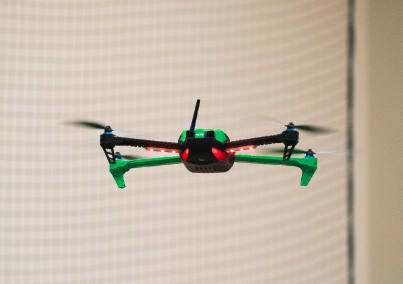
“As unmanned drones – particularly those used for civilian and commercial purposes – grow in number and usage, current software vulnerabilities pose a national security risk,” said Kathleen Fisher, former DARPA HACMS program manager. “Galois’ demonstration offers evidence that software built the right way dramatically reduces vulnerabilities, not just for drones, but for cars, information systems and the Internet itself.”
For the DARPA HACMS program, Galois demonstrated its ability to prevent both UAV drone hacking and automobile hacking. Galois’ secure UAV software provides an alternative to currently available software that’s open to remote takeover and other vulnerabilities. One of the tests Galois performed was having its software evaluated by independent, world-class penetration testing teams that were unable to gain remote access to the vehicle. The software has also been demonstrated to prevent the types of wireless automotive control system attacks exposed in a February 2015 report released by Senator Edward J. Markey (D-Mas) called “Tracking & Hacking: Security & Privacy Gaps Put American Drivers at Risk.”
“The message for organizations building connected vehicles, systems and products is that vulnerabilities are not a foregone conclusion if secure and reliable software is designed into their products up front,” said Rob Wiltbank, CEO, Galois. “The same way an automaker would not design a vehicle by trial and error, you can’t develop a secure system on the fly, as the product is being released. Systems can be made correct by design, which presents an opportunity for organizations to dramatically reduce the hacking threat.”
In the HACMS program, Galois is part of a team led by Rockwell Collins, and also includes University of Minnesota, National ICT Australia, and Boeing.
For Free Info Click Here
More From SAE Media Group
Aerospace & Defense Tech Briefs
Implementing Secure Command and Control in Unmanned Systems
Aerospace & Defense Tech Briefs
Enabling Off-the-Shelf Autonomous Naval Warfare
Aerospace & Defense Tech Briefs
Counter-Drone Technology
Aerospace & Defense Tech Briefs
Low-Impact CUAS System
Aerospace & Defense Tech Briefs
Counter UAS Defense System
Aerospace & Defense Tech Briefs
Multi-Mission UAS (MMU) Systems
Aerospace & Defense Tech Briefs
British Army Completes First Test of Drone Killing Radio Frequency Weapon
Aerospace & Defense Tech Briefs
Precision Attack Drone
Aerospace & Defense Tech Briefs
Drone Swarms: A Transformational Technology
Aerospace & Defense Tech Briefs
Autonomous Air Defense Production
Aerospace & Defense Tech Briefs
Nano-UAV Systems
Aerospace & Defense Tech Briefs
Foreign Counter-Unmanned Aerial Systems: Developments in the International Arms Markets
Aerospace & Defense Tech Briefs
A New Approach to Counter-UAS Technology
Aerospace & Defense Tech Briefs
Optimal UAS Assignments and Trajectories for Persistent Surveillance and Data Collection from a Wireless Sensor Network
Aerospace & Defense Tech Briefs
Autonomous Collaborative Platform
Aerospace & Defense Tech Briefs
Effectiveness of Inter-Vehicle Communications and On-Board Processing for Close Unmanned Autonomous Vehicle Flight Formations
Aerospace & Defense Tech Briefs
Unmanned Hover Plane
Aerospace & Defense Tech Briefs
Drone Control System
Aerospace & Defense Tech Briefs
Hardening Unmanned Aerial Systems Against High-Power Microwave Threats in Support of Forward Operations
Aerospace & Defense Tech Briefs
Defeating Commercial Drone Threats with Open-Source SDR
Aerospace & Defense Tech Briefs
RF-Cyber for Counter-UAS
Aerospace & Defense Tech Briefs
Anti-Drone Jammer
Aerospace & Defense Tech Briefs
Vertical Takeoff and Landing Drone
Aerospace & Defense Tech Briefs
Sonobuoy Dispensing & Remote Processing System
Aerospace & Defense Tech Briefs
Unmanned Aerial Systems Electromagnetic Induction Sensor Development
Tech Briefs
Facility Focus: Battelle Memorial Institute
Aerospace & Defense Tech Briefs
Navigating Regulatory Compliance for UAV Electronics Development
Aerospace & Defense Tech Briefs
Autonomous Surveillance Technologies Relating to Dismounted Soldiers
Tech Briefs
Defense Advanced Research Projects Agency
Tech Briefs
Army Research Laboratory
Top Stories
INSIDERManufacturing & Prototyping
 How Airbus is Using w-DED to 3D Print Larger Titanium Airplane Parts
INSIDERManned Systems
 FAA to Replace Aging Network of Ground-Based Radars
NewsTransportation
 CES 2026: Bosch is Ready to Bring AI to Your (Likely ICE-powered) Vehicle
NewsSoftware
 Accelerating Down the Road to Autonomy
EditorialDesign
 DarkSky One Wants to Make the World a Darker Place
INSIDERMaterials
 Can This Self-Healing Composite Make Airplane and Spacecraft Components Last...
Webcasts
Defense
 How Sift's Unified Observability Platform Accelerates Drone Innovation
Automotive
 E/E Architecture Redefined: Building Smarter, Safer, and Scalable...
Power
 Hydrogen Engines Are Heating Up for Heavy Duty
Electronics & Computers
 Advantages of Smart Power Distribution Unit Design for Automotive...
Unmanned Systems
 Quiet, Please: NVH Improvement Opportunities in the Early Design...
