




Sensing Suspicious Powders Using Noncontact Optical Methods
This handheld sensing instrument enables identification of suspicious powders in near-real time at the site of an incident.
Suspicious powder incidents continue to be a disruptive and costly problem. In-situ assessment of suspicious powders within inorganic matrices, particularly with powders of biological origin, is currently limited to detection by biochemical methodologies that react with monomers such as amino acids, nucleic acids, lipids, or macromolecule compounds comprised of these basic subunits. Current optical methods such as Raman spectroscopy using excitation in the near infrared at 785 nm or visible at 532 nm, have not been able to detect or distinguish biological materials from background or other materials.
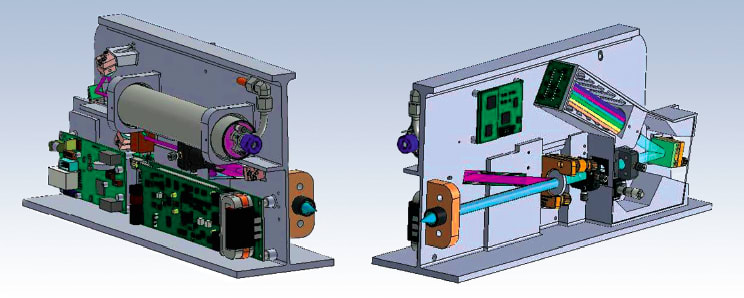
The BRANE sensor has the noncontact, no-sample-handling advantages of Raman-based sensors, with the advantages of deep UV excitation of samples at wavelengths that enable simultaneous detection of both Raman emissions without obscuration by fluorescence, and fluorescence emissions without alteration by Raman emissions. This can only be conducted in the deep UV below 250 nm. The BRANE sensor is capable of making millions of tests with no consumables cost in an instrument with indefinite field lifetime. It is also capable of detection and classification of a much broader range of contaminants beyond biological that includes chemical and explosive hazards. All this is done in a single sensor without the need for modification for different applications.
The BRANE sensor optically analyzes the nucleic, protein, and lipid components of biological threats to assess their presence and identity. This is enabled by three new technology elements: 1) a miniature deep UV laser with narrow linewidth that enables simultaneous Raman and fluorescence detection; 2) a high-speed linear CCD array detector that enables handheld miniaturization; and 3) chemometric algorithms that enable classification of biological material using a fusion of deep UV Raman and fluorescence spectroscopy. The BRANE instrument weighs about 7 pounds, including batteries, and measures about 4" wide by 9" high by 16" deep.
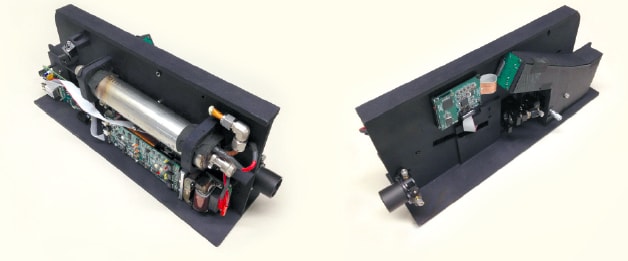
Figure 1 illustrates the BRANE sensor’s laser/computer and spectrometer/detector sides. The right side of the instrument houses the laser, laser drive, and control electronics; input/output control board with onboard battery charging electronics and embedded Microprocessor; memory for storing all suspicious powder library data and processing all spectroscopic data to compare with library data to determine identity of a suspicious powder; and optical element for processing the laser output. The I/O board will also include an onboard GPS to enable logging of position along with date and time for each data set collected. The left side has the objective lens, contextual imaging camera (not yet shown), laser injection optics, and spectrometer input optics and entrance slit with recollimation optics, grating, spectrometer imaging lens, linear CCD array detector, and detector control and processing electronics.
Controls include a simple mechanical on/off button or switch to power up the basic system, energize the display, and prepare the sensor for data acquisition. Under this standby condition, BRANE will draw battery power of about 5W. A trigger in the handle activates the laser and detection electronics, and the system begins taking data on suspicious powders at a rate of about 40 combined Raman and fluorescence spectra per second, proving real-time display of the results. For some weak materials, it may be necessary to dwell on a sample for up to about 10 seconds, although most data can be achieved in less than 1 second.
This work was done by William F. Hug, Ray D. Reid, and Rohit Bhartia of Photon Systems for the Army RDECOM. ARL-0174
More From SAE Media Group
Photonics & Imaging Technology
How a UV-Visible-NIR Range Microscope-Spectrometer Works
Tech Briefs
Portable Acousto-Optic Spectrometers
Photonics & Imaging Technology
Essential Principles for Designing and Specifying Laser Optics
Photonics & Imaging Technology
Compact MEMS-Based NIR Spectroscopy for Mobile Applications

Photonics & Imaging Technology
Spectroscopy Using an Optical Microscope
Medical Design Briefs
OPO Lasers: Putting Optical Components to the Test
Photonics & Imaging Technology
Bringing Precision Anamorphic Micro-Optics to Consumer-Level Laser Applications
Tech Briefs
Correlation Spectrometer

Medical Design Briefs
Tunable Lasers Expand for Time-Resolved Spectroscopy
Photonics & Imaging Technology
Researchers Generate Terahertz Laser with Laughing Gas
Aerospace & Defense Tech Briefs
Matrix-Free Assisted Laser Desorption Ionization Using Metal-Organic Frameworks
Tech Briefs
Instrumentation for Sensitive Gas Measurements
Sensor Technology
A Nanotech Sensor Turns Molecular Fingerprints into Bar Codes
Imaging Technology
Mosaic-Detector-Based Fluorescence Spectral Imager
Medical Design Briefs
Biosensor Measures Extracellular Hydrogen Peroxide
Tech Briefs
Wide-Area Chemical Sensor
Photonics Tech Briefs
Demystifying Spectroscopy

Medical Design Briefs
Optical Design Considerations for Additive Manufacturing
Tech Briefs
Two-Dimensional Active-Pixel Spectral Lidar
Photonics Tech Briefs
Tunable Ultraviolet Light Source for Combustion Experiments
Photonics & Imaging Technology
Moving Precision Communication, Metrology, Quantum Applications from Lab to Chip
Medical Design Briefs
OPO Lasers Spur Advances in Mass Spectrometry Diagnostics
Top Stories
NewsRF & Microwave Electronics
 Microvision Aquires Luminar, Plans Relationship Restoration, Multi-industry Push
INSIDERAerospace
 A Next Generation Helmet System for Navy Pilots
INSIDERDesign
 New Raytheon and Lockheed Martin Agreements Expand Missile Defense Production
INSIDERMaterials
 How Airbus is Using w-DED to 3D Print Larger Titanium Airplane Parts
NewsPower
 Ford Announces 48-Volt Architecture for Future Electric Truck
ArticlesAR/AI

Webcasts
Electronics & Computers
 Cooling a New Generation of Aerospace and Defense Embedded...
Automotive
 Battery Abuse Testing: Pushing to Failure
Power
 A FREE Two-Day Event Dedicated to Connected Mobility
Unmanned Systems
 Quiet, Please: NVH Improvement Opportunities in the Early Design Cycle
Automotive
 Advantages of Smart Power Distribution Unit Design for Automotive &...
Energy
 Sesame Solar's Nanogrid Tech Promises Major Gains in Drone Endurance