




Hurricane-Tracking Unmanned Systems Win NASA Challenge
NASA has selected three winning designs solicited to address the technological limitations of the uncrewed aerial systems (UAS) currently used to track and collect data on hurricanes. Engineering teams at Virginia Polytechnic Institute and State University, Purdue University, and the University of Virginia were named first- through third-place winners, respectively, of the agency's 2013-2014 University Aeronautics Engineering Design Challenge.
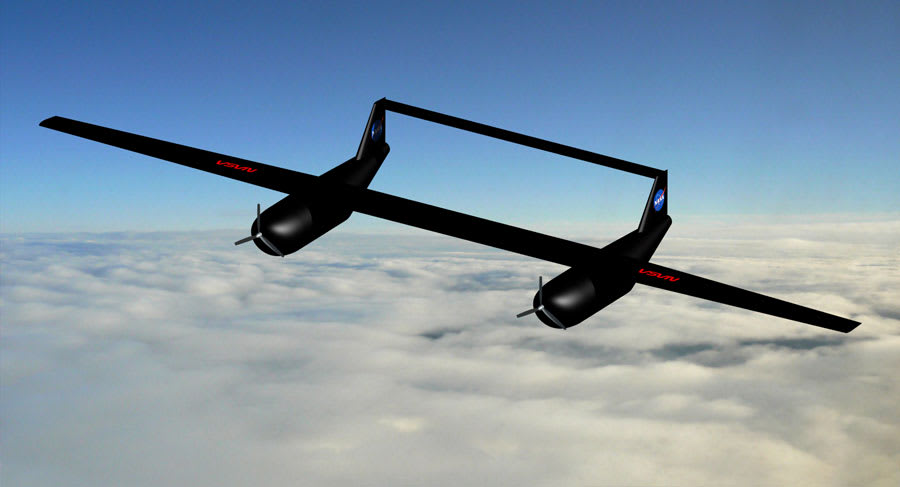
Among other stringent criteria, designs had to successfully demonstrate how the system would provide persistent five-month aerial coverage over an area of the Atlantic Ocean off the west coast of Africa where tropical depressions can form into hurricanes. Through this five-month period, systems must be capable of flying non-stop a minimum of seven days.
Virginia Tech's team won first place with its Gobble Hawk, an aerial system consisting of two aircraft, each with a flight endurance of 7.8 days, and using liquid hydrogen as a fuel source. Taking second place, Purdue's OQ451-5 Trident is a hydrogen-powered UAS capable of seven days of uninterrupted flight over the monitoring area. UVA captured third place with an aircraft dubbed The Big WAHOO — an acronym for Worldwide Autonomous Hurricane and Oceanic Observer — which has a flight endurance of 7.5 days.
More From SAE Media Group



Aerospace & Defense Tech Briefs
Unmanned Ocean Drone
Tech Briefs
Hurricane Sandy's Storm Track Spied by Satellite

NASA Spinoff
AirMap Guides Drones toward Widespread Use


Tech Briefs
Mapping Hurricanes

Aerospace & Defense Tech Briefs
Coastal Lidar and Radar Imaging System (CLARIS) Lidar Data Report
Software Tech Briefs
Tropical Cyclone Information System
Photonics & Imaging Technology INSIDER
NASA, Rocket Lab Launch First Pair of Storm Observing CubeSats
Tech Briefs
Facility Focus: NASA Langley Research Center
Tech Briefs
Facility Focus: NASA Goddard Space Flight Center
Aerospace & Defense Tech Briefs
Eyes In the Sky
Tech Briefs
Algorithms Improve Quadrotor Drone Performance
Aerospace & Defense Tech Briefs
Playing Defense — Uncertain Regulations Stall the Implementation of Counter-UAS Technology in The U.S.
Aerospace & Defense Tech Briefs
New Method to Measure Wind Speed Could Unlock Drones’ Potential
Aerospace & Defense Tech Briefs
Perspective - Colonel Lewis F. Setliff III

Tech Briefs
Smarter Parachutes Tested for Mars Landings
Aerospace & Defense Tech Briefs
Uncrewed Solar Aircraft Passes Key Ground Tests
Top Stories
INSIDERManufacturing & Prototyping
 How Airbus is Using w-DED to 3D Print Larger Titanium Airplane Parts
INSIDERManned Systems
 FAA to Replace Aging Network of Ground-Based Radars
NewsTransportation
 CES 2026: Bosch is Ready to Bring AI to Your (Likely ICE-powered) Vehicle
NewsSoftware
 Accelerating Down the Road to Autonomy
EditorialDesign
 DarkSky One Wants to Make the World a Darker Place
INSIDERMaterials
 Can This Self-Healing Composite Make Airplane and Spacecraft Components Last...
Webcasts
Defense
 How Sift's Unified Observability Platform Accelerates Drone Innovation
Automotive
 E/E Architecture Redefined: Building Smarter, Safer, and Scalable...
Power
 Hydrogen Engines Are Heating Up for Heavy Duty
Electronics & Computers
 Advantages of Smart Power Distribution Unit Design for Automotive...
Unmanned Systems
 Quiet, Please: NVH Improvement Opportunities in the Early Design...
