




Confocal Imaging System for Ultra-Fast, Three-Dimensional Transport Studies in Thermal Management Applications
The objective of this work was to develop a high-speed, three-dimensional (3D) confocal imaging system to study coupled fluidic and heat transport processes for high-performance thermal management applications. However, to successfully implement these approaches, fundamental understanding of interfacial dynamics and transport processes was necessary.

The quantitative high-speed, diffraction- limited confocal imaging system is aimed to achieve new insights into complex liquid-heat-structure interactions and interfacial phenomena. A key component to achieving highly resolved transient flows and interfacial dynamics is the requested laser confocal scanner with selectable pinholes combined with either one of the existing cameras or the high-sensitivity camera. The integration of these components enables imaging of ultra-fast 2D flow phenomena at rates up to 1000 Hz, or 3D flow phenomena down to the diffraction limit (~200 nm) at rates of approximately 100 Hz.
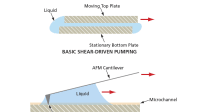
Important functionality of the system was demonstrated to study interfacial phenomena on nanostructured surfaces. Specifically, the confocal microscope system was used to experimentally capture the 3D shape of the meniscus in pillar arrays. Such quantitative understanding is essential to accurately obtaining the capillary pressure and liquid propagation rates. Second, the shape of the liquid front during liquid propagation in pillar arrays was obtained, which determines the local pressure gradient. This understanding helped explain the role of microscopic dynamics in macroscopic propagation rates. Finally, the confocal microscope facilitated understanding of how microstructures can be used to pin the liquid. This is a first step towards developing methods to quantifying thermal interfacial resistances. These measurements offer new insights towards understanding fluid-thermal-structure interactions to aid in the development of high-heat-flux thermal management solutions.
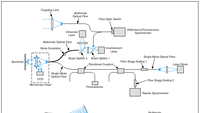
The confocal imaging system is comprised of a Visitech-Infinity3 multi-beam laser confocal scanner with selectable pinholes, two solid-state lasers, a Hamamatsu EMCCD high-sensitivity camera, and a Nikon upright microscope. Together, they provide 2D and 3D capture rates of 1000 Hz and 100 Hz, respectively, down to sub-micron spatial resolutions. The modular system can also be easily integrated with two cameras previously purchased. The confocal system’s modular design allows for easy integration with a variety of cameras and lasers to achieve the ideal optimizations of combined spatial and temporal resolution and sensitivity. The confocal system operates in both fluorescence and reflective modes, and has the potential for unprecedented flow imaging capabilities through a variety of integrated components. Recent efforts have focused on using the confocal microscope system with a 405-nm and 532-nm solid-state laser to investigate interfacial phenomena and quantify meniscus shapes to predict liquid propagation behavior on engineered surfaces. Prediction and optimization of liquid propagation rates in micropillar arrays are important for various thermal management applications.
The confocal microscope system was also used to quantify the meniscus of the liquid front during propagation in micropillar arrays. Such information is important to understand how microscopic dynamics affects macroscopic propagation rates, where the shape of the liquid front determines the local pressure gradient.
This work was done by Evelyn N. Wang of the Massachusetts Institute of Technology for the Office of Naval Research. ONR-0028
This Brief includes a Technical Support Package (TSP).

Confocal Imaging System for Ultra-Fast, Three-Dimensional Transport Studies in Thermal Management Applications
(reference ONR-0028) is currently available for download from the TSP library.
Don't have an account?
More From SAE Media Group
Tech Briefs
Forward-Scattering Particle-Image Velocimetry
Photonics & Imaging Technology
Overcoming the Optical Resolution Limit
Medical Design Briefs
Laser Optics Support High-Resolution 3D Microscopy

Tech Briefs
AI-Powered Self-Driving Microscopy Technique
Photonics Tech Briefs
Instruments for Imaging From Far to Near
Photonics Tech Briefs
Imaging of γ-Irradiated Regions of a Crystal
Tech Briefs
Tunable, Narrow Linewidth, Chip-Scale Lasers
Photonics & Imaging Technology
Let’s Get Small: New Argonne Method Greatly Improves X-Ray Nanotomography Resolution
Photonics & Imaging Technology
New Frequency Comb Can Identify Molecules in 20-Nanosecond Snapshots
Robotics & Automation INSIDER
Smallest Walking Robot Makes Microscale Measurements
Tech Briefs
Levitating Objects with Light
Medical Design Briefs
Multicolor Super-Resolution Imaging Made Easy
Electronics & Sensors INSIDER
New Technique Pinpoints Nanoscale ‘Hot Spots’ in Electronics
Photonics & Imaging Technology
The Latest Advancements in Optics
Photonics & Imaging Technology
2021 OEM Photonics & Imaging Directory
Photonics & Imaging Technology
Researchers Use Inkjet Printing to Make a Portable Multispectral 3D Camera
Electronics & Sensors INSIDER
New Photonic Effect Could Speed Drug Development
Aerospace & Defense Tech Briefs
Detecting Trace Levels of Explosives Using Vibrational Sum Frequency Spectroscopy
Overview
The document presents a final technical report on a research project titled "A Confocal Imaging System for Ultra-Fast Three-Dimensional Transport Studies in Thermal Management Applications," conducted by Principal Investigator Evelyn N. Wang at MIT. The project focuses on developing an advanced imaging system that integrates a confocal microscope with high-sensitivity and high-speed cameras to achieve diffraction-limited three-dimensional imaging of transient fluid flows.
The primary objective of this research is to enhance the understanding of coupled fluidic and heat transport processes, which are critical for improving thermal management in various defense systems, including phased-array radars and high-bandwidth jammers. The existing thermal management systems face limitations in spatial and temporal resolution, which this new imaging system aims to overcome.
Key features of the developed system include a high-speed swept-field confocal imaging capability that allows for capture rates of up to 1000 Hz. This enables researchers to gain fundamental insights into several areas: interfacial dynamics on nanostructured surfaces, phase-change phenomena, flow through porous media, and three-dimensional velocity field measurements in microscale systems. The system is designed to provide a deeper understanding of fluid-heat-structure interactions, which is essential for the design of high-performance thermal management systems.
The report highlights the technical approach taken in the development of the imaging system, emphasizing the use of a laser confocal scanner with selectable pinholes for fast scanning. This innovative setup is crucial for achieving highly resolved transient flows and interfacial dynamics, which are vital for advancing thermal management technologies.
In summary, the document outlines the successful development of a high-speed, diffraction-limited confocal imaging system that significantly enhances the ability to study complex thermal and fluidic interactions at the microscale. The insights gained from this research are expected to inform the design guidelines for next-generation thermal management systems, ultimately contributing to the advancement of critical defense technologies. The project underscores the importance of innovative imaging techniques in addressing the challenges associated with thermal management in high-performance applications.
Top Stories
INSIDERDefense
 New Raytheon and Lockheed Martin Agreements Expand Missile Defense Production
NewsAutomotive
 Ford Announces 48-Volt Architecture for Future Electric Truck
INSIDERManufacturing & Prototyping
 Active Strake System Cuts Cruise Drag, Boosts Flight Efficiency
ArticlesTransportation
 Accelerating Down the Road to Autonomy
INSIDERMaterials
 How Airbus is Using w-DED to 3D Print Larger Titanium Airplane Parts
Road ReadyTransportation

Webcasts
Electronics & Computers
 Cooling a New Generation of Aerospace and Defense Embedded...
Power
 Battery Abuse Testing: Pushing to Failure
Connectivity
 A FREE Two-Day Event Dedicated to Connected Mobility
Automotive
 Quiet, Please: NVH Improvement Opportunities in the Early Design Cycle
Transportation
 Advantages of Smart Power Distribution Unit Design for Automotive &...
Aerospace
 Sesame Solar's Nanogrid Tech Promises Major Gains in Drone Endurance