




Tin-Based IV-IV Heterostructures Fabricated Using Molecular Beam Epitaxy
Tin-based compounds for direct bandgap materials can be used in laser devices.
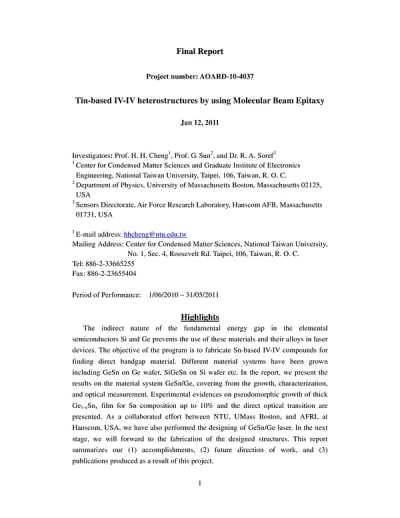
The indirect nature of the fundamental energy gap in the elemental semiconductors Si and Ge prevents the use of these materials and their alloys in laser devices. The objective of this work is to fabricate Sn-based IV-IV compounds for finding direct bandgap material. This work focuses on the material system GeSn/Ge, from the growth, characterization, and optical measurement. Experimental evidences on pseudomorphic growth of thick Ge1-xSnx film for Sn composition up to 10% and the direct optical transition are presented.

By employing several proposed techniques, key issues affecting the growth of the alloy and its heterostructure have been resolved (-Sn segregates during the growth of GeSn film and the misfit dislocations develop at GeSn/Ge interface due to the large lattice mismatch between Sn and the Ge wafer).
A series of Ge1-xSnx films with various Sn compositions up to 30% and thickness of 30 nm was grown. From the analysis of cross-sectional transmission electron microscope (XTEM) and Energy- Dispersive x-ray (EDS), for Sn composition 10%, it shows that: (1) the Ge1-xSnx films are misfit dislocation-free in the XTEM, and (2) Sn is uniformly distributed in the Ge1-xSnx films. For Sn composition 10%, the Ge1-xSnx film is not alloying with defects. All these films are above the predicted critical thickness required for the laser structure.
Various measurements have been performed to characterize these samples, including XTEM, EDS, high-resolution Xray, Raman spectroscopy, etc. Fourier transform infrared spectroscopy (FTIR) is employed for probing the bandgap of the GeSn film. The measurement is arranged in the setup with multi-reflection.
In comparison with bulk Ge, the absorption edge of the Ge0.98Sn0.02 film shifts to lower energy. The spectrum is characterized by two features that locate at around 0.68 eV and 0.55 eV associated with the absorption originated from indirect and direct optical transitions. The value of the absorption is roughly the same as the theoretical value of 0.69 and 0.56 eV.
Two lattice-matched laser structures were proposed using GeSn as active layers and GeSiSn as barriers. One has a double heterostructure (DH) and the other has a multiple quantum well (MQW) structure. The DH laser design is relatively easy to grow, but only operates at low temperatures. The MQW design, on the other hand, can potentially operate up to room temperature. Lasing wavelength can be tuned from near- to mid-infrared with the Sn composition. On the implementation side, growth of GeSn alloys was begun with various compositions on Si substrates using MBE.
Several cycles of laser designs, structure growth, device processing, and characterization will be necessary given the degree of complexity of this project. Laser designs will be refined with the material parameters obtained from the characterization of the actual structures grown on Si substrates, which in turn will guide the material and structure development and subsequent device processing.
This work was done by H. H. Cheng of National Taiwan University, G. Sun of the University of Massachusetts, and R. A. Soref of the Air Force Research Laboratory. AFRL-0195
This Brief includes a Technical Support Package (TSP).
Tin-Based IV-IV Heterostructures Fabricated Using Molecular Beam Epitaxy
(reference AFRL-0195) is currently available for download from the TSP library.
Don't have an account?
More From SAE Media Group
Aerospace & Defense Tech Briefs
3D Meta-Optics for High-Energy Lasers
Tech Briefs
Hybrid Material is an Efficient Photodetector
Photonics & Imaging Technology
Continuous and Stable Lasing Achieved From Low-Cost Perovskites at Room Temperature
Photonics & Imaging Technology
Optical Coatings Technology
Medical Design Briefs
Optical Design Considerations for Additive Manufacturing
Photonics & Imaging Technology
Industrial Blue Lasers



Photonics & Imaging Technology
Ultrafast Laser Micromachining
Tech Briefs
Synthesizing Complex Optical Materials
Photonics & Imaging Technology
Fiber Lasers for Powertrain Welding Applications
Photonics & Imaging Technology
Additive Manufacturing of Precision Optics at Micro and Nanoscale
Electronics Tech Briefs
Using Light To Fabricate Photonic Devices
Photonics & Imaging Technology
Nanoscale Machines Convert Light into Work
Tech Briefs
High-Efficiency Laser for Silicon Chips
Photonics & Imaging Technology
SPIE Photonics West 2022 Preview
Tech Briefs
Chip Measures Quantities with Quantum Precision
Aerospace & Defense Tech Briefs
Integrated Magneto-Optical Devices for On-Chip Photonic Systems
Photonics & Imaging Technology
Deformation Fingerprints Will Help Researchers Identify, Design Better Metallic Materials
Medical Manufacturing and Machining
Hybrid Technique Aims to Produce Stronger, Corrosion-Resistant Nickel

Overview
The document is a final report on a project titled "Tin-based IV-IV Heterostructures," which was conducted from December 1, 2010, to January 11, 2011, under project number AOARD-10-4037. The research was led by Prof. Hung Hsiang Cheng at National Taiwan University, with sponsorship from the Air Force Office of Scientific Research (AOARD).
The primary focus of the project was to fabricate tin-based IV-IV semiconductor compounds using Molecular Beam Epitaxy (MBE), a technique that allows for precise control over the growth conditions of the materials. This approach differs from the conventional method, which typically employs Chemical Vapor Deposition (CVD). The flexibility of MBE enables the adjustment of various parameters, such as growth temperature, to optimize the material properties.
The report details the systematic investigation of GeSn/Ge material systems, where different Sn-based IV-IV compounds, including GeSn on Ge wafers and SiGeSn on Si wafers, were fabricated. The research is organized into several sections: the growth of GeSn, characterization of the structure, optical measurements, and the design of GeSn/Ge lasers.
Key accomplishments include the successful growth of Ge1-xSnx films with varying Sn compositions (up to 30%) and thicknesses (up to 30 nm). The study found that for Sn compositions less than or equal to 10%, the films were free of misfit dislocations and exhibited uniform Sn distribution. However, for compositions greater than 10%, defects began to appear, indicating challenges in alloying at higher Sn concentrations. Notably, the report claims that the defect-free thick films produced are a first in the literature, which could have significant implications for future semiconductor applications.
Additionally, the report presents optical measurements, including absorption spectra that demonstrate both indirect and direct optical transitions in the Ge0.98Sn0.02 films, further validating the potential of these materials for light-emitting devices.
In conclusion, this project represents a significant advancement in the development of direct bandgap materials through the innovative use of MBE for tin-based IV-IV compounds, paving the way for future research and applications in semiconductor technology and laser design.
Top Stories
NewsSensors/Data Acquisition
 Microvision Aquires Luminar, Plans Relationship Restoration, Multi-industry Push
INSIDERRF & Microwave Electronics
 A Next Generation Helmet System for Navy Pilots
INSIDERWeapons Systems
 New Raytheon and Lockheed Martin Agreements Expand Missile Defense Production
NewsAutomotive
 Ford Announces 48-Volt Architecture for Future Electric Truck
INSIDERAerospace
 Active Strake System Cuts Cruise Drag, Boosts Flight Efficiency
ArticlesTransportation

Webcasts
Aerospace
 Cooling a New Generation of Aerospace and Defense Embedded...
Energy
 Battery Abuse Testing: Pushing to Failure
Power
 A FREE Two-Day Event Dedicated to Connected Mobility
Automotive
 Quiet, Please: NVH Improvement Opportunities in the Early Design Cycle
Electronics & Computers
 Advantages of Smart Power Distribution Unit Design for Automotive &...
Unmanned Systems
 Sesame Solar's Nanogrid Tech Promises Major Gains in Drone Endurance