




Crumple Zone Software Absorbs Attack Effects Before System Failures
This architectural construct absorbs cyber-attack effects before they cause significant system failures.
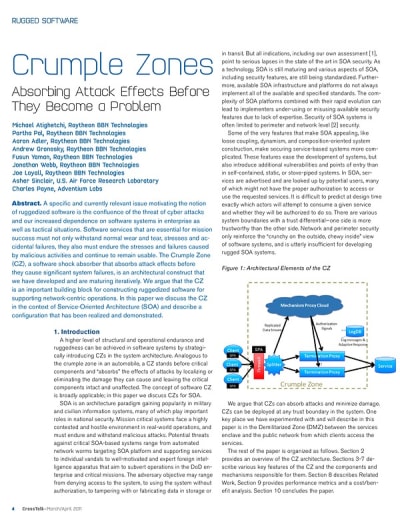
A higher level of structural and operational endurance and ruggedness can be achieved in software systems by strategically introducing crumple zones (CZs) in the system architecture. Analogous to the crumple zone in an automobile, a CZ stands before critical components and “absorbs” the effects of attacks by localizing or eliminating the damage they can cause and leaving the critical components intact and unaffected. The concept of software CZs is broadly applicable; this work focuses on CZs for SOA.

As a technology, SOA is still maturing and various aspects of SOA, including security features, are still being standardized. Furthermore, available SOA infrastructure and platforms do not always implement all of the available and specified standards. The complexity of SOA platforms combined with their rapid evolution can lead to implementers under-using or misusing available security features due to lack of expertise. Security of SOA systems is often limited to perimeter and network-level security.
The CZ is, in basic terms, a layer of intelligent service proxies that work together to present a high barrier to entry to the adversary, to increase the chance of detection of malicious activities, and to contain and recover from failures and undesired conditions caused by malicious attacks. These proxies collectively implement the service’s consumer-facing application programming interface. Different proxies help contain malicious activity by applying security checks and controls, then approving data for release if it passes those checks. A key principle of the CZ’s design is that only data that has been inspected and approved by one or more proxies is passed along to the service.
Because the CZ inspects and processes untrusted data, it is expected to fail occasionally. Automatic monitoring and re-start of the proxies inside the CZ is another key design feature. Effective ness of the CZ depends on three requirements:
• The CZ must be non-bypassable. All consumer requests to the service must be mediated through the CZ.
• The CZ must cover both known and unknown attacks. It should be configurable so defenses can be tailored to the system’s operational requirements and the potential threat environment.
• The CZ must preserve the integrity of data that flows through it to prevent man-in-the-middle scenarios run by corrupted CZ components.
To meet the first requirement, making the CZ non-bypassable, conventional network-level protections such as firewalls and routers can be used. To make it difficult for adversaries to discover and access protected services, the CZ presents a very small ex ploitable surface to untrusted service consumers. This is accomplished by placing the CZ behind a firewall that uses single packet authorization (SPA). On the CZ’s side of the firewall, termination proxies (TPs) are used as the entry point for all incoming client connections.
The second requirement, varied and configurable defenses, is achieved through a set of proxies that implement specific checks and are organized in a mechanism proxy cloud (MPC). The MPC monitors observable behavior of requests. Proxies check assertions on application data, e.g., by checking serialization fields, and canary proxies consume application data and thereby absorb attacks, e.g., by crashing or getting corrupted.
The third requirement, preserving data integrity within the CZ, is achieved by service layer virtual private groups (slVPG). The Splitter component replicates Secure Sockets Layer (SSL) streams between clients and TPs to the MPC without breaking cryptographic envelopes. Key management components that are also part of the slVPG selectively share keys from the TPs to the MPC so that the new streams can be decrypted for inspection.
This work was done by Asher Sinclair of the Air Force Research Laboratory; Michael Atighetchi, Partha Pal, Aaron Adler, Andrew Gronosky, Fusun Yaman, Jonathan Webb, and Joe Loyall of Raytheon BBN Technologies; and Charles Payne of Adventium Labs. AFRL-0200
This Brief includes a Technical Support Package (TSP).
Crumple Zone Software Absorbs Attack Effects Before System Failures
(reference AFRL-0200) is currently available for download from the TSP library.
Don't have an account?
More From SAE Media Group
Off-Highway Engineering
Securing CAN Networks in Commercial Vehicles
Medical Design Briefs
Proactive Cybersecurity Saves Healthcare Organizations from Data Breaches
Off-Highway Engineering
Argus Cyber Security Responds Quickly to New Threats Via Over-The-Air Updates
Off-Highway Engineering
Upstream Devoted to Truck Cybersecurity Threats
Automotive Engineering
OTA Will Drive Cybersecurity Programs
Automotive Engineering
Cybersecurity Firm Enlists AI in Battle as Threats Increase


Automotive Engineering
'Function on Demand' Brings Opportunities, Security Challenges
Automotive Engineering
Cybersecurity Expert Says Crowdstrike and CDK Global Incidents Serve as Wake-Up Calls
Sensing Technology
IoT Threat Protection Is a Shared Ecosystem Responsibility
Automotive Engineering
SkillReal Signs Tier 1 Supplier for NVIDIA-Powered AI Inspection
Automotive Engineering
Securing the Software-Defined Vehicle
Medical Design Briefs
Securing the Future of Healthcare through the Right Cybersecurity Architecture

Off-Highway Engineering
Making Software-Defined Vehicles Cyber-Secure
Off-Highway Engineering
Addressing Configuration Controls in an Era of Multiple Security Frameworks
Medical Design Briefs
Cybersecurity

Photonics & Imaging Technology
Total Versatility: Flexible Test Station With a Cobot and Camera
Automotive Engineering
No, Really, What’s an SDV?
Automotive Engineering
Building Resilient SDVs: Secure by Design in the Automotive Industry
Automotive Engineering
Closing Gap to Leverage Enhanced Computational Power for SDV Advancement
Aerospace & Defense Tech Briefs
SIPHER: Scalable Implementation of Primitives for Homomorphic Encryption
Tech Briefs
Overheard in Tech Support: Cybersecurity

Automotive Engineering
Electrifying Opportunities at IAV
Autonomous Vehicle Engineering
Autonomy’s Computing Edge
Automotive Engineering
Automotive Cybersecurity Needs Serious Work
Overview
The document discusses the concept of "Crumple Zones" (CZs) in software architecture, drawing an analogy to automotive safety features designed to absorb impact during collisions. The primary focus is on enhancing the resilience and security of software systems, particularly in the context of Service-Oriented Architecture (SOA). As organizations increasingly rely on software for critical operations, the threat of cyber attacks necessitates robust mechanisms to ensure system integrity and availability.
Crumple Zones are proposed as architectural constructs that act as shock absorbers, localizing and mitigating the effects of attacks before they can cause significant damage to essential components. This approach aims to maintain the usability of software services even in the face of malicious activities. The document emphasizes that software must not only withstand typical operational stresses but also endure intentional disruptions caused by cyber threats.
The authors highlight the importance of integrating CZs into software systems to create a more ruggedized architecture capable of supporting network-centric operations. The paper outlines various mechanisms associated with CZs, including recovery-focused adaptation strategies that enable systems to automatically recover from attacks. For instance, watchdog components monitor system health and can restart failed components, ensuring minimal downtime and continued service availability.
Additionally, the document discusses the role of logging and analysis in enhancing system security. By maintaining a database of log messages, the system can track events leading up to crashes and analyze patterns that may indicate vulnerabilities or attack vectors. This proactive approach to logging helps in preventing future incidents and improving overall system resilience.
The authors acknowledge the support of the U.S. Air Force Research Laboratory and highlight the contributions of key researchers in the field, including Michael Atighetchi and Dr. Partha Pal, who have extensive experience in survivability and information assurance.
In conclusion, the document advocates for the adoption of Crumple Zones in software architecture as a critical strategy for enhancing the security and reliability of software systems in an increasingly hostile cyber environment. By implementing these concepts, organizations can better protect their essential services and ensure mission success despite the challenges posed by cyber threats.
Top Stories
INSIDERManufacturing & Prototyping
 How Airbus is Using w-DED to 3D Print Larger Titanium Airplane Parts
INSIDERManned Systems
 FAA to Replace Aging Network of Ground-Based Radars
NewsTransportation
 CES 2026: Bosch is Ready to Bring AI to Your (Likely ICE-powered) Vehicle
NewsSoftware
 Accelerating Down the Road to Autonomy
EditorialDesign
 DarkSky One Wants to Make the World a Darker Place
INSIDERMaterials
 Can This Self-Healing Composite Make Airplane and Spacecraft Components Last...
Webcasts
Defense
 How Sift's Unified Observability Platform Accelerates Drone Innovation
Automotive
 E/E Architecture Redefined: Building Smarter, Safer, and Scalable...
Power
 Hydrogen Engines Are Heating Up for Heavy Duty
Electronics & Computers
 Advantages of Smart Power Distribution Unit Design for Automotive...
Unmanned Systems
 Quiet, Please: NVH Improvement Opportunities in the Early Design...
