




Thermal-to-Visible Face Recognition
This technology addresses the problem of accurate face recognition in low-light conditions.
For nighttime surveillance, acquisition of visible light imagery is impractical due to the lack of illumination. Thermal imaging, which acquires mid-wave infrared or long-wave infrared radiation naturally emitted by the human body, can be utilized in low-light conditions to perform surveillance tasks. Identification of individuals captured by thermal imaging would significantly enhance nighttime intelligence gathering capabilities. However, government watch lists and databases almost exclusively contain visible-light face imagery of individuals of interest. Matching thermal face imagery to the existing databases therefore requires the development of across-modality face recognition algorithms and methods. Due to the large modality gap caused by the wavelength difference between visible and thermal radiation, thermal-to-visible face recognition is a challenging problem.
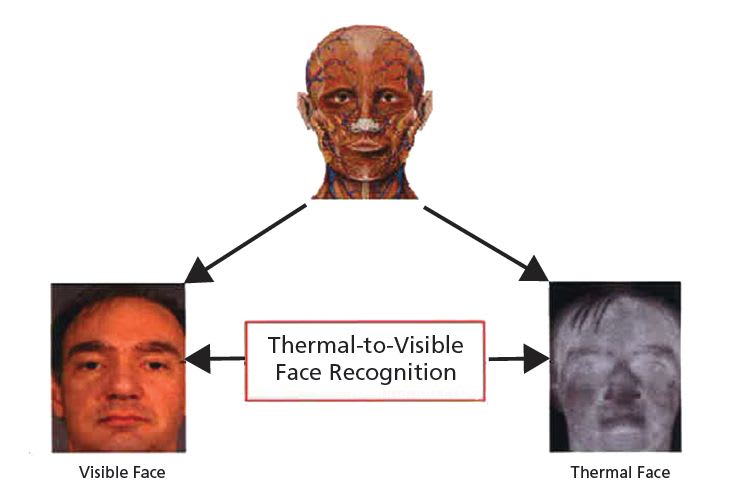
The infrared spectrum consists of four main regions: near infrared (NIR; 0.74- 1μm), shortwave infrared (SWIR; 1-3 μm), mid-wave infrared (MWIR; 3-5 μm), and long-wave infrared (LWIR; 8- 14 μm). While NIR and SWIR are also referred to as reflected infrared, MWIR and LWIR are naturally emitted by the human body and commonly referred to as thermal IR. Due to the proximity of the NIR spectrum to the visible spectrum, NIR face images preserve much of the information as in visible face images. However, both NIR and SWIR require active illumination so it is not very practical for nighttime surveillance.
The natural emission of thermal IR from the human body makes it an ideal modality for nighttime tasks, but the large disparateness between the thermal IR and visible spectrums results in a wide modality gap that makes thermal-to-visible face recognition a significantly more challenging problem than the NIR-tovisible or SWIR-to-visible face recognition problems. The key to solving thermal- to-visible face recognition is the development of an algorithm or transform space that well-correlates the thermal and visible face signatures.
This work addressed the problem of matching thermal probe images to visible gallery images. The gallery imagery consists of visible images to simulate government watch lists, and the thermal IR probe imagery simulates suspect imagery acquired during nighttime surveillance operations. This face identification problem of matching thermal probe images to visible gallery images is cast as a multimodal face recognition problem. Although there are several previous studies dealing with acrossmodality NIR-to-visible face recognition, this work is the first in trying to match thermal face images to visible face images.
To tackle this problem, various preprocessing techniques were explored such as self-quotient images and difference- of-Gaussian filtering, as well as various feature transforms to reduce the variations in each domain and enhance the multi-modal matching. In addition, a discriminant modeling function is used to weight the feature vectors by maximizing covariance between two modalities using partial least squares (PLS) analysis.
Since thermal and visible face images have very different signatures, preprocessing is important in solving the thermal-tovisible face recognition problem. For this work, preprocessing consists of two main stages: thermal image normalization, and local variation reduction for thermal and visible imagery. The dead pixels within the thermal imagery were removed via simple median filtering prior to image normalization. As a first preprocessing step for thermal imagery, the thermal signatures are normalized by its mean and standard deviation to reduce the temperature offset and statistical variation across thermal images. The second preprocessing step adjusts the thermal and visible imagery for local variations. For visible imagery, illumination primarily induces the local variations, whereas for the thermal imagery, the varying heat distribution within the face produces the local variations. Self quotient image (SQI) and difference of Gaussian filtering (DOG) were applied to reduce the local variations in thermal face imagery. SQI emphasizes the edge information in the thermal imagery, while DOG filtering blurs the visible imagery.
The best combination is DOG filtering and HOG features. The reason that HOG with DOG performs the best is that DOG makes the images spatially smooth so the gradient information becomes more stable. LBP is sensitive to subtle pixel-wise differences, which was lost due to the spatial smoothing during preprocessing.
This work was done by Jonghyun Choi and Larry S. Davis of the University of Maryland, and Shuowen Hu and S. Susan Young of the Army Research Laboratory. ARL-0145
This Brief includes a Technical Support Package (TSP).
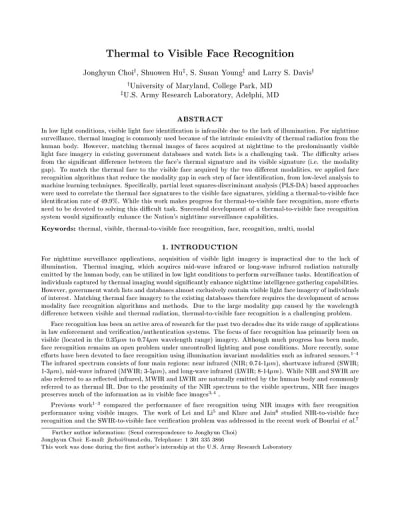
Thermal-to-Visible Face Recognition
(reference ARL-0145) is currently available for download from the TSP library.
Don't have an account?
More From SAE Media Group
Aerospace & Defense Tech Briefs
Calibrated Long-Wave Infrared (LWIR) Thermal and Polarimetric Imagery of Small Unmanned Aerial Vehicles (UAVs) and Birds
Photonics & Imaging Technology
INRS Researchers Design the World’s Fastest UV Camera
Photonics & Imaging Technology
Thermal Imaging: How Does It Work?
Photonics & Imaging Technology
Comparing Sensitivity of Thermal Imaging Cameras Modules
Aerospace & Defense Tech Briefs
High-Speed Midwave Infrared Cameras Enable Military Test Range Tracking System
Tech Briefs
High-Sensitivity Microwave Radiation Sensor
Tech Briefs
Multi-Spectral Imaging Pyrometer

Photonics & Imaging Technology
T-Ray Camera Speed Boosted a Hundred Times Over
Photonics & Imaging Technology
New Imaging Method Reveals Concealed Objects
Photonics & Imaging Technology
Harnessing SWIR Line Scan Imaging Technology
Sensor Technology
Convolutional Neural Networks Enable Nighttime Imaging
Aerospace & Defense Tech Briefs
Spatial Calibration for Accurate Long Distance Measurement Using Infrared Cameras
Electronics & Sensors INSIDER
New Method Measures Temperature Within 3D Objects
Imaging Technology
Pixel-Scale Coated Sensors Bring Multispectral Imaging to New Users
Tech Briefs
Infrared Zoom Moves Toward the Mainstream
Photonics & Imaging Technology
Compact Cooling for Superconducting Single-Photon Detectors
Photonics & Imaging Technology
Ultra-Narrowband Optical Filters Pushing Boundaries from the UV to the LWIR
Tech Briefs
Compressed Ultrafast Photography
Tech Briefs
Strengthening Electron-Triggered Light Emission
Photonics Tech Briefs
Shortwave Infrared (SWIR) Imaging Aids Laser Tracking, Detection
Tech Briefs
Smart Surgical Microscope
ADAS & Autonomous Vehicle Engineering
Owl AI’s 3D Thermal Sensors See Further into the Dark
Overview
The document discusses advancements in thermal-to-visible face recognition, particularly for nighttime surveillance applications where visible light imagery is impractical due to low illumination. It highlights the challenges associated with matching thermal images, which capture the mid-wave or long-wave infrared radiation emitted by the human body, to visible light images commonly found in government databases and watch lists. The primary issue is the significant modality gap between the thermal and visible signatures of faces.
To address this challenge, the authors applied face recognition algorithms designed to reduce the modality gap throughout the identification process. They utilized partial least squares-discriminant analysis (PLS-DA) based approaches to correlate thermal face signatures with visible face signatures. This method yielded a thermal-to-visible face identification rate of 49.9%, indicating progress in the field but also underscoring the need for further research and development.
The document emphasizes the importance of successful thermal-to-visible face recognition systems for enhancing nighttime intelligence gathering capabilities. The authors argue that improving these systems could significantly bolster national security efforts, particularly in surveillance scenarios where traditional methods fail.
The research is presented by a team from the University of Maryland and the U.S. Army Research Laboratory, indicating a collaboration between academic and military institutions to tackle real-world challenges in face recognition technology. The findings are part of a broader effort to develop multi-modal recognition systems that can operate effectively under varying conditions and modalities.
In summary, the document outlines the current state of thermal-to-visible face recognition technology, the methodologies employed to bridge the modality gap, and the implications of these advancements for nighttime surveillance and security. It calls for continued research to enhance identification rates and improve the reliability of these systems in practical applications.
Top Stories
INSIDERDefense
 New Raytheon and Lockheed Martin Agreements Expand Missile Defense Production
NewsAutomotive
 Ford Announces 48-Volt Architecture for Future Electric Truck
INSIDERManufacturing & Prototyping
 Active Strake System Cuts Cruise Drag, Boosts Flight Efficiency
ArticlesTransportation
 Accelerating Down the Road to Autonomy
INSIDERMaterials
 How Airbus is Using w-DED to 3D Print Larger Titanium Airplane Parts
Road ReadyTransportation

Webcasts
Electronics & Computers
 Cooling a New Generation of Aerospace and Defense Embedded...
Power
 Battery Abuse Testing: Pushing to Failure
Connectivity
 A FREE Two-Day Event Dedicated to Connected Mobility
Automotive
 Quiet, Please: NVH Improvement Opportunities in the Early Design Cycle
Transportation
 Advantages of Smart Power Distribution Unit Design for Automotive &...
Aerospace
 Sesame Solar's Nanogrid Tech Promises Major Gains in Drone Endurance