




Advanced Hypersonic Weapon Technology Undergoes Flight Test
At the U.S. Army Space and Missile Defense Command/Army Forces Strategic Command, successes sometimes happen faster than a speeding bullet.
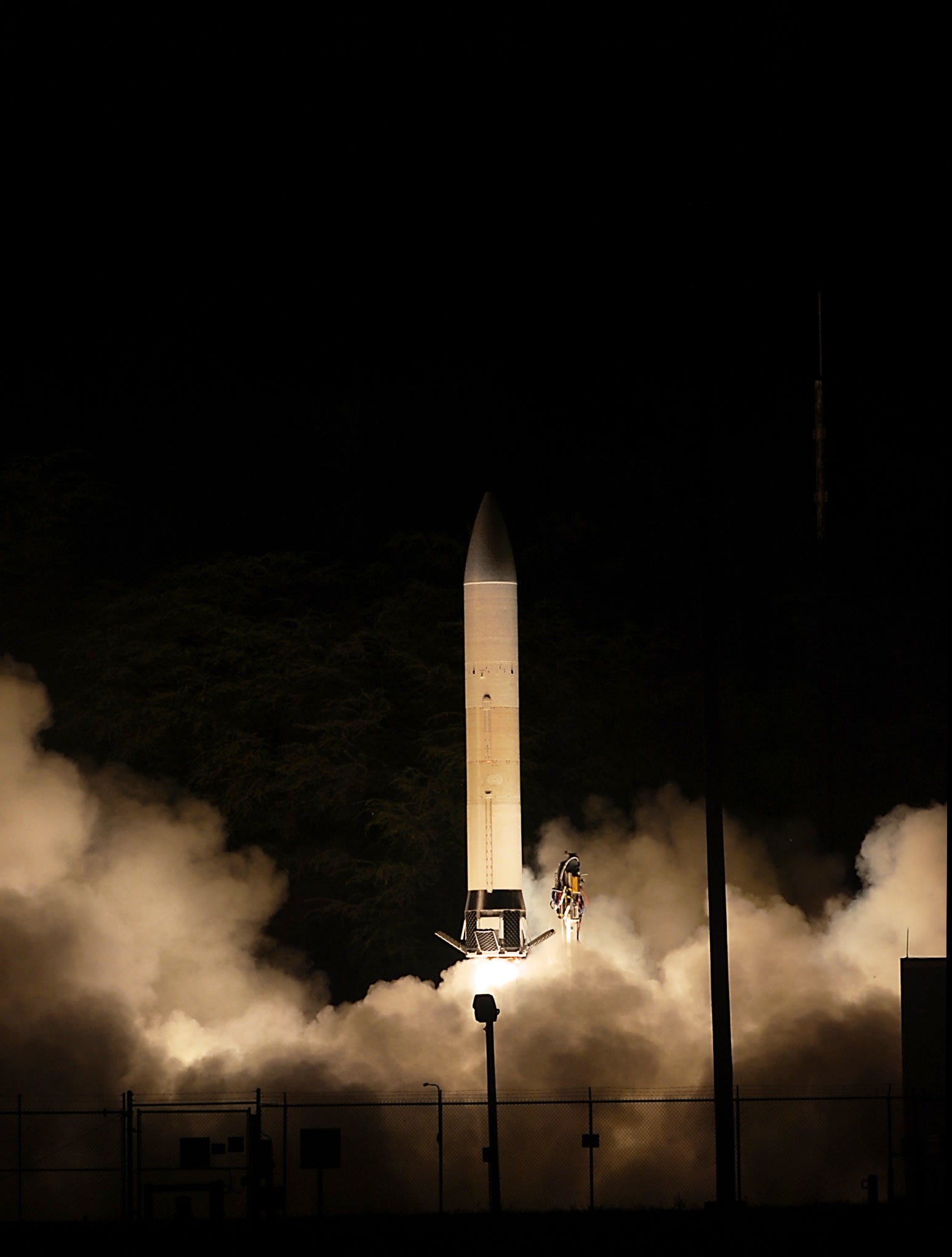
In a flight which lasted less than 30 minutes, USASMDC/ARSTRAT recently conducted the first test flight of the Advanced Hypersonic Weapon (AHW) concept. The AHW is a first-of-its-kind glide vehicle, designed to fly within the earth's atmosphere at hypersonic speed and long range. It was launched from the Pacific Missile Range Facility, Kauai, Hawaii, to the Reagan Test Site, U.S. Army Kwajalein Atoll, Marshall Islands.
"It is a first-of-its-kind glide vehicle that has a potential to change warfare forever," said Lt. Gen. Richard P. Formica, SMDC commanding general. "It is a great example of how the material development function in the SMDC Technical Center is a part of ARSTRAT that is developing future capabilities for U.S. Strategic Command - for 'the day after tomorrow.'"
The Army's Advanced Hypersonic Weapon Technology Demonstration is a cooperative effort within the Department of Defense to develop a conventional Prompt Global Strike capability. More specifically, the AHW-TD is an all endo-atmospheric boost glide, non-ballistic, missile flight that will advance state-of-the art thermal protection materials, enabling and integrating systems such as controls and communications, and internal thermal management schemes. Further, in-flight environmental data collection will advance the understanding and modeling efforts for all Prompt Global Strike concepts such as the Conventional Strike Missile being developed by the Air Force.
The conical-shaped AHW is designed to meet the demanding environments and operations of Continental United States-based systems capable of global strikes. As a precision glide body flying at supersonic speeds, the AHW can deliver a variety of payloads at medium and global ranges.
Hypersonic flight is defined as speeds of Mach 5, which is about 3,600 mph, or higher.
The objective of the test is to collect data on hypersonic boost-glide technologies and test range performance for long-range atmospheric flight. Mission emphasis is aerodynamics; navigation, guidance, and control; and thermal protection technologies.
"Two key technical challenges that the flight test addressed was thermal protection/thermal management and navigation, guidance and control," said Debra Wymer, SMDC Technical Center director.
A three-stage booster system launched the AHW glide vehicle and successfully deployed it on the desired flight trajectory. The vehicle flew a non- ballistic glide trajectory at hypersonic speed to the planned impact location at the Reagan Test Site. Space, air, sea and ground platforms collected vehicle performance data during all phases of flight. The data collected will be used by DOD to model and develop future hypersonic boost-glide capabilities for Conventional Prompt Global Strike.
More From SAE Media Group
Defense INSIDER
Hypersonic Glide Vehicle Successfully Tested

Aerospace & Defense Tech Briefs
Raytheon, DARPA Push Forward with Hypersonic Weapon Design
Defense INSIDER
Navy Proves Cold-Gas Approach in Hypersonic Launch Test
Aerospace Manufacturing and Machining INSIDER
DARPA Completes Key Milestone on Hypersonic Air-breathing Weapons Program
Aerospace & Defense Tech Briefs
Five Missile-Tracking Satellites Launched


Defense INSIDER
Adranos Secures Government Contracts for Hypersonic Research
Aerospace & Defense Tech Briefs
Next Generation Air and Missile Defense Radar

Aerospace INSIDER
Millennium Space to Build Eight 'FOO Fighter' SDA Satellites
Defense INSIDER
Kauai Test Facility Launches Its Largest Missile
Aerospace & Defense Tech Briefs
Can Embedded Electronics Components Meet the Demands of Hypersonic Missiles?


Defense INSIDER
High-Speed Test Track Prepared for Upcoming Hypersonic Missions
Aerospace INSIDER
ATHENA Sensor Brings Generational Leap to Airborne MANPAD Protection
Aerospace & Defense Tech Briefs
Prototype Hypersonic Defense Engine
Aerospace INSIDER
Hermeus Quarterhorse Joins Hypersonic High Cadence Testing Program
Aerospace & Defense Tech Briefs
Northrop Grumman Will Fit Its Scramjet Combustors to Raytheon’s Hypersonic Missile
Defense INSIDER
PAC-3 Missile Successfully Intercepts Cruise Missile Target
Aerospace & Defense Tech Briefs
Generation Orbit’s GOLauncher1 Is Officially the Air Force’s X-60A Hypersonic Flight Research Vehicle
Defense INSIDER
Sandia Delivers First DOE Sounding Rocket Program Since 1990s
Defense INSIDER
Patriot Missile Hits Target in Test of Upgraded ICBS Radar

Aerospace INSIDER
Navy Selects Lockheed Martin and Raytheon to Develop Hypersonic Missile
Aerospace & Defense Tech Briefs
Notre Dame’s New Boundary Breaking Mach 10 Quiet Wind Tunnel
Top Stories
INSIDERManufacturing & Prototyping
 How Airbus is Using w-DED to 3D Print Larger Titanium Airplane Parts
INSIDERManned Systems
 FAA to Replace Aging Network of Ground-Based Radars
NewsTransportation
 CES 2026: Bosch is Ready to Bring AI to Your (Likely ICE-powered) Vehicle
NewsSoftware
 Accelerating Down the Road to Autonomy
EditorialDesign
 DarkSky One Wants to Make the World a Darker Place
INSIDERMaterials
 Can This Self-Healing Composite Make Airplane and Spacecraft Components Last...
Webcasts
Power
 E/E Architecture Redefined: Building Smarter, Safer, and Scalable...
Power
 Hydrogen Engines Are Heating Up for Heavy Duty
Automotive
 Advantages of Smart Power Distribution Unit Design for Automotive...
Transportation
 Quiet, Please: NVH Improvement Opportunities in the Early Design...
AR/AI
 A FREE Two-Day Event Dedicated to Connected Mobility
Power
 Powering America’s EV Future: Connect, Collaborate, Innovate