




Fabrication of Transparent Carbon Nanotube Films for OLED Applications
This process produces single-wall carbon nanotube (SWCNT) dispersion solutions that are stable enough to be stored and used repeatedly.
The process to prepare single-wall carbon nanotube (SWCNT) solutions with a good degree of dispersion of individually isolated SWCNTs and very thin SWCNT bundles was optimized. The SWCNT-dispersion solutions are so stable that they can be stored and used repeatedly for some period of time.
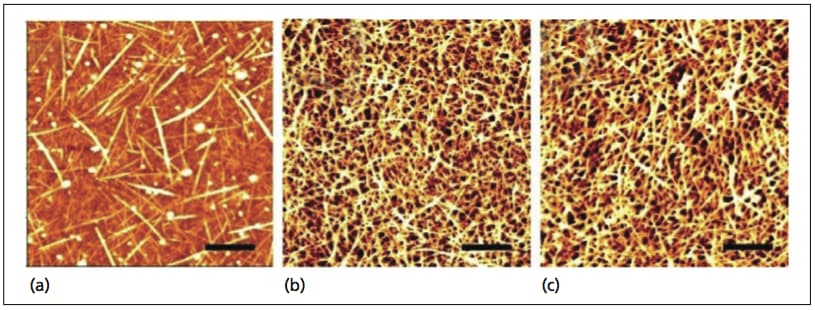
Another process that was developed for more efficient reduction of the sheet resistance was the combination treatment of SWCNT films with HNO3 and SOCl2. This new process turned out to be more stable against undesired increase of the sheet resistance due to the inevitable heating that the SWCNT would experience during the organic light emitting diode (OLED) fabrication. It appears that the doping and dedoping effects are more prominent in the combination treatment with HNO3 and SOCl2, as evidenced by the suppression and recovery of the van Hove singularities in response to the combination treatment and heating.
More evidence for the anodic doping (electron withdrawal) due to the combination treatment was found from the resonance Raman scattering. The distinct Raman modes of some semiconducting SWCNTs that appeared strong because of the resonance of the excitation energy (1.15 eV) with the S22 transition became substantially weak after the HNO3-SOCl2 combination treatment.
One of the key process steps for OLED fabrication on SWCNT electrodes is the anode patterning. Through systematic investigation of photolithography and oxygen plasma etching processes, process parameters were optimized to pattern the SWCNT films into desired anode patterns without the contamination, delamination, and sheet-resistance increase.
Another important issue related to the SWCNT anode is how to overcome the surface roughness; in particular, very large peak-to-valley height variation. This problem was solved by using a PEDOT:PSS hole-injection layer for the planarization. OLEDs with the structure of SWCNT-anode/PEDOT:PSS(90nm)/ NPB(200nm)/Alq3(40nm)/LiF(1nm)/Al(100nm) were successfully fabricated. The operation of such a device showed that the performance of a green-emitting OLED based on the SWCNT anode is comparable to that of more conventional green-emitting OLEDs fabricated on ITO anodes.
SWCNT-network films were cast on either glass or flexible PET substrates using a spin coater. The number of spin-coatings was one of the important process parameters to control the sheet resistance and the visible transmittance of SWCNT films. To cast SWCNT films on PET substrates, proper-size PET pieces were attached to glass backing plates using double-sided adhesive tapes to prevent bending and sliding of PET substrates during spin-coating operation. In the case of casting on glass substrates, 3-aminopropyl triethoxysilane was used to improve the adhesion between SWCNT films and the glass substrates. First, 1 wt% solution of 3-aminopropyl triethoxysilane was dropped on the glass substrate and left set for 5 minutes. Next, the excess 3-aminopropyl triethoxysilane solution was removed by spinning and thoroughly rinsing the substrates prior to the SWCNT-film casting.
The conventional photolithography technique was used to form patterned SWCNT anodes. The exposed areas of the SWCNT films were easily removed by using a radio-frequency oxygen-plasma (40 s, 100 mTorr, 100mW), whereas the PR-coated areas remained intact. Acetone-rinsing to remove the protective PR after the reactive ion etching induced no degradation to the SWCNT anodes. For OLED fabrication, a PEDOT:PSS layer was deposited by spin coating, and then NPB, Alq3, LiF, and Al layers were evaporated at the pressure of 110-6 torr. All the fabrication steps were performed in a glovebox with a thermal evaporator directly connected to it. The fabricated OLEDs were hermetically sealed by glass encapsulations with getters before being taken out from the glovebox for current-luminance voltage measurements.
Selection of dispersion medium and ultrasonication conditions, such as power, frequency, and time, are important process parameters to make stable, good-quality SWCNT dispersion solutions. Preparation of good CNT dispersion soluions, without cutting CNTs too short due to excessive ultrasonication, is essential for the successful fabrication of CNT electrodes with low sheet resistance and high visible-light transmission. Through an extensive search for optimal process conditions, dispersion solutions were created that contained less bundled and individually separated micrometer-scale SWCNTs.
This work was done by Soon Il Lee of Ajou University, South Korea, for the Asian Office of Aerospace Research and Development. AFRL-0155
More From SAE Media Group
Aerospace & Defense Tech Briefs
Progress Toward Carbon-Nanotube Arrays for Probing Cells
Aerospace & Defense Tech Briefs
Solution Deposition Methods for Carbon Nanotube Field-Effect Transistors
Tech Briefs
Stretchable, Flexible Biofuel Cell Runs on Sweat
Medical Design Briefs
Nontoxic, Flexible Energy Converters Could Power Wearable Devices
Aerospace & Defense Tech Briefs
Fabrication of Carbon Nanotube Channels on Three- Dimensional Building Blocks
Tech Briefs
Holey Carbon Allotropes
Tech Briefs
Metallization for SiC Semiconductors
Aerospace & Defense Tech Briefs
Advances in Fabrication of Nanoscale Devices

Power Electronics INSIDER
Carbon Nanotubes Store Energy

Tech Briefs
A Thin, Flexible OLED Display
Medical Manufacturing and Machining
Researchers Develop Ultra-Thin, Ultra-Flexible Electronic Material
Electronics & Sensors INSIDER
Researchers Demonstrate Self-Assembling Electronics

Power Electronics INSIDER
Scalable Supercapacitor Technology Made from Graphene

Power Electronics INSIDER
Substrate Engineering to Improve Power Electronics
Battery & Electrification Technology
Leading the Charge to Better Batteries
Tech Briefs
Rapidly Testing Stretchable Sensors


Aerospace Manufacturing and Machining
Optimizing Plasma Treatments to RESOLVE Challenging Adhesion Issues
Top Stories
NewsSensors/Data Acquisition
 Microvision Aquires Luminar, Plans Relationship Restoration, Multi-industry Push
INSIDERRF & Microwave Electronics
 A Next Generation Helmet System for Navy Pilots
INSIDERWeapons Systems
 New Raytheon and Lockheed Martin Agreements Expand Missile Defense Production
NewsAutomotive
 Ford Announces 48-Volt Architecture for Future Electric Truck
INSIDERAerospace
 Active Strake System Cuts Cruise Drag, Boosts Flight Efficiency
ArticlesTransportation

Webcasts
Aerospace
 Cooling a New Generation of Aerospace and Defense Embedded...
Energy
 Battery Abuse Testing: Pushing to Failure
Power
 A FREE Two-Day Event Dedicated to Connected Mobility
Automotive
 Quiet, Please: NVH Improvement Opportunities in the Early Design Cycle
Electronics & Computers
 Advantages of Smart Power Distribution Unit Design for Automotive &...
Unmanned Systems
 Sesame Solar's Nanogrid Tech Promises Major Gains in Drone Endurance