




Ultraviolet Polymerization of Hydrodynamically Shaped Fibers
These fibers can be used in high-strength materials, wound-healing dressings, controlled-release materials, or anti-ballistic fabrics.
Materials composed of stacked plates are stronger than the same materials in bulk. However, such stacked plate materials are generally composed of hard, inorganic materials cemented together by a more flexible substance, and do not occur in long fiber shapes. Very few natural or manmade materials are composed of stacks of plate-like fibers. Manmade polymer fibers are nearly always round because they are fabricated using two-phase systems; for example, a solubilized polymer precursor or a monomer–initiator solution is introduced into air by electrospinning, extrusion, or pulling.
Hydrodynamic focusing using microfluidic systems has been reported for making solid or hollow round fibers with micron and sub-micron diameters. The fibers and tubes have been polymerized using both chemical initiators and ultraviolet (UV) polymerization. Hydrodynamic focusing has also been used to precipitate fibers in microfluidic channels as two reactive streams intersect. These fibers are roughly rectangular, as a result of the shape of the interface between the two streams. Hydrodynamic focusing can be performed using grooves in the walls of microfluidic channels to focus one stream with another to create cross-sectional stream shapes more complex than simply circular or rectangular.
In an initial demonstration of production of polymer fibers with pre-designed cross-sectional shapes, acrylate fibers were cast using a hydrodynamic focusing device with grooves in the top and bottom of a microfluidic channel that focused a miscible sheath fluid around the solubilized polymer core solution. Laminar flow minimized mixing of the sheath and core fluids, and hydrodynamic focusing of the sheath fluid controlled the cross-sectional shape of the core. The cross-sectional size was determined by the flow rate ratio of the core and sheath streams.
The fiber hardened as the solvent diffused out of the core into the sheath fluid after the hydrodynamic shaping process and during subsequent flow through the microfluidic channel. However, the range of fiber diameters that could be produced using this casting process was limited. The larger fibers tended to harden first on the outside, leading to collapse of the fibers as the internal regions shrunk during casting. The smallest diameter that could be achieved (~300 nm) was limited by the ability of the pumps to transport the viscous fluids without pulsing. The slow rate of hardening also meant that the fibers tended to become rounder after exiting the microfluidic channel.
To overcome these limitations, UV polymerization was explored as a faster, more uniform method of polymerizing fibers during the hydrodynamic shaping process. The initial challenge was to determine conditions under which the UV polymerization could be accomplished fast enough to lock in the cross-sectional shape of the fiber before it exited the microfluidic channel. The roles of flow velocity, flow-rate ratio, and UV power in creating fibers with rectangular cross-sectional shapes were explored. The microfluidic sheath flow system successfully shaped an acrylate mixture into flat fibers using hydrodynamic focusing and UV polymerization. Initial measurements of the structural and mechanical properties demonstrated shape control and fiber integrity.
Hydrodynamic focusing using passive wall structures was used to shape a prepolymer stream, which was subsequently polymerized using UV exposure. The shape designed using flow simulations was maintained, and the size of the fibers was controlled using the ratio of the flow rates of the sheath and the prepolymer. The fibers exhibited reproducible shapes over meter lengths. The fidelity of the shape was a function of both exposure time and phase matching of the sheath and prepolymer fluids. This microfluidic approach for production of fibers with defined cross-sectional shape can produce fibers for further development of materials with new or improved performance characteristics.
This work was done by Abel L. Thangawng, Peter B. Howell Jr., Christopher M. Spillmann, Jawad Naciri, and Frances S. Ligler of the Naval Research Laboratory. NRL-0050
This Brief includes a Technical Support Package (TSP).
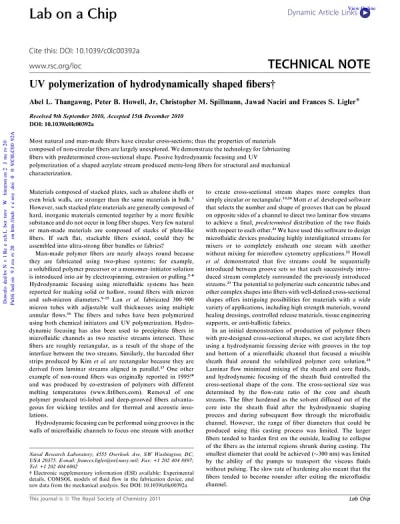
UV polymerization of hydrodynamically shaped fibers
(reference NRL-0050) is currently available for download from the TSP library.
Don't have an account?
More From SAE Media Group
Tech Briefs
3D-Printed Device Produces Nanofiber Meshes


Aerospace & Defense Tech Briefs
Evaluation of Additively Manufactured Ultrahard Steels
Medical Design Briefs
Parallel Fluidics Produces Ultra-Precise Microfluidics Prototypes with CYROLITE® MD
Medical Design Briefs
Portable Nanofiber Device Offers Precise Control for Fabricating 3D Tissue
Medical Design Briefs
High-Performance Micro-Porous Fluoropolymer Plastics for Critical Applications

Medical Design Briefs
Conductive, Cotton-Based Fiber for Smart Textiles
Aerospace & Defense Tech Briefs
High-Temperature Resins for Composite Materials

Medical Design Briefs
Wound Dressings Made of Drug-Releasing Polymers
Medical Design Briefs
Medical Plastics: Understanding Ultrasonic Welding, Part 1

Tech Briefs
A Precision Arm for Mini Robots
Tech Briefs
Conductive Carbon Fiber Polymer Composite
Aerospace & Defense Tech Briefs
How to Select the Right Silicone for Space Applications
Medical Design Briefs
Automated Production of Advanced Materials
Medical Design Briefs
Medical Device Market Pushes the Limits of Tubing


Tech Briefs
Self-Growing 3D Objects
Automotive Engineering
Linking Embroidery and Carbon Fiber to save Weight and Cost
Medical Design Briefs
Options for Reducing Friction When Using Silicone Elastomers
Tech Briefs
Nanowicks
Automotive Engineering
Lighter, Recyclable Body Seal from Cooper Standard Wins SAA Award

Overview
This document presents research on the UV polymerization of hydrodynamically shaped fibers, focusing on the fabrication of fibers with predetermined non-circular cross-sectional shapes. Traditional fibers typically have circular cross-sections, and the properties of non-circular fibers remain largely unexplored. The study aims to overcome limitations in fiber production by employing a microfluidic sheath flow system that utilizes UV polymerization to create flat fibers from an acrylate mixture.
The research details the preparation of the acrylate solution, which consists of 4-hydroxybutyl acrylate, acrylic acid, ethylene glycol dimethacrylate, and a photoinitiator. The solution is mixed with a sheath solution made of glycerol, methanol, and water, achieving a viscosity of approximately 10 cP. The document outlines the experimental setup, including the design and operation of the microfabrication device and the simulations of fluid flows within the device.
Key findings include the successful shaping of fibers with rectangular cross-sections through hydrodynamic focusing and UV polymerization. The study investigates the effects of flow velocity, flow-rate ratio, and UV power on the fiber formation process. Initial measurements of the structural and mechanical properties indicate that the fibers exhibit good shape control and integrity. The tensile modulus of the fibers was measured at 6.1 MPa, comparable to that of round acrylate-based fibers produced using similar methods.
The document also discusses the impact of exposure time on shape retention, noting that shorter exposure times can lead to incomplete polymerization, resulting in rounded shapes. The mechanical properties were further evaluated through stress/strain cycles, revealing a decrease in tensile modulus with repeated tensile stress, suggesting a process of polymer training or annealing.
Overall, the research demonstrates the feasibility of producing robust, non-circular fibers with unique mechanical properties through in situ polymerization. This advancement opens new avenues for the application of non-circular fibers in various fields, potentially leading to innovative materials with enhanced performance characteristics. The findings contribute to the understanding of fiber fabrication techniques and their implications for material science and engineering.
Top Stories
INSIDERManufacturing & Prototyping
 How Airbus is Using w-DED to 3D Print Larger Titanium Airplane Parts
NewsAutomotive
 Microvision Aquires Luminar, Plans Relationship Restoration, Multi-industry Push
INSIDERAerospace
 A Next Generation Helmet System for Navy Pilots
INSIDERDesign
 New Raytheon and Lockheed Martin Agreements Expand Missile Defense Production
ArticlesAR/AI
 CES 2026: Bosch is Ready to Bring AI to Your (Likely ICE-powered) Vehicle
Road ReadyDesign

Webcasts
Semiconductors & ICs
 Advantages of Smart Power Distribution Unit Design for Automotive...
Unmanned Systems
 Quiet, Please: NVH Improvement Opportunities in the Early Design...
Electronics & Computers
 Cooling a New Generation of Aerospace and Defense Embedded...
Power
 Battery Abuse Testing: Pushing to Failure
AR/AI
 A FREE Two-Day Event Dedicated to Connected Mobility
