




Environmental Awareness of Sensor and Emitter Employment
Many Army missions rely on effective sensing capabilities that provide intelligence on the adversary, and protect friendly forces from enemy detection. Sensors that are stationary (microphones, geophones, and ground-based radars) and moving (cameras on unattended aerial vehicles and ground vehicles) assist operations such as persistent surveillance of small, forward-operating bases, and rapid covert troop maneuvers in the air and on the ground. When advantageous, sensing is often performed in multiple signal modalities including visible, infrared, acoustic, seismic, radiofrequency, chemical, and biological.
Environmental Awareness of Sensor and Emitter Employment (EASEE) is a software framework that provides a single environment for analyzing sensor performance involving many different signal modalities. This ability for multimodal signal analysis enables EASEE to also perform higher-level data synthesis needed to answer critical sensing questions such as the sensor types and locations best suited for accomplishing mission objectives within the constraints of a particular environment.
The EASEE software design is formulated within the conceptual framework of object-oriented programming in the Java language. Random environmental effects on transmitted and received features are accounted for by representing them as random variables. Parametric descriptions of these random variables are programmed in EASEE within Java classes. These Java classes are denoted as signal models, and instances of them are signal model objects. Signal model objects are key in the architecture of EASEE, since they are what are actually transmitted, received, and processed.
Specifically, the feature generator produces a signal model object that is inputted and then altered by the feature propagator and feature sensor before it is finally analyzed by the feature processor to produce an inference, which represents desired information derived from the data features such as probability of detection or error of target location estimates.
Signal model classes contain methods for the various statistical operations necessary for making probabilistic predictions on sensor performance, including setting the mean and variance; converting from mean and variance to unique parameter values; computing the pdf, cdf, and quantile; and summing a random variable described by an instance of the class with another one.
This work was done by Kenneth K. Yamamoto, D. Keith Wilson, and Chris L. Pettit of the Cold Regions Research and Engineering Laboratory for the U.S. Army Corps of Engineers. ARL-0123
This Brief includes a Technical Support Package (TSP).
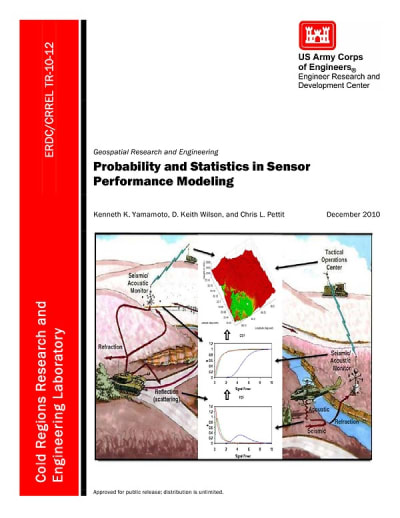
Probability and Statistics in Sensor Performance Modeling
(reference ARL-0123) is currently available for download from the TSP library.
Don't have an account?
More From SAE Media Group
Automotive Engineering
Mapping out Future Vehicle Cockpits
Tech Briefs
Flight-Tested Prototype of BEAM Software
Tech Briefs
MSET Industrial Early Warning System
Automotive Engineering
Ford Releasing Comprehensive Dataset to Promote Autonomous R&D
Automotive Engineering
ZF’s Smart Chassis Sensors Debut in Cadillac Celestiq
Autonomous Vehicle Engineering
Foretellix Building Precise Software Language for Validating Self-Driving Scenarios
Off-Highway Engineering
Big Data’s Benefits Keep A-Comin’
Off-Highway Engineering
AI Moves into Military Boards and Subsystems
Automotive Engineering
Tuning-Up AI’s ‘Understanding’ to Make Safer ADAS, AVs
Automotive Engineering
CES 2024: VW, Cerence Integrate ChatGPT in IDA Voice Assistant
Off-Highway Engineering
COMVEC 2022: Hiring Talent to Meet High-Tech Demands
Autonomous Vehicle Engineering
Sensing Enters a New Era
Automotive Engineering
Undeterred, WCX Strides Toward Future
Automotive Engineering
Revolutionizing Vehicle Technology Through Intelligent Actuators
Automotive Engineering
Mercedes CEO Talks SDVs and 30 Years in Silicon Valley
ADAS & Autonomous Vehicle Engineering
Making Sense of Next-Gen ADAS Sensing
Tech Briefs
Software Improves Accuracy of 3D-Printed Parts
Off-Highway Engineering
Increasing Connectivity in Construction

Automotive Engineering
AutoSens: Nodar’s Plan to Make Park Assist Tech Better, Cheaper, Cleaner
Photonics & Imaging Technology
Total Versatility: Flexible Test Station With a Cobot and Camera
Tech Briefs
Meta Monitoring System
Automotive Engineering
WCX 2024: Traditional OEMs Vs. Startups: Report to Cite Strengths, Weaknesses
Tech Briefs
Nanomagnets Can Perform AI-Like Processing
Tech Briefs
Pervasive Biocybernetic Adaptation
Off-Highway Engineering
WCX 2021: Top Engineers Talk Industry Transformation
Aerospace & Defense Tech Briefs
In-Network Processing on Low-Cost IoT Nodes for Maritime Surveillance
Autonomous Vehicle Engineering
Complexity of Autonomous-Systems Simulation, Validation Soars to the Clouds
Autonomous Vehicle Engineering
Improving Lidar – or Defeating It
Software Tech Briefs
InSAR Scientific Computing Environment
Overview
The document titled "Probability and Statistics in Sensor Performance Modeling" discusses the challenges and methodologies associated with modeling signals from military sensors in complex environments. It highlights the significance of effective sensing capabilities for modern Army missions, which are crucial for gathering intelligence on adversaries and ensuring the safety of friendly forces.
A central theme of the report is the randomness inherent in signal generation and propagation, particularly in dynamic terrestrial and atmospheric conditions. Factors such as man-made objects, vegetation, and turbulence contribute to the randomization of signals, making deterministic predictions impractical. Instead, the report advocates for a probabilistic approach to modeling these signals, treating them as random variables. This allows for statistical manipulation and the generation of probabilistic predictions regarding sensor performance.
The document outlines the extraction of signature data features from raw sensor data, which are essential characteristics that can identify the source of signals. These features are derived after low-level processing, such as calibration and filtering, and include metrics like sound power, infrared brightness, and chemical concentrations. By focusing on features rather than raw signals, simulations become more efficient and applicable across various sensor systems.
The report also discusses the use of statistical models to represent sensor data, including the exponential distribution for scattered signals and the lognormal distribution for variables resulting from multiplicative processes. These models help in understanding the behavior of signals and noise, facilitating better predictions of detection probabilities.
Additionally, the document introduces a software tool called Environmental Awareness for Sensor and Emitter Employment (EASEE), designed to implement these probabilistic modeling techniques in an object-oriented programming framework. This tool aims to assist in battlefield signal transmission and sensing, providing a decision-support mechanism for military operations.
In summary, the report emphasizes the need for probabilistic modeling in sensor performance due to the random nature of signals in complex environments. It presents a comprehensive approach to understanding and predicting sensor behavior, ultimately enhancing the effectiveness of military sensing capabilities. The integration of statistical methods and software tools represents a significant advancement in the field of battlefield signal modeling.
Top Stories
INSIDERAerospace
 How Airbus is Using w-DED to 3D Print Larger Titanium Airplane Parts
NewsAutomotive
 Microvision Aquires Luminar, Plans Relationship Restoration, Multi-industry Push
INSIDERManufacturing & Prototyping
 A Next Generation Helmet System for Navy Pilots
INSIDERDefense
 New Raytheon and Lockheed Martin Agreements Expand Missile Defense Production
ArticlesAR/AI
 Accelerating Down the Road to Autonomy
Road ReadyDesign

Webcasts
Transportation
 Advantages of Smart Power Distribution Unit Design for Automotive...
Automotive
 Quiet, Please: NVH Improvement Opportunities in the Early Design...
Defense
 Cooling a New Generation of Aerospace and Defense Embedded...
Power
 Battery Abuse Testing: Pushing to Failure
Internet of Things
 A FREE Two-Day Event Dedicated to Connected Mobility
Energy
 Sesame Solar's Nanogrid Tech Promises Major Gains in Drone Endurance