




Autonomous Vehicle Engineering - November 2022
Inside this issue
Overview
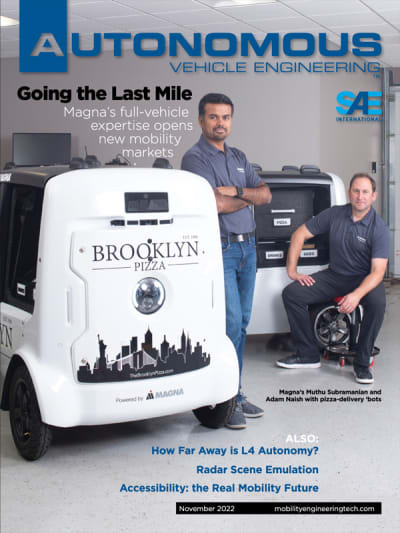
The November 2022 issue of Autonomous Vehicle Engineering delves into the transformative landscape of mobility, focusing on the intersection of technology, accessibility, and urbanization. This edition highlights significant advancements in autonomous vehicles, robotics, and the implications of these technologies on society and the automotive industry.
One of the key features of this issue is an in-depth exploration of Magna International's innovative contributions to the last-mile delivery sector. The company is recognized for its expertise in robotics, advanced controls, and electric propulsion, which are crucial for enhancing the efficiency and effectiveness of delivery systems. As e-commerce continues to grow, the demand for efficient last-mile solutions has become paramount, and Magna's advancements are positioned to meet this need.
The issue also discusses the evolution of accessibility in transportation. It emphasizes how mobile phones have reshaped personal mobility preferences, with a notable anecdote about two daughters who prioritized their phones over their cars, illustrating the profound impact of digital connectivity on lifestyle choices. This shift underscores the notion that accessibility is not solely about physical transportation but also about the digital tools that facilitate communication and information exchange.
A significant theme throughout the issue is the competitive threat posed to traditional auto manufacturers by digital-age companies. The article argues that the real challenge for the automotive industry is not just competition from other car manufacturers but rather how digital innovations will redefine mobility. The convergence of transportation, communication, and information technologies is set to revolutionize how people move and interact, with implications for urban planning and societal structures.
The issue further explores the historical context of innovation in the automotive sector, noting that substantial advancements in how we use our time have occurred since 1980, while the automotive industry has lagged in enhancing accessibility. The last major innovation in automobile accessibility was the establishment of the U.S. Interstate System in 1956. This historical perspective sets the stage for understanding the urgency of integrating new technologies into the automotive landscape.
Emerging technologies such as 5G cellular networks, augmented and virtual reality, artificial intelligence, and cloud-based platforms are highlighted as key drivers of future accessibility enhancements. These technologies are not only significant on their own but, when integrated with automotive innovations, have the potential to profoundly impact how individuals navigate urban environments. The issue posits that the future of cities will be redefined by these advancements, as they reshape the fundamental drivers of urbanization, including access to markets, jobs, education, and healthcare.
The editorial section introduces the contributors and editorial team, providing insights into the publication's commitment to delivering high-quality content on autonomous vehicle engineering. The issue also includes circulation data, reflecting the magazine's reach and engagement with its audience.
In summary, the November 2022 issue of Autonomous Vehicle Engineering presents a comprehensive overview of the current state and future prospects of the automotive industry in the context of rapid technological advancements. It emphasizes the importance of accessibility, the competitive landscape shaped by digital innovations, and the potential for these changes to redefine urban living. As the industry navigates these challenges, the insights provided in this issue serve as a valuable resource for professionals and enthusiasts alike, highlighting the critical intersection of technology, mobility, and society.
Articles
-
The Navigator
-
Features
12 Steering Toward Full Vehicle Autonomy
Stories
Top Stories
INSIDERAerospace
 How Airbus is Using w-DED to 3D Print Larger Titanium Airplane Parts
NewsAutomotive
 Microvision Aquires Luminar, Plans Relationship Restoration, Multi-industry Push
INSIDERManufacturing & Prototyping
 A Next Generation Helmet System for Navy Pilots
INSIDERDefense
 New Raytheon and Lockheed Martin Agreements Expand Missile Defense Production
ArticlesAR/AI
 Accelerating Down the Road to Autonomy
Road ReadyDesign

Webcasts
Automotive
 Advantages of Smart Power Distribution Unit Design for Automotive...
Unmanned Systems
 Quiet, Please: NVH Improvement Opportunities in the Early Design...
Defense
 Cooling a New Generation of Aerospace and Defense Embedded...
Power
 Battery Abuse Testing: Pushing to Failure
Power
 A FREE Two-Day Event Dedicated to Connected Mobility
Aerospace

Similar Stories
NewsUnmanned Systems
 Single-chip digital imaging radar heads for 2022 production
NewsTransportation
 Hopeful but Closer Scrutiny for SAE Level 4 Automation
NewsSensors/Data Acquisition
 Steering Toward Full Vehicle Autonomy
ArticlesElectronics & Computers
 New Lidar Tech Illuminates CES 2022

