




Autonomous Vehicle Engineering - March 2020
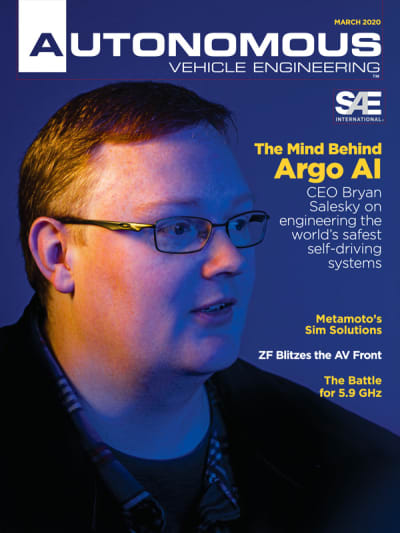
Inside this issue
Overview
The March 2020 issue of Autonomous Vehicle Engineering presents a comprehensive overview of the latest advancements and discussions in the field of autonomous vehicles (AVs). This edition features a variety of articles that delve into technological innovations, industry insights, and the ongoing evolution of self-driving technology.
Editorial Insights: The issue opens with an editorial by Bill Visnic, the Editorial Director, who sets the tone for the discussions on the importance of innovation and safety in the development of autonomous vehicles. He emphasizes the need for a realistic approach to self-driving technology, highlighting the balance between ambition and practical implementation.
Key Features:
-
The Mind of Argo AI: A significant feature in this issue is an in-depth interview with Bryan Salesky, co-founder and CEO of Argo AI. Salesky discusses the company's mission to drive innovation in self-driving technology, particularly through its partnerships with major automotive players like Ford and Volkswagen. He outlines the challenges and opportunities in the AV landscape, advocating for a methodical approach to development that prioritizes safety and reliability.
-
Congestion-Busting with Autonomous Shuttles: An article by Bradley Berman explores the testing of low-speed driverless shuttles at the GoMentum Station AV proving grounds in Concord, California. The shuttles, equipped with advanced sensors including six lidars and radars, demonstrate their ability to navigate safely in urban environments. The testing highlights the potential of autonomous shuttles to alleviate traffic congestion and improve public transportation systems.
-
Metamoto Goes Deep on AV Simulation: This piece discusses the role of simulation in the development of autonomous vehicles. Metamoto is at the forefront of creating realistic simulations that replicate the physics of vehicles and their sensors. This technology aims to reduce the need for extensive real-world testing, which can be costly and risky. The article emphasizes the importance of quality simulation coverage in ensuring the safety of AVs.
ZF Establishes Level 2+ ADAS: The issue also covers ZF's introduction of Level 2+ Advanced Driver-Assistance Systems (ADAS). Senior VP Aine Denari explains how these cost-effective technology solutions cater to diverse customer needs. The article discusses the evolving landscape of driver-assistance technologies and the push towards more sophisticated systems that enhance vehicle safety and user experience.
-
Lidar in a Flash: Continental's development of a short-range 3D flash lidar sensor is highlighted as a significant advancement for commercial vehicles and off-highway machines. This technology is expected to enhance the capabilities of AVs by providing accurate environmental sensing, which is crucial for safe navigation.
-
Sensor Heat Relief: Canatu introduces innovative carbon nanobots designed to keep critical sensor surfaces and LED headlamps clear in sub-freezing weather. This technology addresses one of the challenges faced by autonomous vehicles in extreme weather conditions, ensuring that sensors function optimally regardless of environmental factors.
-
Building a City: Toyota's ambitious plan to manufacture an entire city is discussed, showcasing the company's vision for integrating autonomous technology into urban planning. This initiative aims to create a living laboratory for testing and developing smart city solutions that incorporate AVs into everyday life.
-
Delivering Self-Driving Definitions: The issue concludes with a discussion on shifting the validation of AV safety from merely accumulating miles driven to understanding the quality of simulation coverage. This perspective emphasizes the need for rigorous testing and validation processes that ensure the safety and reliability of autonomous systems.
Subscription and Contact Information: The magazine provides details for subscriptions, including pricing for both members and non-members of SAE International. It also includes contact information for various representatives across different regions, ensuring that readers can easily reach out for inquiries or support.
Conclusion: Overall, the March 2020 issue of Autonomous Vehicle Engineering serves as a vital resource for industry professionals, researchers, and enthusiasts interested in the future of autonomous vehicles. With its blend of technical insights, industry interviews, and discussions on emerging technologies, this edition encapsulates the dynamic nature of the AV sector and the ongoing efforts to make self-driving technology a safe and integral part of modern transportation.
Articles
-
Features
CES 2020: Toyota to Build a City of the Future
Foretellix Building Precise Software Language for Validating Self-Driving Scenarios
FCC Actions, Incompatible Options Muddy V2X Outlook
A Solution for Ice-Free Sensors
Continental's Lidar in a Flash
GoMentum Begins Testing Autonomous Shuttles
Stories
Top Stories
INSIDERAerospace
 How Airbus is Using w-DED to 3D Print Larger Titanium Airplane Parts
NewsAutomotive
 Microvision Aquires Luminar, Plans Relationship Restoration, Multi-industry Push
INSIDERManufacturing & Prototyping
 A Next Generation Helmet System for Navy Pilots
INSIDERDefense
 New Raytheon and Lockheed Martin Agreements Expand Missile Defense Production
ArticlesAR/AI
 Accelerating Down the Road to Autonomy
Road ReadyDesign

Webcasts
Automotive
 Advantages of Smart Power Distribution Unit Design for Automotive...
Unmanned Systems
 Quiet, Please: NVH Improvement Opportunities in the Early Design...
Defense
 Cooling a New Generation of Aerospace and Defense Embedded...
Power
 Battery Abuse Testing: Pushing to Failure
Power
 A FREE Two-Day Event Dedicated to Connected Mobility
