




Airbrush-Fabricated Carbon Nanotube Supercapacitor Electrodes
These supercapacitors provide an alternative to large batteries that soldiers currently carry for peak power supply.
In order for the batteries used by soldiers to provide peak power, an increase in battery size and weight is necessary, which is becoming a burden. A light, compact alternative to large batteries for supplying peak power is electrochemical double-layer capacitors. These supercapacitors have a much higher energy density than conventional capacitors. Supercapacitors also have a higher cycle life, higher efficiencies, and a higher specific power than conventional batteries. Such supercapacitors will complement batteries and fuel cells to produce hybrid systems with extended capabilities.
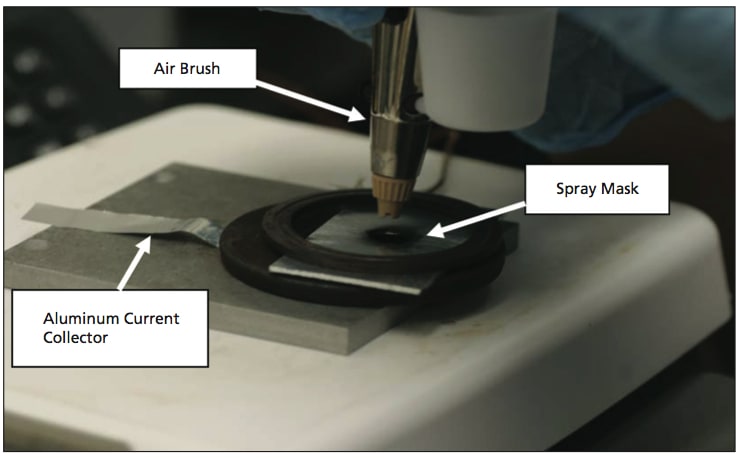
To fabricate these electrodes, a spray deposition technique called airbrushing was used. A spray deposition technique for preparing CNT films over a large area is ideal due to low costs, ease of use, and manufacturability.
The electrode fabrication process optimizes the CNT electrode capacitance. The main goal was to achieve a specific capacitance in excess of 120 F/g, which is the maximum achievable with activated carbon, the current industry standard. The nanotubes used for spraying were either pristine single-walled carbon nanotubes (SWCNTs), or carboxylic acid functionalized SWCNTs suspended in acetone or water, with or without the aid of surfactants/dispersants.
Three different types of SWCNT solution pretreatments were used before the spray deposition. Some of the nanotube solutions were sonicated using a probe sonicator for 2 minutes at 20% amplitude, and then centrifuged for 8 minutes at 10,000 RPM; some of the SWCNT solutions were only sonicated, and others were used as received. Sonication was used in the hope of debundling the CNTs, and centrifugation was used in an attempt to remove remaining CNT bundles so as to increase the percentage of single tubes.
The substrates used for spray deposition were initially strips of aluminum (Al) foil approximately 1 × 8.5 cm. The Al foil strip was chosen because of its ease of use and ability to withstand high temperatures. Later experiments used nickel (Ni) foil substrates (current collectors), as they work well with a potassium hydroxide (KOH) electrolyte. During CNT spray deposition, the substrate sat on a hot plate at a temperature of 60 to 65 °C for the initial experiments in which acetone-based CNT solutions were used. Higher temperatures (175 to 200 °C) were used in subsequent experiments to speed the evaporation of acetone- and water-based solutions. A circular copper (Cu) weight was placed directly on top of the substrate to prevent movement. The SWCNTs were sprayed at a constant pressure of 6–8 psi.
The type of spray nozzle used on the airbrush was determined by the area intended to be covered and the need for low-pressure spraying to prevent splatter. The nozzle produced a very fine mist at a relatively low-pressure range. A scanning electron microscope (SEM) and an environmental scanning electron microscope (ESEM) were used to image the deposited SWCNT films.
The weight of the deposited SWCNTs was obtained using a microbalance. But for calculating the specific capacitances, the estimated weight of CNTs from the solution volumes is used, as the associated mass of surfactant/dispersant is not contributing to the capacitance. The SWCNT film electrode was used as the working electrode; either a Cu, Ni, or Al foil strip was used as the counter electrode; and a silver/silver chloride (Ag/AgCl) electrode was used as the reference electrode.
The sonicated and centrifuged SWCNT film had the higher mass even though there seemed to be less SWCNTs on the substrate shown in SEM images, as well as capacitance readings. Because there is more mass present in the centrifuged electrode film, but not as many SWCNTs, it leads to the conclusion that there is a lot more contamination deposited on this film than expected. Presumably, the centrifugation removed the CNTs (CNT bundles) more effectively than the contaminants (surfactants/dispersants).
Although the SWCNTs are well entangled and interconnected, they are not as dense as initially thought. There also does not seem to be a difference between the sonicated and non-sonicated electrodes in SEM images. There is a lot of contamination present that seems to be clogging the pores expected in these films, decreasing capacitance. The solutions that these CNT films were made from used dispersants and surfactants to aid the solubilization of the CNTs, but which contaminate the final films.
Initial results showed that using Al current collectors with a nitric acid electrolyte was not a viable system. While the Al current collector electrodes were stable in dilute nitric acid, the measured capacitances were low, presumably due to electrolyte resistance. At higher concentration, the electrodes were no longer stable. After switching to Ni current collectors and KOH electrolyte, the electrodes were stable and yielded useful capacitance data. A comparison of electrodes formed by airbrush deposition of various commercial CNT solutions yielded a wide range of specific capacitances. In particular, solutions that used surfactants and/or dispersants produced poor specific capacitances due to contamination of the CNTs, yielding poor porosity and conductivity.
This work was done by Matthew H. Ervin and Benjamin S. Miller of the Army Research Laboratory. For more information, download the Technical Support Package (free white paper) at www.defensetechbriefs.com/tsp under the Electronics/Computers category. ARL-0119
This Brief includes a Technical Support Package (TSP).

Air Brush Fabricated Carbon Nanotube Supercapacitor Electrodes
(reference ARL-0119) is currently available for download from the TSP library.
Don't have an account?
More From SAE Media Group
Electronics Tech Briefs
Supercapacitors With C and Nanostructured Mn0₂ Electrodes
Battery Technology
Flexible, Thin-Film Battery
Aerospace & Defense Tech Briefs
Rolls-Royce and Superdielectrics Explore Supercapacitor Technology
Tech Briefs
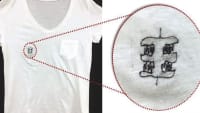
Supercapacitors for Wearable Devices
Battery Technology
Hybrid Membrane Doubles the Lifetime of Rechargeable Batteries
Automotive Engineering
Nano-Based Ultracap Tech Boosts EV Power Density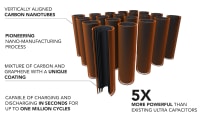
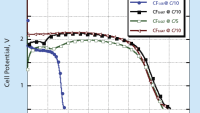
Battery Technology
3D-Printed Biodegradable Battery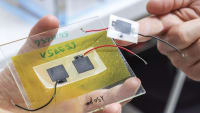
Battery Technology
Nanostructured Alloy for Battery Anodes
Tech Briefs
Ultrahigh-Energy-Density Capacitor
Battery Technology
Low-Cost, Fast Production of Solid-State Batteries
Tech Briefs
5 Ws of the SAFIRE Lithium-Ion Battery

Tech Briefs
Ultracapacitor-Powered Cordless Drill
Automotive Engineering
Clarios to Build Supercapacitor Plant in U.S.
Battery Technology
Semi-Liquid Metal Anode
Battery Technology
Electrolyte Design Improves Anode Capacity in Lithium-Ion Batteries
Battery Technology
Sustainable Aluminum-Anode Batteries
Battery Technology
Cobalt-Free Cathodes for Lithium-Ion Batteries
Battery Technology
Mapping Performance Variations to See How Lithium-Metal Batteries Fail
Battery Technology
Method Tracks What Happens Inside Batteries
Tech Briefs
Flexible, Water-Based Lithium-Ion Batteries
Tech Briefs
Solid-State High-Temperature Power Cells
Tech Briefs
Using Silicon for Battery Anodes
Battery Technology
Spreadable Way to Stabilize Solid-State Batteries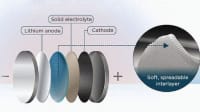
Battery Technology
Design Enables Safe Storage of Lithium Ions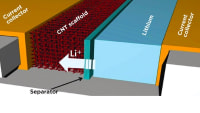
Battery Technology
Stretchable Micro-Supercapacitors Self-Power Wearable Devices
Overview
The document titled "Air Brush Fabricated Carbon Nanotube Supercapacitor Electrodes" by Matthew H. Ervin and Benjamin S. Miller, published by the U.S. Army Research Laboratory in September 2010, presents research focused on the development of supercapacitor electrodes using carbon nanotubes (CNTs) fabricated through an airbrush technique.
The introduction outlines the increasing demand for efficient energy storage solutions in military applications, particularly for portable power sources used by soldiers. Traditional batteries often face limitations in terms of size, weight, and energy density, prompting the exploration of alternative technologies like supercapacitors, which can offer higher power densities and faster charge/discharge rates.
The motivation section emphasizes the advantages of carbon nanotubes, including their high electrical conductivity, large surface area, and mechanical strength, making them ideal candidates for supercapacitor electrodes. The authors aim to demonstrate that airbrush fabrication can produce high-quality CNT electrodes that enhance the performance of supercapacitors.
The experimental section details the methodology employed in the study, including the preparation of CNT dispersions and the airbrush application process. The researchers conducted various tests to evaluate the electrochemical performance of the fabricated electrodes, including cyclic voltammetry and galvanostatic charge/discharge tests. These tests aimed to assess the specific capacitance, energy density, and power density of the supercapacitors.
Results and discussion highlight the successful fabrication of CNT electrodes with promising electrochemical properties. The findings indicate that the airbrush technique allows for uniform deposition of CNTs, leading to improved electrode performance compared to traditional methods. The authors discuss the implications of their results, suggesting that the use of airbrush-fabricated CNT electrodes could significantly enhance the efficiency and effectiveness of energy storage systems in military applications.
In conclusion, the document summarizes the potential of airbrush-fabricated carbon nanotube supercapacitor electrodes as a viable solution for meeting the energy storage needs of soldiers. The research contributes to the ongoing efforts to develop lightweight, high-performance energy storage technologies that can support modern military operations. The authors advocate for further exploration and optimization of this fabrication technique to maximize the benefits of CNTs in supercapacitor applications.
Top Stories
INSIDERDefense
 New Raytheon and Lockheed Martin Agreements Expand Missile Defense Production
NewsAutomotive
 Ford Announces 48-Volt Architecture for Future Electric Truck
INSIDERManufacturing & Prototyping
 Active Strake System Cuts Cruise Drag, Boosts Flight Efficiency
ArticlesTransportation
 Accelerating Down the Road to Autonomy
INSIDERMaterials
 How Airbus is Using w-DED to 3D Print Larger Titanium Airplane Parts
Road ReadyTransportation

Webcasts
Electronics & Computers
 Cooling a New Generation of Aerospace and Defense Embedded...
Power
 Battery Abuse Testing: Pushing to Failure
Connectivity
 A FREE Two-Day Event Dedicated to Connected Mobility
Automotive
 Quiet, Please: NVH Improvement Opportunities in the Early Design Cycle
Transportation
 Advantages of Smart Power Distribution Unit Design for Automotive &...
Aerospace
 Sesame Solar's Nanogrid Tech Promises Major Gains in Drone Endurance